
What is a retainer, exactly?
A retainer is an ongoing arrangement where a client pays a recurring monthly fee and, in return, gets a reserved amount of your attention. For a bookkeeper or virtual assistant that usually means one of two shapes: a block of included hours ("up to 10 hours a month") or a defined scope ("monthly reconciliation and inbox care"). Many agreements combine both: a scope, with an hours ceiling that keeps the scope honest.
The fee is due every month. That is the trade. The fee stays flat in a heavy month (anything past the available hours is billed only as overage, on terms agreed in advance), and in exchange the client can't leave you with an empty calendar in a light one.
- Monthly fee is what the client pays each month, whether or not they use every included hour.
- Included hours are the hours the fee is meant to cover. Hours carried in from earlier months are added to make the hours available.
- Overage rate is the hourly price for hours beyond what is available.
To check what one of your retainers really pays, the free Retainer Rate Calculator runs one client for one month. The Bookkeeping & VA Retainer Workbook runs these terms for every client, month to month.
Is this the same as a legal retainer?
No, and the word causes real confusion. A legal retainer is typically an advance payment an attorney holds and draws down against as work is done, and it sits under professional rules that differ by place. A service retainer, the subject of this page, is a recurring fee for included hours or scope that a bookkeeper, VA, or similar independent operator sets in their own agreement. Same word, different mechanics.
Rollover vs use-it-or-lose-it: what happens to unused hours?
The rollover rule is the term that most changes what a retainer is worth to each side. It answers one question: when the month ends and the client hasn't used all their included hours, what happens to the rest? Three common policies:
- None (use-it-or-lose-it). Unused hours expire at month end and don't carry forward. It is the simplest to explain and suits steady, predictable work such as weekly inbox care or monthly reconciliations.
- Next month only. Unused hours carry into the following month once, are used first, and expire if still unused at the end of that month. Hours that have already carried can't carry a second time.
- Carry with cap. Unused hours keep carrying, but the banked balance can never exceed a cap set as a percentage of the monthly included hours. It suits seasonal or project-shaped clients, and the cap keeps a large balance from becoming a month you can't staff.
A worked example, using illustrative arithmetic (not real client data): a client has 10 included hours a month and uses 7 in January, leaving 3 unused.
| Rollover policy | Hours available in February | What happens to the 3 unused hours |
|---|---|---|
| None | 10 | Expire at the end of January |
| Next month only | 13 | Carry into February and expire then if unused |
| Carry with cap (50%) | 13 | Carry, because the banked balance of 3 is under the 5-hour cap (50% of 10) |
Whichever you choose, write it into the agreement before the first month starts. A rollover rule that lives only in your head becomes an argument the first time a client has a balance.
What is overage on a retainer?
Overage is the hours used beyond the hours available in a month, meaning the included hours plus anything carried in. Overage hours multiplied by the overage rate is the amount you invoice on top of the monthly fee.
Illustrative arithmetic: a client with 10 available hours and a $95 overage rate uses 12. That is 2 overage hours, and 2 × $95 = $190 to invoice with the next month's fee. Good terms also say when you warn the client, for example at a set percentage of the available hours, and that hours past the limit are worked once the client approves them in writing.
How do you tell if a retainer is actually profitable?
The fee tells you what you charge, not what you earn. The honest test is the effective hourly rate: the monthly fee divided by every hour the client cost you. That includes the retainer work, including any out-of-scope requests you quietly absorbed, plus the unbilled admin (chasing receipts, invoicing, check-in calls).
Illustrative arithmetic: a $900 retainer for "up to 10 hours" pays $90 an hour if it takes 10. If admin and extras push it to 12 hours, the same fee pays 900 ÷ 12 = $75 an hour, and nothing on the invoice shows it. The hours that slip in without a change in the fee are scope creep, and it is how a retainer that looked fine at signing drifts underwater.
How the Bookkeeping & VA Retainer Workbook handles it
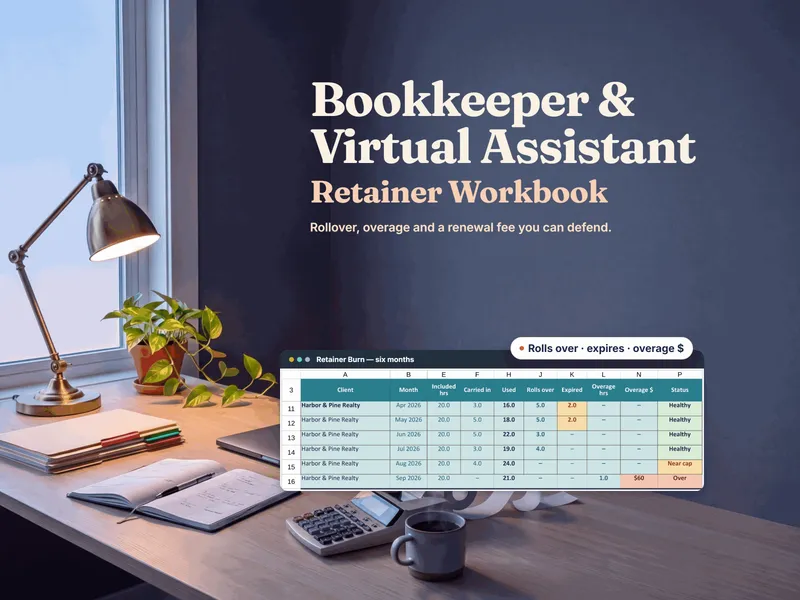
Tracking rollover by hand across a roster of clients, each with a different rule, is the chore that gets skipped. The Bookkeeping & VA Retainer Workbook tracks each client's unused and overrun hours month to month under that client's own rollover rule (None, Next month only, or Carry with cap), prices the overrun in dollars, and turns your recent real usage into a renewal fee and included hours you can defend. Renewal evidence is the last 3 months of usage by default, a Setup setting you can change. Its effective rate divides the fee by all the retainer work (out-of-scope requests included) plus the unbilled admin, so a retainer that looks fine on paper shows up as what it is. It comes with an 11-page Retainer Terms & Renewal Playbook PDF of sample agreement wording to adapt (not legal advice), and you buy it once and keep it, with no subscription.
Want to check one client first? The free Retainer Rate Calculator takes one client and one month: the fee, the included hours, and the hours worked split into retainer work in scope, retainer work out of scope, and unbilled admin. It returns your effective hourly rate against your target and a Healthy, Watch or Reprice verdict. It has no rollover, roster or renewal planner; that is what the full workbook adds.
Common retainer mistakes
- Leaving rollover unwritten. If the agreement is silent, the client assumes unused hours carry and you assume they expire.
- Not logging unbilled admin. The invoicing, check-ins and receipt chasing are real hours, and they pull the effective rate down.
- Renewing at the same fee without checking usage. A renewal is the moment to reprice from what the last few months actually took.
- No overage rule. Without one, an over-the-limit month is either free work or an awkward conversation.
Related templates and concepts
A retainer only pays if the hours behind the fee do. Read what effective hourly rate is and what scope creep is, follow the step-by-step guide to pricing a monthly retainer, or browse every tool on the templates for freelancers hub. Working across many kinds of clients? The broader Freelancer Business Manager includes a basic retainer burn-down.
Templates that implement this
The workbook that runs the retainer terms for you
1 template
A connected workbook for Excel, Google Sheets and LibreOffice that tracks each client's unused and overrun hours from month to month under that client's own rollover rule and prices the overrun in dollars.
Frequently asked questions
- What is a retainer in bookkeeping or virtual assistant work?
- A retainer is a recurring monthly fee a client pays for a defined block of your time or a defined scope of work. The fee is due each month whether the client uses every included hour or not, which gives you predictable income and gives the client reserved capacity.
- What is the difference between rollover and use-it-or-lose-it?
- Use-it-or-lose-it means unused included hours expire at month end. Rollover means some or all of them carry into a later month. Common rules are no rollover, carry for one month only, or carry with a cap set as a percentage of the monthly included hours.
- What is retainer overage?
- Overage is the hours used beyond the hours available in a month, which are the included hours plus anything carried in. Overage hours multiplied by the overage rate is the amount you invoice on top of the monthly fee.
- Is a service retainer the same as a legal retainer?
- No. A legal retainer is usually an advance deposit an attorney holds and draws down against, and it is governed by professional rules that vary by place. A service retainer for a bookkeeper or VA is a recurring fee for included hours or scope. This page is not legal advice, so have your own agreement reviewed where you work.
- How do I know if a retainer is actually profitable?
- Divide the monthly fee by every hour the client cost you, the retainer work (out-of-scope requests included) plus the unbilled admin, and compare the result to your target hourly rate. For example (illustrative), a $900 fee that quietly takes 12 hours pays $75 an hour, however the quote read.