
What it is, in one paragraph
When a seller accepts your offer, you send a deposit — the earnest money — to demonstrate you intend to complete the purchase rather than tie the property up while you keep looking. It is held by a third party, usually an escrow or title company or a brokerage trust account, and at closing it is applied to your down payment and costs. It is not a fee, and a transaction that runs to plan does not cost you it: you either buy the house or you exit under a contingency the contract gave you. This page is general information, not legal advice — practice and standard forms differ by state.
How much, and who holds it
The amount is negotiable and varies enormously by market, and a competitive market pushes it up because a larger deposit reads as a more committed buyer. Ask your agent what the going range is where you are buying.
Who holds it matters more than how much it is. Money sitting with a licensed escrow or title company, under written instructions, is far easier to recover than money handed to the other side of the deal. If the contract names the seller or the seller's agent as the holder, that is worth a question before you sign, not after.
The contingencies are what make it refundable
A contingency is a condition that, if it is not satisfied, typically gives you a right to withdraw — and, on the terms the clause sets out, to take your deposit with you. They are the main mechanism by which earnest money stays yours:
- Inspection — a window in which to have the property examined, and a right to request repairs or withdraw. Watch for an inspection that is described as information only: it lets you discover the problem and obliges you to buy it anyway.
- Financing — a right to exit if your loan does not come through, usually with a deadline and sometimes a maximum interest rate. A rate ceiling set below the market rate removes the protection as effectively as waiving it.
- Appraisal — what happens if the valuation comes in below the price. An appraisal gap clause is a promise to cover the difference in cash, and it is one of the quickest ways to owe money you had not budgeted.
- Title and survey — a period to review what the title work turns up (easements, encroachments, unreleased liens) and to object.
- Association documents, where the property is in one — the assessments, reserves, litigation and rules that change what the property is worth to you.
Waiving a contingency is not a formality. It converts a refundable deposit into an amount you can lose by exercising ordinary judgment — deciding, after an inspection, that you do not want the house.
How it is actually released
This is the paragraph people discover too late. Read how the deposit is released when a deal ends: if the release requires both parties to sign, a disappointed seller can sit on your money even when you exited under a contingency you were plainly entitled to use. Look for an automatic release on written notice of a valid termination, and for a deadline and a remedy if the other side simply does not sign.
Earnest money is not the same as these
- The down payment — the buyer's own share of the price. Earnest money is credited toward it, but it is a much smaller sum paid far earlier.
- An option fee, where local practice uses one — money paid for a defined right to walk away during a set period, which is often non-refundable by design because that right is what it buys.
- A holding or reservation deposit on new construction — frequently tied to design selections that become non-refundable the moment they are ordered.
Before you send it
Two habits are worth more than any clause. First, confirm the wire instructions by phone, on a number you obtained independently at the start of the transaction — wire fraud in real-estate closings typically arrives as revised instructions at the last minute, most often by email, and once funds have left, recovery is difficult and depends on how fast the wire is reported. Second, write down which contingencies you have, and their deadlines, in your own calendar on the day you sign. Some forms drop a contingency when its date passes and others require you to remove it in writing — knowing which one you signed is the point.
Checking the contract itself
You can take a free printable Lease Red-Flags Checklist for the rental side of the same problem — no signup. For a purchase agreement, the paid Contract & Deposit Red-Flags Review Checklist carries thirty checks on home purchase and earnest money specifically, each with the wording to ask for instead, and tracks what your deposit is exposed to as the dates move.
A note on what this is
This is a general explanation, not legal advice. Contract law and real-estate practice differ by state and country, standard forms differ between them again, and a clause that is unenforceable in one place is routine in another. On a purchase agreement, an hour of a local real-estate attorney's time is small against what is at stake.
Related concepts
A deposit's real exposure is usually set by a second clause elsewhere in the document — see what an auto-renewal clause is for the same pattern in service agreements, and what a change order is for how scope changes get priced once you own the place. For the decision itself rather than the paperwork, the Big Decisions workbooks score the choice before you get to a contract.
Templates that implement this
Tools for the contract and the decision behind it
4 templates
A review checklist for the purchase agreement itself, and the workbooks for the choice that led to it.
- $14.95 Spreadsheet

Home-Inspection Review & Repair-Negotiation Worksheet — Price Every Finding, Then Build the Ask (Excel & Google Sheets)
Turn a home-inspection report into a costed, prioritized repair ask — every finding priced from a built-in library and netted against your cash to close.
Big DecisionsView details - $14.95 Spreadsheet

Contract & Deposit Red-Flags Review Checklist — 180 Clause Checks Across Six Contract Types, Scored, With a Deposit & Cancellation Tracker (Excel & Google Sheets)
180 curated contract red flags across venue, lease, contractor, home, vehicle and membership agreements — scored, with a deposit and cancellation tracker.
Big DecisionsView details - $2.95 Excel
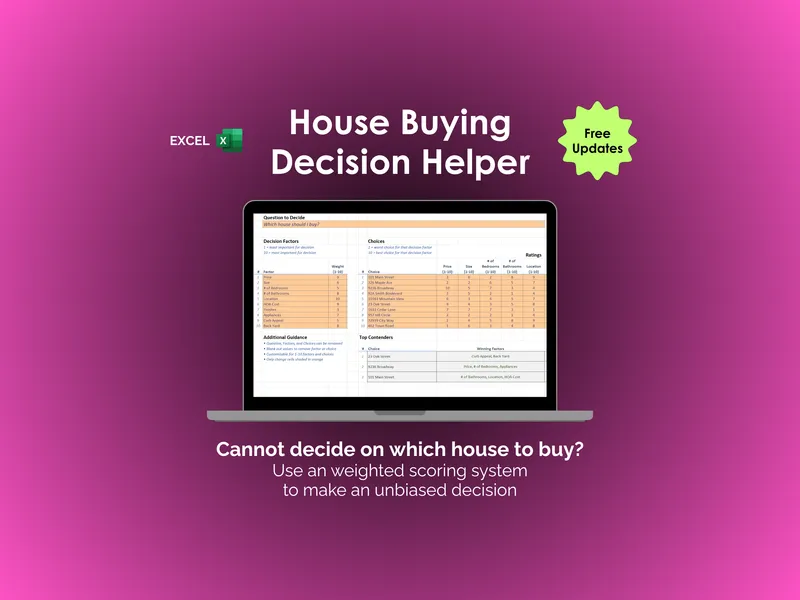
House Buying Decision Helper - Excel
Which house actually wins on the factors you care about? An excel house buying decision helper that scores up to 10 homes against 10 weighted factors.
Big DecisionsView details - $14.95 Spreadsheet
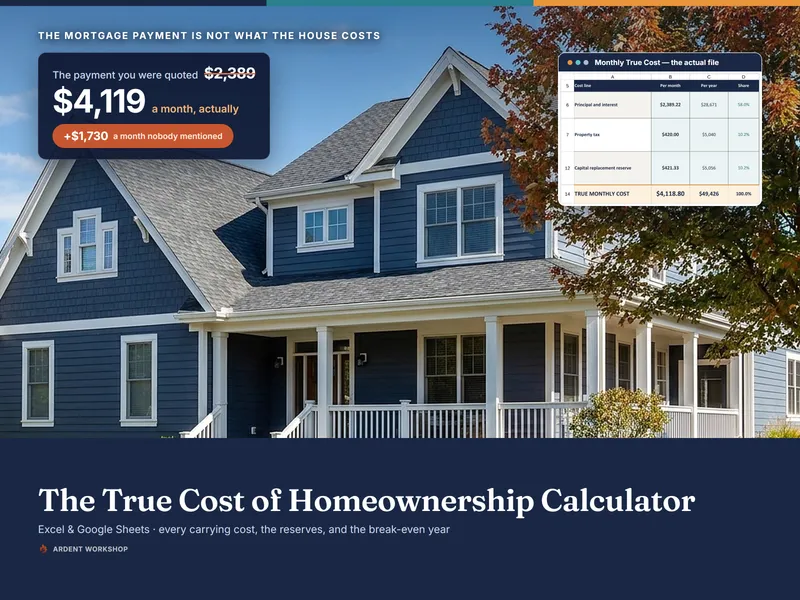
True Cost of Homeownership Calculator — Every Carrying Cost, the Replacement Reserves & the Buy-vs-Rent Break-Even Year (Excel & Google Sheets)
Find what a specific home really costs per month — the mortgage payment plus the seven lines listing sites leave out — and the year owning beats renting.
Big DecisionsView details