
The distinction that makes this work: a restricted balance is not runway
A small nonprofit or congregation typically keeps one operating bank account, and everything the organization receives lands in it — a grant for a specific program, a capital gift given toward a roof repair, a gift a donor designated for next year, and the ordinary gifts that come in through the general collection. The bank statement adds all of it together into a single balance. But much of that balance may not be free to spend: the grant can only fund the program it was given for, the capital gift can only go toward the roof, and the designated gift cannot be touched until next year.
An operating reserve is what remains after every one of those conditions is taken back out — the money with no string attached, sitting in the same account as the rest but not actually available for whatever comes up. Treat the whole balance as spendable and an organization can look financially secure right up until it discovers that most of what it was counting on was never really its money to use.
What counts toward an operating reserve, and what does not
The reserve figure — usually expressed as months of runway — is calculated as:
Unrestricted operating cash ÷ average monthly operating cost = months of runway.
The numerator is unrestricted cash only. Every restricted balance — every grant not yet spent, every gift tied to a program or a time period — is subtracted out before the division happens, not folded in and hoped to average out. A fund a donor restricted is not smaller runway; it is not runway at all, because the organization does not have the legal freedom to spend it on payroll or rent if a funding gap opens up.
Board-designated funds are the subtle case
Not every earmark is a donor restriction. When a board sets money aside for a purpose — a future building project, a rainy-day cushion — that money is board-designated, not restricted. Legally, it remains unrestricted: no donor attached a binding condition, and the board that designated it can undesignate it. In practice, though, a board designation is rarely treated as available on demand. Spending it means going back to the board, not writing a check.
Because of that gap between what the money legally is and how an organization actually behaves around it, the honest way to report a reserve is to show it twice: once counting board-designated funds as available, and once with them held back alongside the truly restricted money. Both figures are correct — they answer different questions. The first is “what could the board vote to spend tonight.” The second is “what is sitting there without anyone having to decide anything first.”
A worked example: calculating an operating reserve
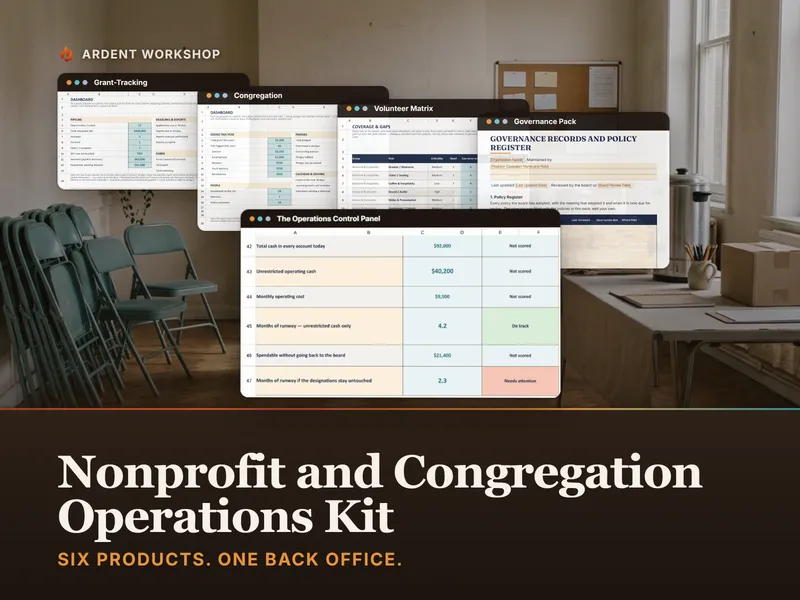
These figures are invented to illustrate the arithmetic — they are not a benchmark to copy. An organization holds $92,000 in its operating bank account. Of that, $51,800 is restricted — split across open grants, a capital gift, and a gift the giver designated for next year. Subtracting the restricted balance leaves $40,200 in unrestricted operating cash. Against average monthly operating costs of $9,500, that is:
$40,200 ÷ $9,500 = 4.2 months of runway.
The same organization also holds $18,800 in board-designated funds inside that $40,200. Held back alongside the restricted money — because spending it takes a board decision rather than being available by default — the unrestricted, undesignated balance is $40,200 less $18,800, or $21,400, and the runway figure drops to:
$21,400 ÷ $9,500 = 2.3 months of runway.
Same bank account, same monthly cost, two defensible answers depending on one question: does “available” include money the board has to vote to release. The gap between 4.2 months and 2.3 months is not an error in either calculation — it is the whole point of showing both.
Setting a target is the board's decision, not a rule
How many months of reserve is “enough” is not a fixed answer that applies the same way to every organization. A board sets its own target based on how predictable its funding is, how seasonal its costs are, and how much risk it is willing to carry — and that target is a policy choice the board owns, reviewed and adjusted as circumstances change, not a number imposed from outside. What matters more than which target a board picks is that it picks one on purpose, and that the figure it is measured against is unrestricted cash and nothing else.
An operating reserve figure is not accounting advice
Computing months of runway tells an organization something real and useful about its own cash position — but it is not financial, tax, or legal advice, and it does not replace fund accounting in the books. Which balances are restricted, how a board designation is documented, and what belongs in “operating cost” are decisions for your finance team, your treasurer, and your own records. Use a reserve figure to watch your position and set a policy; reconcile it against your actual accounting records.
Related templates and concepts
An operating reserve is one output of keeping restricted and unrestricted money straight in the first place — see what restricted fund accounting is for the distinction underneath it, and what an indirect cost rate is for the other figure a grant-funded organization is expected to already know. The free Nonprofit Operating-Reserve Check computes this exact figure, pre-filled with a worked example, as an ungated taste; the full Nonprofit & Congregation Operations Kit ties it to a full Fund Map, a per-fund reconciliation, and a board-ready funding report in one owned workbook. See the templates for nonprofits and templates for congregations hubs for the rest.
Templates that implement this
A workbook that computes this figure for you
1 template
The Nonprofit & Congregation Operations Kit's Fund Reconciliation & Runway tab reads each fund's restriction class from the Fund Map, sums the restricted balances, subtracts them from cash on hand, and computes months of runway on what is left — plus the same figure again with board-designated funds also held back.
Frequently asked questions
- How do you calculate an operating reserve?
- Take cash on hand, subtract every restricted balance, then divide what is left by average monthly operating cost. The result is months of runway. For example, $92,000 in the bank less $51,800 of restricted balances leaves $40,200 of unrestricted operating cash; divided by $9,500 a month, that is 4.2 months. The subtraction is the step that matters — divide the whole bank balance instead and the answer comes out wrong in the organization's favor. Where a board has also set money aside for a purpose, report the figure twice: holding back $18,800 of board-designated funds leaves $21,400, or 2.3 months.
- Is an operating reserve the same as cash in the bank?
- No. Cash in the bank is one number; the reserve is what is left after every restricted balance comes out of it. For example, a checking account can hold $92,000 and still leave an organization with $40,200 it can actually spend, because the rest is a grant, a capital gift, or a gift designated for a purpose the organization does not control.
- Do board-designated funds count toward the reserve?
- They are legally unrestricted, so they can be counted — but spending them takes a board vote to undesignate, not a signature on a check. The honest answer is both figures: the reserve including board designations, and the reserve without them. The gap between the two is what a board actually has on hand without a meeting first.
- How many months of reserve should a nonprofit or congregation keep?
- That is a policy decision for the organization's own board, weighed against its own cash-flow pattern, funding mix, and appetite for risk. There is no single number that fits every organization, and treating one as a rule rather than a choice is a mistake in itself.
- Why does restricted money show up in the bank balance at all?
- Because it is the same checking account. A funder pays a grant into the organization's operating account, not a separate vault — the restriction is a bookkeeping and legal condition, not a physical separation of dollars. That is exactly why it has to be tracked and subtracted deliberately, rather than assumed away.