
A rate is not a number — it's a fraction, and the bottom half matters
Say two organizations each report an indirect cost rate of 15% — a figure picked here only to make the point. That sentence alone tells you almost nothing about whether the two rates are comparable, because a rate is a fraction: shared cost divided by a basis. The basis is the denominator — the slice of direct cost the shared-cost pool gets measured against — and it is not always the same slice.
Bases you will commonly see include total direct costs (everything a program spent directly), direct salaries and wages only (a much narrower base, since it leaves out supplies, travel, and contracted services), and a modified total direct cost base — one some funders define — that excludes certain large pass-through items. Divide the same shared-cost pool against a narrower basis and the rate climbs; divide it against a broader basis and the rate falls — with nothing about the organization's actual overhead having changed. A rate quoted with no basis named is, strictly, an incomplete answer. The basis is not a footnote to the rate; it is half of it.
Why the rate is so often estimated rather than computed
Computing a real indirect cost rate means adding up two things a small organization is rarely set up to track:
- Volunteer labor is invisible in the books. A volunteer treasurer's hours, a board member's time reviewing grant paperwork, a member covering the front desk — none of it generates an invoice or a payroll entry, so none of it is sitting anywhere to add up. The value is real; the record of it usually is not.
- Shared facility cost often goes unallocated. A small nonprofit or congregation renting or owning its own space commonly treats rent, utilities, and insurance as one lump operating line — not divided out across the programs that actually use the building. Without an allocation step, there is no per-program facility cost to fold into either half of the rate.
Where neither number is tracked, there is nothing real to divide — and the figure that ends up on a grant application is a round estimate, picked because it sounds reasonable rather than because anyone did the arithmetic.
A worked example: computing the rate and naming its basis
Say an organization's shared, indirect cost pool — the administrative, bookkeeping, insurance and other overhead costs no single program used up on its own — totals $24,000 for the year. Its basis is its total direct program cost: the direct spend each program made, plus a fair allocated share of facility cost, but excluding the value of volunteer time, which is tracked separately. That basis comes to $141,914.
The rate is the pool divided by the basis:
$24,000 ÷ $141,914 ≈ 16.9%
That 16.9% is only true for this organization's own shared-cost pool and this organization's own basis — it is not a benchmark to copy. What makes it a usable figure on a grant application is not the percentage alone; it is the percentage together with the $24,000 pool, the $141,914 basis, and what that basis does and does not include, all stated in the same place.
Why funders ask for this, and the honest way to answer
Grant budgets and funder application forms routinely ask for an indirect cost rate and its basis, because a funder needs to know what share of its money is going to overhead versus direct program spend. Funders differ — sometimes widely — in what indirect or administrative cost they will reimburse: some cap the percentage, some require a specific basis, some ask for the arithmetic behind the number. Those rules change and vary by funder and by program, so nothing here states what any particular funder allows.
The honest sequence is to do the two steps in order, and never skip the first one to get to the second faster:
- Compute your own real rate, with its basis stated. This is your organization's own number, built from your own shared costs and your own basis — not a figure chosen because it looks acceptable.
- Then apply the funder's own current rules to it. Check directly with each funder or grant program for what it currently allows, rather than assuming last year's terms, or another funder's terms, still apply.
A rate computed honestly and then adjusted to a specific funder's rules is a defensible number. A rate picked to match what a funder is assumed to want, with no real computation behind it, is not — and it is the gap between those two that a grant budget line is quietly testing.
This is arithmetic, not accounting or grants advice
Computing an indirect cost rate this way gives you a real, defensible number to put on a budget or application — but it is not financial, tax, or legal advice, and it does not replace your own bookkeeping, your auditor's judgment, or a specific funder's own rules and documentation requirements. Which costs belong in your indirect pool, how facility cost should be allocated, and what a particular grant or funder will accept are decisions for your finance team, your auditor, and each funder's own guidance — use the computed rate to plan and to answer the question honestly, then confirm it against whatever that funder currently requires.
Related templates and concepts
An indirect cost rate is one of two numbers a grant-funded nonprofit or congregation is expected to already know. The other is how long it could keep running on money it is actually free to spend — see what an operating reserve is, and what restricted fund accounting is for the distinction underneath both.
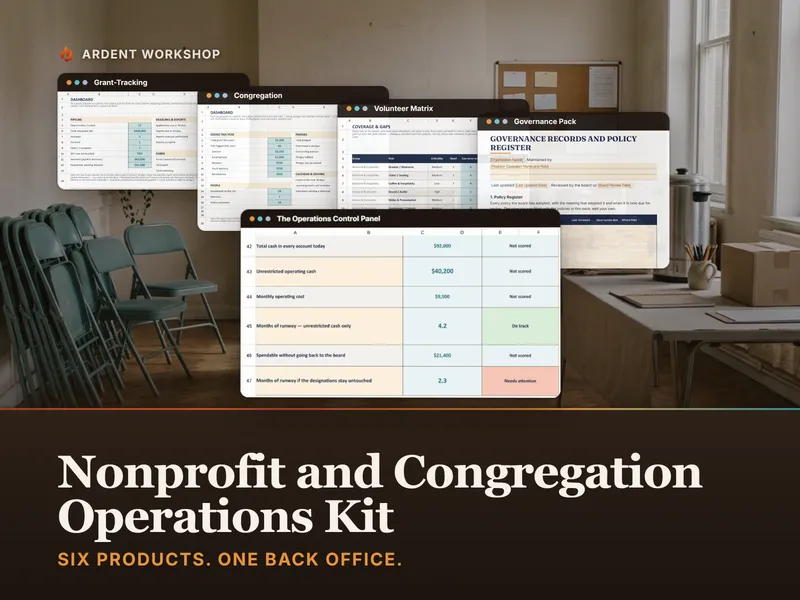
The free Nonprofit Operating-Reserve Check is an ungated taste of that second figure — months of runway on unrestricted cash only, pre-filled with a worked example. The full Nonprofit & Congregation Operations Kit adds the Program Cost & Indirect Rate tab, which turns direct program spend, volunteer hours, and facility use into a computed rate with its basis in a labeled cell, routed straight to the grant-budget line that asks for it — a workbook you own outright, not a calculator you re-fill every application. See the templates for nonprofits and templates for congregations hubs for the rest.
Templates that implement this
A workbook that computes your rate and states its basis
1 template
The Nonprofit & Congregation Operations Kit's Program Cost & Indirect Rate tab turns direct program spend, volunteer hours, and facility use into a computed indirect-cost rate with its basis stated in its own labeled cell — then routes the answer straight to the grant-budget line that asks for it.
Frequently asked questions
- What counts as an indirect cost?
- An indirect cost is a shared, non-program-specific cost that no single program used up on its own — rent, utilities, insurance, and the time of a bookkeeper, office manager, or volunteer treasurer who supports every program rather than one. A direct cost, by contrast, belongs to one program: the supplies it bought, the staff time spent delivering it, the venue it rented. Where a cost is genuinely shared, it either goes in the indirect pool or gets allocated across programs on a stated basis — but the same cost must not be counted in both places.
- What does “basis” mean in an indirect cost rate?
- The basis is the denominator — the pool of direct costs the shared-cost total gets divided against. Bases you will commonly see include total direct costs (everything spent directly on programs), direct salaries and wages only (a narrower slice), or a modified total direct cost base — one some funders define — that excludes certain large pass-through items like subcontracts or equipment. Two organizations, or even the same organization on two different grant applications, can quote different-looking rates that are both correct — because they were computed against different bases.
- Why don't many small nonprofits and congregations know their indirect cost rate?
- Because the two costs that make up the rate are rarely captured in the books. Volunteer labor does not generate a bill, so the shared administrative time volunteers contribute is not sitting in any ledger to add up. And a small nonprofit or congregation renting or owning its own space commonly treats rent, utilities, and insurance as one lump operating cost rather than allocating a share to each program. Where neither number is tracked, there is nothing to divide — so the rate on a grant application ends up an estimate rather than a computed figure.
- How do you calculate an indirect cost rate?
- Divide your total shared or indirect cost pool by your chosen basis of direct costs, and state both numbers together with the result. For example, a shared indirect cost pool of $24,000 divided by a basis of $141,914 in total direct program cost (direct program spend plus a fair allocated share of facility cost, excluding volunteer time) works out to about 16.9%. Change the basis — say, to direct salaries and wages only — and the same $24,000 pool produces a different percentage, because the denominator changed, not the shared costs themselves.
- Do all funders accept the same indirect cost rate?
- No. Funders set their own rules for what indirect or administrative cost they will reimburse, and those rules differ by funder and sometimes by grant program — some cap the reimbursable percentage, some require a specific basis, and some ask for documentation behind the number. Because the rules vary and change, the honest sequence is to compute your organization's own real rate and its basis first, then apply the specific funder's current rules to it — never to guess a number that sounds acceptable. Always check the current rules directly with the funder or grant program rather than assuming last year's terms still apply.
- What's the difference between an indirect cost rate and an overhead rate?
- In everyday nonprofit and congregation use, the two terms describe the same idea — shared, non-program-specific costs expressed as a percentage of a basis — and people use them interchangeably along with “administrative rate.” What matters more than which word is used is whether the basis is stated. A rate quoted with no basis attached, under any of these three names, is not a usable figure yet.