
What an amortization schedule is
Every fixed-payment loan — a car loan, a personal loan, most student loans, a mortgage — pays the same amount each month, but that payment isn't split the same way twice. Early on, a larger share of it is interest on the full remaining balance; by the last few payments, almost all of it is principal. An amortization schedule is simply the record of that split, one row per payment, for every payment in the loan. Open the Loan Payoff Calculator on a real loan and it builds this table automatically, for up to eight loans and with extra payments layered in.
You don't have to take the lender's word for what a loan costs — an amortization schedule is the arithmetic that proves it, one row at a time.
The columns, one by one
A basic schedule has these five core columns, in this order (a lender's version may add others, such as a payment date):
- Payment number (month). Which payment this row is — 1, 2, 3, and so on through the last one.
- Payment. The fixed amount due that month. On a standard fixed-rate loan this number is the same on every row; it's the split beneath it that changes.
- Interest. That month's interest charge — the remaining balance times the monthly rate. Because the balance keeps shrinking, this number shrinks a little every row.
- Principal. What's left of the payment after interest — payment minus interest. This is the part that actually reduces what you owe, and it grows a little every row as the interest column shrinks.
- Remaining balance. What's still owed after that row's principal is applied — last row's balance minus this row's principal. It reaches zero on the final row, which is what "paid off" means on a schedule.
Reading a real schedule: a $28,000 car loan
A $28,000 auto loan at 7.5% APR over 60 months has a scheduled payment of $561.06. Here are its first three rows and its final row, as a schedule would print them:
| Month | Payment | Interest | Principal | Balance |
|---|---|---|---|---|
| 1 | $561.06 | $175.00 | $386.06 | $27,613.94 |
| 2 | $561.06 | $172.59 | $388.47 | $27,225.47 |
| 3 | $561.06 | $170.16 | $390.90 | $26,834.57 |
| 60 (final) | $561.06 | about $3.48 | about $557.58 | $0.00 |
Reading row 1: of the $561.06 payment, $175.00 covers a month's interest on the full $28,000, and the other $386.06 actually reduces the balance, to $27,613.94. By row 60, the balance is almost gone, so there's almost nothing left to charge interest on — that row's payment is nearly all principal.
Finding the payoff month, total interest and the crossover point
Three numbers people usually want from a schedule aren't printed as a single cell — you read them off the shape of the table:
- Payoff month. The row where the balance column reaches $0.00. On the loan above, with no extra payments, that's row 60 — the 5-year term the loan was written for.
- Total interest. Add up every row's interest column from row 1 to the payoff row. For this loan, that sum is $5,663.75 — about a fifth of the $28,000 borrowed, paid on top of it.
- The crossover point. The row where the principal column permanently overtakes the interest column. On a 30-year mortgage that's often many years in. On this loan it happens immediately — row 1 already carries more principal ($386.06) than interest ($175.00) — because a 5-year term at a moderate rate front-loads far less interest than a 30-year one does. The crossover point moves earlier as the rate drops or the term shortens, and later as either one grows.
Why the interest share is largest in the early rows — heavily so on long loans like mortgages — and why that isn't a trick of the lender's, is its own question, answered fully in what is amortization.
What an extra payment does to the schedule
An extra payment doesn't change the interest formula — it changes which row you're reading. Send more than the scheduled amount and the surplus goes straight to the principal column, which pulls every balance after it down, which shrinks every interest charge after it, which pulls the zero-balance row earlier. The schedule doesn't get new columns; it just gets shorter. Here is what that looks like on this schedule.
| Extra payment | New payoff month | Total interest | Interest saved |
|---|---|---|---|
| None (scheduled) | 60 | $5,663.75 | — |
| +$50 / month | 55 | $5,092.17 | $571.59 |
| +$100 / month | 50 | $4,627.46 | $1,036.29 |
| +$200 / month | 42 | $3,916.63 | $1,747.12 |
| "13th payment" (+$46.76 / month) | 55 | $5,125.90 | $537.86 |
| $1,000 lump sum, month 12 | 58 | $5,321.42 | $342.33 |
A recurring extra shows up on every remaining row: each month's balance is a little lower than the no-extra schedule, so each month's interest is a little lower too, compounding for the rest of the loan. A lump sum only touches the schedule once — the balance drops in the month it's applied, and every row after that is a little cheaper, but rows before it are unaffected. For comparison, a "13th payment" — one extra $561.06 payment a year, split into $46.76 extra every month — saves $537.86 and ends the schedule in month 55. It saves more than the $1,000 lump sum ($342.33) because it starts in row 1 and puts in more money: roughly $2,500 over the shortened loan, against $1,000 once.
Where to get a schedule for your own loan
Building the full schedule for one loan by hand, row by row, is what a spreadsheet is for. The free Loan Extra-Payment Calculator runs one loan with a recurring extra, pre-filled with a worked example. The Loan Payoff Calculator builds the full schedule for up to eight auto, student or personal loans at once, with a recurring extra, dated lump sums and true bi-weekly payments, and compares paying off highest-rate-first, smallest-balance-first or your own order. See it worked through on one car loan in how much interest does an extra car payment save, and across several debts at once in avalanche vs. snowball with real numbers.
Two things to check on a real loan before trusting a monthly schedule down to the penny: many auto lenders actually compute interest daily (simple interest) rather than monthly, so a real payoff can differ slightly from a monthly model like this one — and when you do send extra money, ask the lender in writing to apply it to principal, not to your next due date, or it may not shorten the schedule.
Templates that implement this
Build your own schedule
1 template
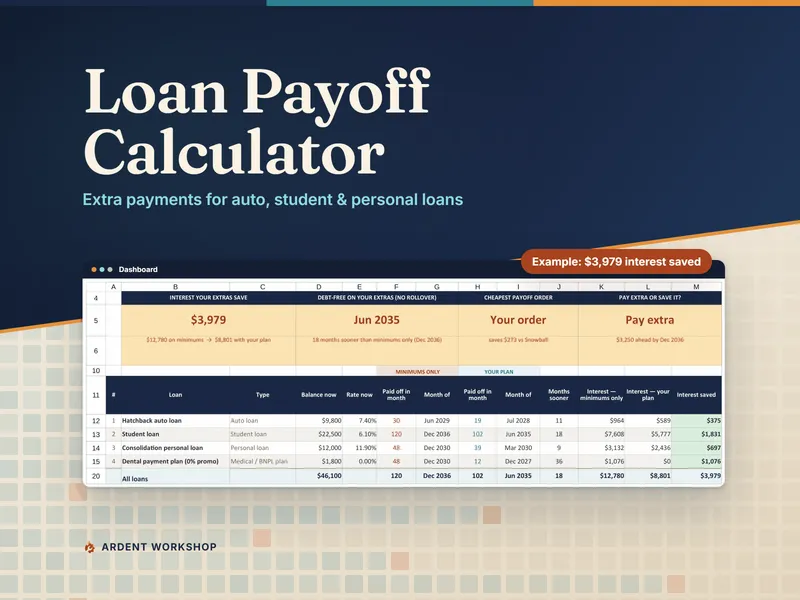
Enter a balance, rate and term and get the full month-by-month schedule for up to eight loans at once, plus what a recurring extra, a lump sum or bi-weekly payments do to it.
Frequently asked questions
- What is an amortization schedule?
- An amortization schedule is the row-by-row table behind a fixed-payment loan: one row per payment, showing the payment number, the payment, how much of it is interest, how much is principal, and the balance left afterward — from the first payment to the one that brings the balance to zero.
- What columns does an amortization schedule have?
- Five core columns: the payment number, the payment amount, the interest portion (last month's balance times the monthly rate), the principal portion (the payment minus that interest), and the remaining balance (last month's balance minus the principal portion).
- How do you read the first row of an amortization schedule?
- On a $28,000 car loan at 7.5% APR over 60 months, the payment is $561.06. Row one charges $175.00 of interest ($28,000 × 7.5% ÷ 12), so $386.06 goes to principal and the balance drops to $27,613.94. Every later row repeats that arithmetic on the new balance.
- What does an extra payment do to an amortization schedule?
- It goes straight to principal, so every later row starts from a lower balance and charges less interest, and the schedule ends sooner. On that same car loan, an extra $100 a month ends the schedule in month 50 instead of 60 and cuts total interest from $5,663.75 to $4,627.46 — if the lender applies the extra to principal rather than to the next due date.