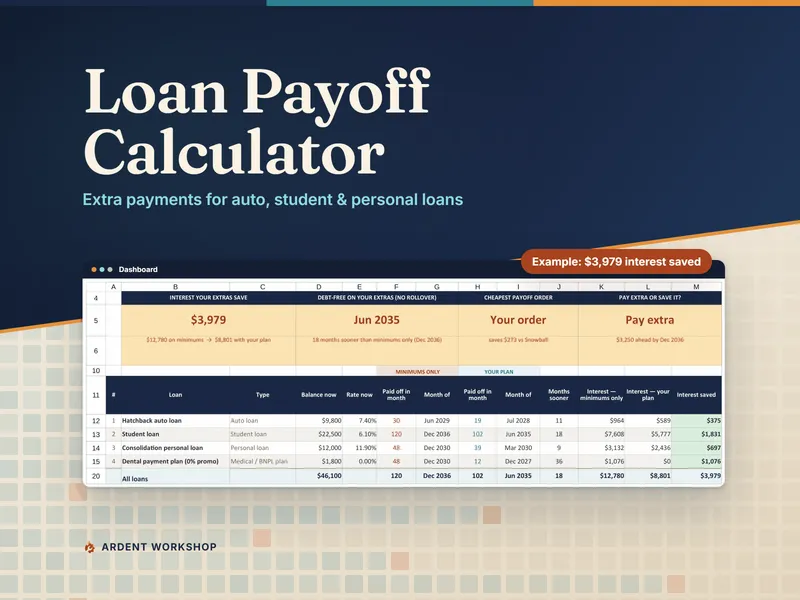
An extra $100 a month on a car loan sounds like it should matter, and it does: on a $28,000 loan at 7.5% over 60 months, it saves $1,036.29 in interest and ends the loan 10 months early. How much any extra saves depends on its shape, not just its size — a one-time lump sum, a recurring monthly top-up and a “13th payment” spread across the year each lower a different balance for a different length of time. The Loan Payoff Calculator runs recurring extras and dated lump sums across up to eight loans at once; this tutorial runs one loan by hand so you can see where the numbers come from.
The loan, with no extras
Start with the baseline: a $28,000 car loan at 7.5% APR over 60 months. The scheduled payment is $561.06 a month, and paid on schedule with no extras at all, the loan costs $5,663.75 in total interest over its five-year term. Every number below is a saving measured against that baseline.
What a recurring monthly extra buys you
Adding a fixed amount to every payment shortens the loan and cuts its interest, but the relationship isn’t linear — each added dollar of extra saves a little less than the one before, because a bigger extra also ends the loan sooner, leaving fewer months for it to work:
| Extra per month | New payoff | Months saved | New total interest | Interest saved |
|---|---|---|---|---|
| $0 (baseline) | 60 months | — | $5,663.75 | — |
| +$50 | 55 months | 5 | $5,092.17 | $571.59 |
| +$100 | 50 months | 10 | $4,627.46 | $1,036.29 |
| +$200 | 42 months | 18 | $3,916.63 | $1,747.12 |
Going from +$50 to +$100 — doubling the extra — doubles the months saved (from 5 to 10) but only nearly doubles the interest saved (from $571.59 to $1,036.29, about 1.8 times as much). But +$200, four times the smallest extra, saves not four times the interest but a bit over three times as much ($1,747.12), because the loan is already paid off by month 42 and there’s less term left for a bigger extra to work against.
A lump sum or a 13th payment?
A single $1,000 lump sum applied in month 12 shortens the loan to 58 months, brings total interest to $5,321.42, and saves $342.33 against the baseline. A “13th payment” — one extra scheduled payment of $561.06 a year, split into +$46.76 a month — pays the loan off in 55 months, with total interest of $5,125.90, a saving of $537.86.
The 13th payment saves nearly $200 more, but it isn’t the same money: $46.76 every month for the 55 months the loan now runs comes to roughly $2,500 of extra payments, against $1,000 for the lump sum. Per extra dollar, the lump sum actually did more here — about 34 cents of interest saved per dollar, against about 21 cents — because every dollar of it sat against the balance from month 12 to the end, while the 13th payment’s later dollars had only a few months left to work. The 13th payment wins on total interest and on months because it puts more money in, and because it starts in month one.
Why an early extra dollar does more
The first three rows of the 60-month amortization schedule, with no extras applied, show why an extra payment early in the loan does more than the same payment made later:
| Month | Payment | Interest | Principal | Balance |
|---|---|---|---|---|
| 1 | $561.06 | $175.00 | $386.06 | $27,613.94 |
| 2 | $561.06 | $172.59 | $388.47 | $27,225.47 |
| 3 | $561.06 | $170.16 | $390.90 | $26,834.57 |
In month 1, $175.00 of the $561.06 payment — nearly a third — goes to interest, because interest is charged on the full $28,000 balance. By the final month of the unmodified schedule, month 60, interest is down to roughly $3.48 and principal makes up about $557.58 of the payment, because there’s almost nothing left to charge interest on. An extra dollar applied in month 1 avoids interest on that dollar for all 59 remaining months; the same dollar applied in month 55 avoids interest on it for five months, if that. That’s the whole mechanism behind every table above — it isn’t a preference for paying early, it’s what the interest calculation actually charges for.
Should I put the extra toward the loan or into savings instead?
Compare two rates: the loan’s APR, and what the same money would earn in savings after tax. A dollar paid toward this 7.5% loan saves interest at 7.5%; a dollar in savings earns its rate minus the tax on it. When the loan’s rate is the higher of the two, paying extra saves more dollars than saving earns — and when the after-tax savings rate is higher, saving comes out ahead on the arithmetic, before you weigh having the cash on hand. The calculator runs both sides of that comparison — interest saved by paying extra versus after-tax earnings from saving the same amount — for whatever rates and terms you enter.
What to tell your lender
None of the savings above happen automatically just because you send extra money. Confirm with the lender, before you pay, that any extra amount is applied to the loan’s principal balance — not counted toward next month’s regular payment, which some lenders may do unless you say otherwise. An “extra” payment applied to the next due date may not shorten the loan; it can simply pre-pay a bill you hadn’t gotten yet.
Many auto lenders calculate interest daily on the outstanding balance (simple interest) rather than once a month, so a real payoff schedule from an actual lender will differ slightly, month to month, from the monthly model used here — the shape of the result holds, but expect the exact dollars to be a little different.
Where this fits
This tutorial runs one loan, one baseline, and a handful of extra-payment shapes by hand. The Loan Payoff Calculator — Extra Payments for Auto, Student & Personal Loans runs up to eight non-mortgage loans at once, with a full monthly schedule per loan, recurring extras, several dated lump sums per loan, true bi-weekly (26 half-payments a year), a 0%-promo end month with deferred interest flagged, and the pay-extra-or-save-it comparison against after-tax savings earnings. Works in Excel and Google Sheets. If you have more than one loan and want to know which one to attack first, Avalanche vs. Snowball, With Real Numbers runs both payoff orders on the same four debts side by side. Or try the free Loan Extra-Payment Calculator — one loan, a recurring extra, already filled in — before you buy anything.
A note on what this is
The loan and its terms are invented for illustration; every figure above is computed from them.