What belongs on a medical wallet card?
A wallet card is read by a stranger — a paramedic, an ER nurse, a neighbor — in the first few minutes, with you unable to explain. So it should hold the short list they need and nothing more:
- Name and date of birth.
- Medicines, each with the name, the dose and how often, exactly as your prescriber or pharmacist gave it.
- Allergies, with the reaction (more on that below).
- Conditions a responder should know about.
- Implanted devices, such as a pacemaker or insulin pump.
- Emergency contacts, in the order to call, with their relationship and best number.
- Prescriber and pharmacy.
- A last-updated date, so a stranger can judge how old the information is.
Blood type is a common extra if you know it from a reliable record. Leave any box blank that doesn’t apply. A card with five accurate lines beats one with twenty guesses.
Allergy, intolerance or adverse drug reaction — and why it matters
In everyday talk all three get called “allergies.” They’re different things, and these are common distinctions:
- Allergy: the immune system reacts to the substance. These reactions can be severe.
- Intolerance: an unpleasant reaction that isn’t an immune response, such as trouble digesting lactose.
- Adverse drug reaction: a harmful or unwanted effect of a medicine at a normal dose.
Record the kind and the reaction in plain words for each substance. A responder who can tell these apart knows quickly what to avoid, and “rash” or “throat swelling” says more than the substance name alone. If you aren’t sure which kind a reaction is, don’t guess a label: write down what happened, and ask your doctor or pharmacist. If you carry an emergency medicine, note it and where it is.
What if the medicine list is too long for one card?
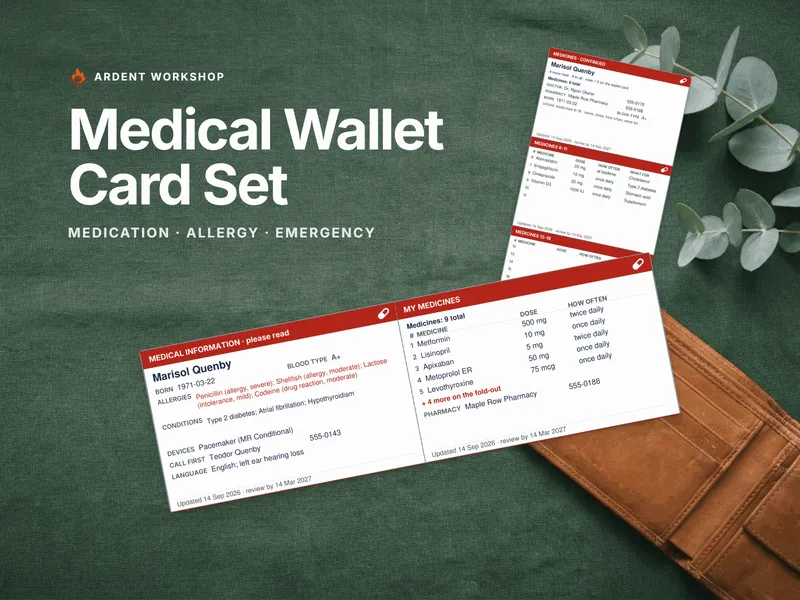
A wallet card is small. The fix is a fold-out: put the first few medicines on the card itself, then add a line that counts the rest — for example, ”+ 4 more on the fold-out” — so nobody misses that a longer list exists. The rest goes on a narrow panel that folds to card size and tucks behind the wallet card.
In the Medication, Allergy & Emergency Wallet Card Set, the fold-out takes up to 16 medicines in total. If you take more than that, ask your pharmacy for a printed list, tuck it behind the fold-out, and write “full list attached” on the card so it isn’t overlooked.
How do you record an implanted device?
Imaging and surgical staff need the specifics, so write them exactly:
- The type of device.
- The maker and model.
- The implant date.
- The MRI (magnetic resonance imaging) label, copied exactly as printed on the device maker’s patient ID card. Never guess it, and use “not sure” until you have the maker’s card in your hand. The labels are MR Safe, MR Conditional and MR Unsafe, the terms of the ASTM F2503 standard for MRI-safety marking, which the FDA recognizes.
- The clinic that manages the device.
The cards people forget
A medical card answers “what’s wrong with this person.” These answer “what happens next”:
- “If I can’t get home.” Who has your keys, who feeds the pets, who takes the kids. A neighbor, friend or officer can act on it.
- A child’s card. Your child’s allergies, medicines and the adults to call, for a sitter, teacher or school nurse. It lives in the backpack, not your wallet.
- A caregiver card. If you look after someone else, the card says “I care for … if I am hurt, call …” so the person who depends on you isn’t forgotten.
Give the child’s and caregiver cards to adults you trust, and record only what a helper needs.
Keep it current
A card with old information is worse than no card. Put a last-updated date on it and a review-by date a few months out (the card set stamps one 6 months after the last update). The review date is a house reminder, not a medical rule — pick your own rhythm.
When anything changes, update the master record, then reprint all the cards together so no two disagree. Replace them everywhere they live (wallet, bag, backpack, a caregiver’s wallet, the fridge), and shred the old ones, since they carry your health details.
Print, cut and laminate
- Print at 100% (Actual size). Never choose “Fit to page” or “Shrink to fit” — they change the card size. Print a ruler or outline first and measure it against a real ruler.
- Use card stock if your printer takes it. Plain paper works for a first try.
- Cut and fold. A fold-over card has front and back side by side; fold on the line and glue the halves together or laminate them.
- Laminate the wallet cards, which stiffens them for a wallet. Don’t laminate the fold-out, because it has to fold; cover the outside panel with clear tape or just reprint it when it wears.
Phone Medical ID or a paper card?
Use both. A phone’s Medical ID (the Health app on iPhone, emergency information on Android) is quick to set up and always with you, but a paper card works without the phone: it doesn’t need a charge, a passcode or a signal, and it can sit in a wallet, a bag, a backpack or on the refrigerator door. They back each other up.
Privacy: what to leave off
Anyone who finds the card can read it, and a lost card still shows everything on it. Put what a responder needs and leave off what you wouldn’t want a stranger to read — every box can stay blank. Record the care, not the credentials: no portal logins, no full insurance member numbers. On the “If I can’t get home” card, name the person who has a key rather than writing your home address or where a spare key is hidden, and keep a child’s card to the child’s name, allergies, medicines and the adults to call, without the school name or home address.
Put it in a set you own
You can do all of this with a pen and an index card. The Medication, Allergy & Emergency Wallet Card Set is the same method already laid out:
- Type once, every card fills. What you type on the My Record pages fills the wallet card, the fold-out for up to 16 medicines, the allergy and device cards, contacts, a fridge sheet and a phone lock-screen card.
- Fill it in with Adobe Acrobat Reader on a computer. The computed lines (the medicine count and the review-by stamp) need it; Apple Preview copies typed text but leaves those lines blank.
- A blank write-on set is included for handwriting.
You buy it once and keep the files, instead of renting an ID service by subscription. It’s a record-keeping set, not a certified medical alert device, and it isn’t affiliated with any medical-alert company.
Want to start with one card? The free emergency contacts wallet card comes pre-filled with a worked example, so you can see a finished one.
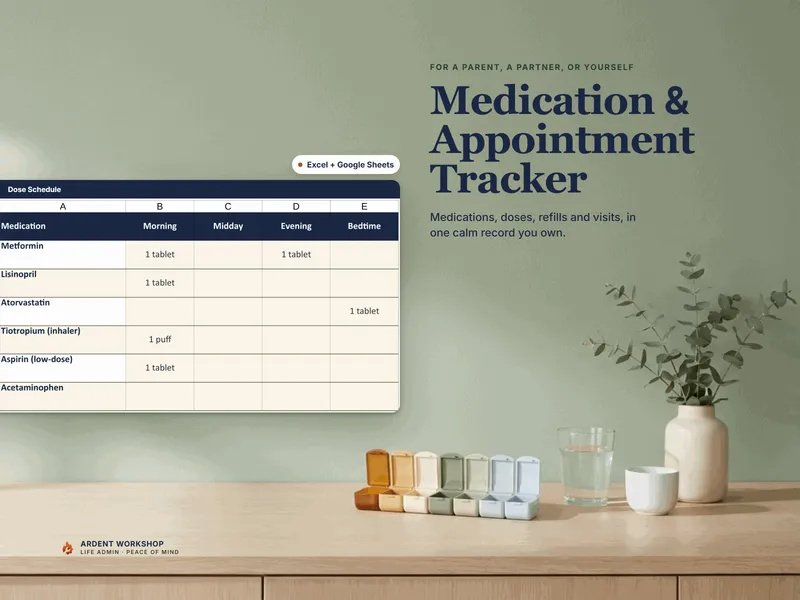
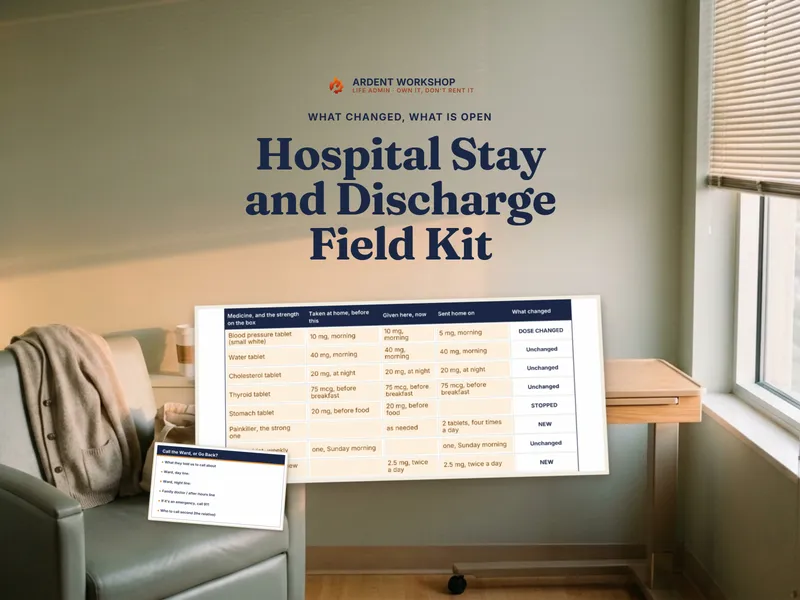
To keep the medicine list behind the card accurate, see how to organize medications for an aging parent and the Medication & Appointment Tracker. Heading to the hospital? The Hospital Stay & Discharge Field Kit covers the stay itself.