Somewhere around the second week of a month of daily meals, the plan that felt generous in the first week starts to feel like a job. The grocery runs multiply. The same two people are always at the stove. A guest cancels and the dessert goes with them.
None of that is a failure of effort. A month of suhoor and iftar is 30 nights of two meals each, often at different head counts, and it is hard to hold in your head. It is much easier to hold on paper, in layers.
This guide is about household logistics only. It does not set prayer or fasting times, give rulings or say what any family should do. Dates, timings and traditions are your household’s and your community’s to decide; everything below works whatever you choose.
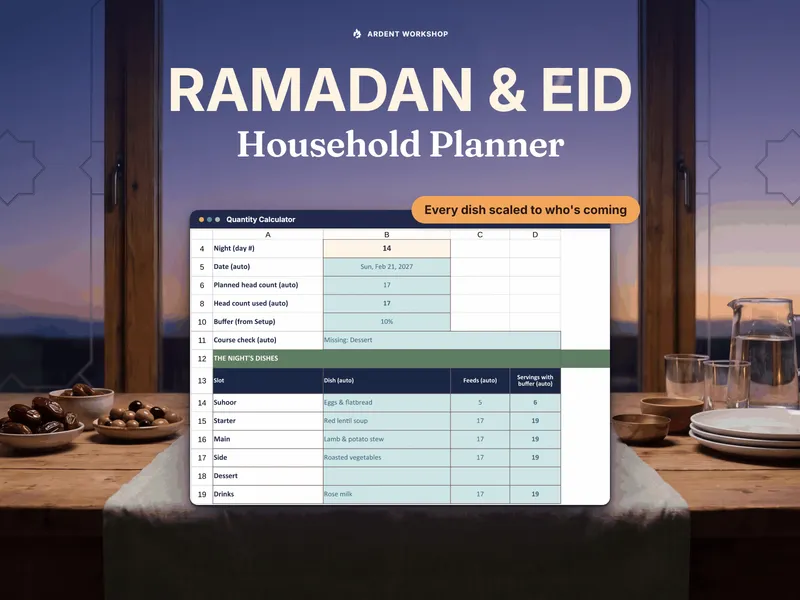
If you host, the free Iftar Hosting Night Sheet puts one evening on a printable page. If you’d rather not build the month yourself, the Ramadan & Eid Household Planner runs every step below in one workbook.
Step 1: Set the frame once
Before you plan a single dish, write down four things and then leave them alone:
- Day 1. Use the date your community announces. If the announced date changes, change the one cell or line and let every other date follow.
- How many days. 29 or 30, whichever your community announces.
- Who is in the household. The number matters, because it is the base for every quantity.
- Your buffer. The extra percentage you add so a second helping doesn’t leave you short. The worked example below uses ten percent as a round number to start from; set your own.
Also decide which courses a hosting night needs. A simple table might need a main, a dessert and drinks. A bigger gathering might add a starter and a side. Write the list down now, because Step 7 checks against it.
Step 2: Plan the menu one night at a time
Give every night a row, and give every row the same slots: one suhoor dish and, for iftar, a starter, a main, a side, a dessert and drinks. Blank is allowed. A night with a soup, a tray of something baked and dates on the table is a complete night.
A few habits make the menu go faster:
- Plan the iftar mains first. The main drives the shopping and the cooking time. Everything else is easier to fit around it.
- Then suhoor. Suhoor tends to repeat well, so a small rotation of three or four dishes can carry most of the month.
- Repeat a favorite on purpose. One tray of the dish everybody asks for, on a night you are hosting, beats inventing something new.
- Put the heavy cooking where the energy is. Look at your own calendar: work, school, travel, late evenings. Place the simple nights there.
- Keep a dish list. The moment you decide on a dish, add it to a running list with its ingredients per person. That list is what makes the next steps almost automatic.
Step 3: Count heads the right way
The two meals are counted differently, and it is worth doing that on purpose.
Iftar scales to the table. Take your household, add the guests who are confirmed or still pending, and that is the night’s head count. Add your buffer on top. In formula form: per-person amount × head count × (1 + buffer).
Suhoor scales to the household. Suhoor is usually just the people who live with you, so it scales to the household only.
Worked example, a fictional household with round numbers for illustration only: five people live in the house and twelve guests are coming on Saturday, so the head count is 17. With a 10% buffer, you cook for about 19 servings of each iftar dish (17 × 1.1 = 18.7, rounded up). The same Saturday’s suhoor still scales to 5.
The per-person amounts are yours to set. A general home-cook rule is to start with what your household actually eats at a normal meal and adjust after a few nights, not to take a number from anyone else’s table. For the full method with a worked table, see how to calculate food quantities for a gathering.
Step 4: Shop in 10-day blocks
One giant shop on the eve of the month tends to fail in two places: the fridge can’t hold it, and fresh things don’t last. Thirty separate shops fails differently, because you are in a store almost every day. Three blocks of ten nights is a workable middle.
For each block:
- Add up every ingredient needed across those ten nights, using each night’s scaled amounts.
- Subtract what you already have. Count what is actually in the pantry and freezer, not what you think is there. Do this before you build the list, not after.
- Group what is left by store section, in your own walk order. If you pass produce, then dairy, then the butcher, list it that way. One pass through the store beats three.
- Add the extras that aren’t in any recipe: foil, paper plates, dates for the table, a gift for a host.
- After shopping, add what you bought to what is on hand, so the next block starts accurate.
Print the first block before the month starts, and each later block a few days before you need it, so fresh items are bought close to the night you cook them.
Step 5: Cook ahead and use the freezer
Some dishes are made for the freezer: soups, stews, filled pastries, marinated proteins, doughs. Cook once, portion, label, and let the plan call each portion out on its night.
The method is a cook-by date: the serve date minus the dish’s lead days. Lead days are your own scheduling choice, the number of days before serving that you like to cook it. A pastry you want fresh might have a lead of a day. A soup you want out of the way might have a longer lead. Lead days are a scheduling choice, not a guide to how long a dish keeps.
Sort the list by soonest date, and give every item one of four statuses:
- Cook now: the cook-by date is today or already past.
- This week: it falls within the coming week.
- Later: further out, nothing to do yet.
- In the freezer: you’ve made the batch and stopped needing the reminder.
Add up how many servings of a dish the whole month needs and cook that batch in one session. One long afternoon can stand in for five evenings.
A note on safety: a plan sets dates; it does not set safe cooling, freezing or reheating times. Follow your recipe and standard freezer guidance for how long a dish keeps and how to thaw and reheat it.
Step 6: Share the cooking load
Without a plan, the load drifts toward whoever is most willing, and by week two that person is tired. Put a name next to every night, then count nights per person.
If one name has twenty-two nights and the others have three, you will see it in the first week rather than discover it in the third. Then move nights. A teenager can own a simple night. A spouse can own all the suhoors. A relative who has offered can own every Friday. Rotate the chore that nobody likes, like dishes, as deliberately as you rotate the cooking.
Sharing the load is also not only cooking. Name an owner for the shopping run, the freezer labeling and the clean-up on hosting nights. Visible work gets shared. Invisible work gets absorbed.
Step 7: Choose which nights to host, and check the table
You don’t have to host every night, or any night. If you do host, a few choices keep it sustainable:
- Spread it out. Hosting on three nights in a row is tiring. Try to leave a simple night between big ones.
- Match the night to the menu. Host on the nights you planned a freezer-friendly main and a dessert that was made ahead.
- Say yes to help. A guest who offers to bring a course is not imposing, and a table with shared dishes is a normal one.
- Write it down. For each hosting night, list each guest family, how many people, the course they are bringing and whether they have confirmed.
Then check the night against the courses you decided it needs in Step 1. A course counts as covered if it is on your own plan or a guest who hasn’t declined is bringing it. If neither is true, the night has a gap, like “Missing: Dessert.” Do that check a few days ahead, when you can still ask someone to bring something or cook it yourself. A guest marked pending still counts toward head count and coverage, because you are expecting them; a guest who says no comes out of both.
The free Iftar Hosting Night Sheet puts exactly this on one printable page: guests, menu, who brings what and timings, pre-filled with a worked evening so you can see how it reads. Print one for each night you host.
A weekly rhythm that holds
- Weekend: look at the next seven nights. Confirm guests for hosting nights. Check the cook-by list.
- Before each shopping block: update what’s on hand, print the block and shop in one pass.
- Every evening: glance at tomorrow’s night and pull the frozen portion out.
- Mid-month: count nights per person again, and move a few if the load has slipped.
Set it up once
You can run all of this in a plain spreadsheet. The parts worth building are a night-by-night menu, a dish list with per-person amounts, a head count that adds guests to the household, and a shopping list that subtracts what you have. Those four feed everything else.
If you’d rather not build it, the Ramadan & Eid Household Planner is that engine, ready to use. Enter each night’s menu and guests once, and the workbook scales every dish to that night’s head count, builds a store-section shopping list for any 10-day block net of what’s on hand, schedules what to cook and freeze by its cook-by date, and flags any hosting night still missing a needed course. Goals, reflections, a giving plan, an Eid countdown and a kids’ chart sit in the same file, which isn’t tied to any one year, and there is a printable version for the fridge door. It is a file your household owns, not a subscription.
If you keep a giving record for the month, the Charitable Giving and Zakat-Tithing Records Workbook is a place to log it. It records and totals the figures you enter; the amounts, rates and decisions stay yours, and it is not guidance on what or how much to give.