You’ve said yes to hosting. Now there is a number you can’t quite pin down: how much to make.
It’s easy to handle it one of two ways. You cook what feels like a lot and eat the same dish for a week, or you cook what feels reasonable and watch the second helpings disappear. Both are guesses. A guess is fine for a Tuesday dinner. It’s a worse deal for a table of seventeen, where the cost and the effort are both multiplied.
The fix is one small formula, applied dish by dish, and then carried through to the grocery list. It works for an iftar table, an Eid gathering, a holiday dinner or a family reunion. This guide uses an iftar as the running example, and leaves every household’s own timings and traditions to the household.
The method in one line
Per-person amount × head count × (1 + buffer) = what to make.
Each piece has a job:
- Per-person amount is how much one person typically eats of that dish. This is the number only you can set. A general home-cook rule of thumb is to start from how your own household eats and adjust from there; treat any figure you read, including the ones below, as a starting point to change.
- Head count is everyone who will eat, children included.
- Buffer is a small percentage on top so a second helping or a surprise guest doesn’t leave you short. Ten percent is a round number to start from. Raise it for a dish people go back for, lower it for something rich that few people finish.
Step 1: Get the head count right
The head count is the number that most often drifts, so give it a rule.
- Start with your household. Count everyone who will actually eat at the table that night.
- Add each guest family by the number of people, not the number of invitations.
- Count guests who have said yes and guests who haven’t answered yet. You are expecting them until you hear otherwise.
- Remove anyone who has said no, but keep their name on the list so you remember who you asked.
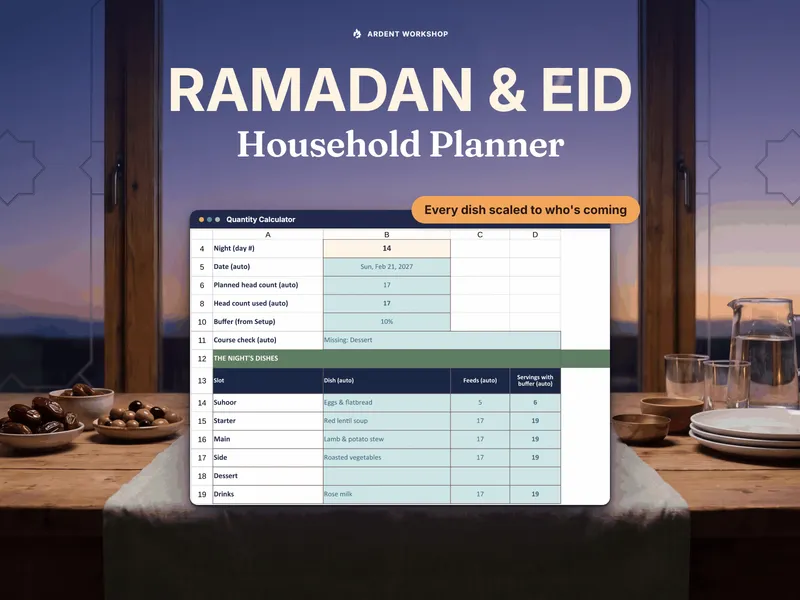
If your gathering has a split between meals, count each meal separately. An early-morning meal that’s just your own household scales to your household size. The evening meal with guests scales to the full table. In the Ramadan & Eid Household Planner, suhoor scales to the household and iftar scales to household plus guests, for exactly this reason.
Step 2: Add the buffer and round up
Multiply the head count by 1 plus the buffer, then round up to a whole serving.
Example (fictional household, round numbers). A household of 5 is hosting 12 guests, so the head count is 17. With a 10% buffer:
17 × 1.10 = 18.7, which rounds up to 19 servings.
Every dish for that night is now scaled to 19, not 17. That’s the number to carry through everything below.
Step 3: Scale each dish
Now apply a per-person amount to each dish. These amounts are made up for the example. Replace them with your own.
| Dish (example menu) | Illustrative per-person amount | × 19 servings | What to make |
|---|---|---|---|
| Lentil soup (starter) | 1 cup | 19 cups | About 1 gallon and 3 cups |
| Chicken and rice (main) | 1 chicken piece and 1 cup of cooked rice | 19 pieces, 19 cups rice | 19 pieces; about 6 1/3 cups dry rice, if your rice roughly triples |
| Roasted vegetables (side) | 3/4 cup | about 14 cups | A little over 14 cups, roasted |
| Dates for the table | 3 each | 57 | About 60 |
| Baklava-style pastry (dessert) | 1 piece | 19 | 20 pieces, one extra |
| Drinks | 2 cups | 38 cups | About 2 1/2 gallons |
Two habits help. First, round to whatever is natural to buy or bake: a tray of 20, a bag of dates. Second, notice that not every dish needs the same treatment. A rich dessert at the end of a long table is eaten in small pieces; a main is the dish that runs out. Adjust the per-person amount, not the formula.
Step 4: Turn servings into a shopping list
A table of dishes is not a grocery list. The list comes from one more multiplication: each dish’s ingredient amount per serving × the servings you just worked out.
Example (illustrative per-serving amounts). For the lentil soup at 19 servings:
| Ingredient | Per serving | × 19 | Round to |
|---|---|---|---|
| Dry lentils | 1/4 cup | 4 3/4 cups | 5 cups |
| Onion | 1/4 of a medium onion | 4 3/4 onions | 5 onions |
| Broth | 1 cup | 19 cups | About 5 quarts |
Do the same for each dish. Then three steps turn the pile of numbers into a trip to the store:
- Add like ingredients across dishes. Onions show up in the soup and the vegetables; they go on the list once, with one total.
- Subtract what you already have. Check the pantry and freezer for real, not from memory. If you own 3 onions and need 8, you buy 5.
- Group by store section, in your own walk order. Produce, dairy, the butcher, dry goods, whatever your store is like. One pass through the store beats three.
If you’re feeding a crowd all month, do this in blocks of several days rather than one night at a time. That’s the thinking behind the 10-day blocks in the planner and in how to plan a month of iftars.
Step 5: Decide who brings what
Guests who ask “what can I bring?” are doing you a favor, and a vague answer produces five desserts and no drinks. Make it concrete.
- List the courses your table needs. A common set is main, dessert and drinks. Add a starter or a side if your gatherings always have one, and drop what you don’t need.
- Assign each course to a name. It can be yours or a guest’s.
- Check for holes. Any course with no name beside it is the one to fill: ask a guest, or cook it yourself.
- Re-check when someone cancels. A guest who bows out takes their course with them, and the hole reappears. Treating a cancellation as a change to the head count and the course list is what stops the missing dessert from surfacing at the table.
When a guest brings a dish, ask roughly how many it serves, and subtract that from what you plan to make. Don’t scale your own dishes up to cover a guest’s.
The planner does this check automatically: a hosting night with no host plan or guest covering a required course reads “Missing: Dessert” (or whichever course is open). A pen and the free sheet below do the same job on paper.
Step 6: Keep notes and adjust
A formula is only as good as its per-person amounts, and those get better with feedback.
After each gathering, write two lines: what ran short, and what you had left over. Next time, nudge the per-person amount for those dishes up or down. After two or three gatherings, your numbers will be better than any rule of thumb, because they’re built on how your family and friends actually eat.
Common mistakes
- Counting invitations, not people. A family of six is six servings.
- Forgetting children. If your children eat less, lower the per-person amount on a dish rather than leaving them out of the count.
- Scaling every dish equally. A drink or a main usually needs more attention than a side.
- Buying before checking on-hand stock. It’s how the third bag of rice ends up in the pantry.
- Skipping the buffer on the main. A small buffer costs little; running short costs a lot.
Do it on paper or in a sheet
For one night, the free Iftar Hosting Night Sheet is enough. It’s a printable page for guests, menu, who brings what and timings, pre-filled with a worked evening so you can see how it fits together.
If you host more than once, a spreadsheet saves you doing the arithmetic again. The Ramadan & Eid Household Planner is built on exactly this method. You enter each night’s menu and guests once, and the workbook scales every dish to that night’s head count, builds a store-section shopping list for any 10-day block net of what’s on hand, schedules what to cook and freeze by its cook-by date, and flags any hosting night still missing a needed course. You own the file outright, with no subscription. Its per-person amounts are home-cook starting estimates that you change to match your table.
If you also keep a record of your giving through the season, the charitable giving records workbook is the companion. It records and totals the figures you enter; the amounts, rates and decisions stay yours, and it doesn’t tell you what to give.