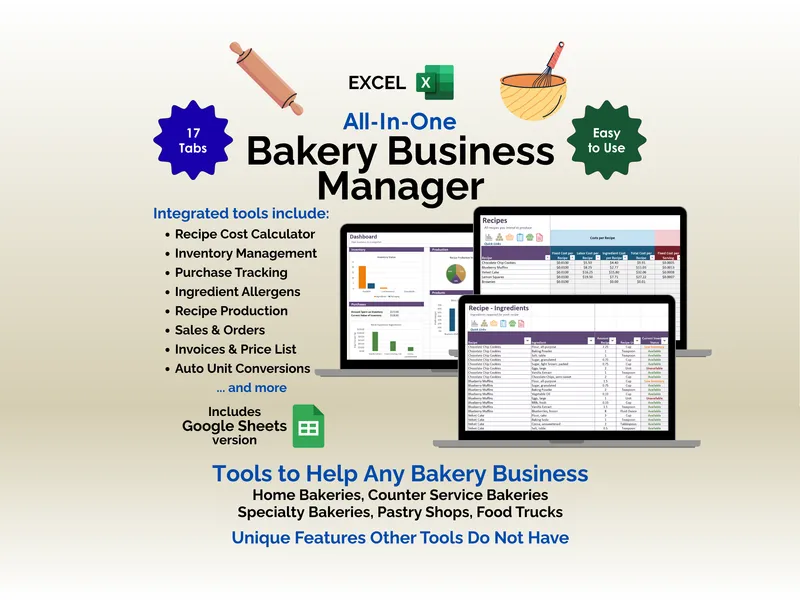
This isn't really spreadsheet-versus-platform. Computing an ingredient statement and joining batches to supplier lots is one job that food compliance software happens to wrap in audit management and document control. The mistake is buying the whole facility system when the part you will actually use — a label you can defend and a trace you can run — is something you can own outright.
What each one is for
- A compliance spreadsheet is a labeling and traceability tool. Convert a recipe to weights, rank the ingredients, assemble the statement, declare the allergens, log the lots and the batches, and trace one code forward to buyers or backward to ingredients.
- Food compliance software is a facility management system. It assumes a plan to maintain, suppliers whose certificates expire, corrective actions to close out, monitoring to schedule, and an auditor who will ask for the trail. Labeling is one module among many.
What the workbook does completely
- The ingredient statement. Labels list ingredients in descending order of predominance by weight. Recipes are written in mixing order, in cups. Converting and ranking is arithmetic, and a workbook does it exactly.
- The allergen declaration. Flag an allergen once against an ingredient and every product that uses it inherits the flag, so the "Contains" line is computed rather than remembered.
- Two-way traceability. One join table — which supplier lot went into which batch — is all that stands between a recall notice and an answer. It is a lookup, and a workbook is a lookup engine.
- Knowing what is missing. Batches logged without their lots, labels short an element, ingredient lots past their use-by: countable, and therefore fixable before they matter.
What the platform adds — and when that is worth it
- HACCP or preventive-control plan management — hazard analyses, critical limits, monitoring records and corrective actions held together as a living document. A home kitchen under a cottage food exemption is generally not operating one.
- Supplier document control — certificates of analysis, allergen statements and audit certificates collected and chased automatically as they expire.
- Continuous monitoring — temperature and sensor logs on a schedule, with alarms. If you make anything needing refrigeration, this matters, and so does the fact that most cottage food rules exclude it.
- Multi-user sign-off and audit trails — who recorded what, when, and who verified it. Genuinely valuable once more than one person enters data and a scheme auditor will read it.
Every one of those is worth paying for in a facility. None of them is what a person labeling cookies at a kitchen table is being asked for.
When to move up
The signal is not volume, and it is rarely price. It is a change in what you are being asked to prove: a wholesale buyer wanting your supplier certificates and an audit certificate, a scheme requiring a documented plan with corrective actions, a second person entering records, or products that need temperature control. At that point you have usually outgrown the cottage food exemption itself, not just the file.
Until then, the middle rung is the one that fits: not a blank spreadsheet you have to build the ordering logic into yourself, and not a facility platform priced for a plant.
Try it before you decide
The free allergen and label worksheet does the headline job for one product — type a recipe, get an ingredient statement ordered by weight and a Contains line. It is ungated, it opens on a worked example, and it will tell you quickly whether a workbook is the right size of tool for your kitchen.
Two other things are worth knowing before you spend anything: revenue caps and the rules themselves are free. Our own Ardent Seller platform publishes a maintained 50-state cottage food guide and a live revenue cap tracker, both ungated. There is no reason to pay anyone for those.
Nothing on this page is legal, regulatory or food-safety advice. Cottage food rules are set state by state and change often — check your own state's published guidance before you print a run of labels.
Frequently asked questions
- What's the difference between a compliance spreadsheet and food compliance software?
- A compliance spreadsheet is a file you own that computes your ingredient statements and allergen declarations from your recipes, and records which supplier lots went into which batch so you can trace both ways. Food compliance software is a hosted platform that does the same core job for a facility — usually bundled with HACCP plan management, supplier document control, audit scheduling, sensor and temperature logging, and multi-user sign-off — sold as a monthly or annual subscription. One is a focused tool sized for one kitchen; the other is a system sized for a plant with an auditor visiting.
- Can a spreadsheet handle cottage food record keeping?
- For the job a home kitchen actually has, yes, and completely. The enforceable obligation under a cottage food exemption is a compliant label on every package — an ingredient statement in descending order by weight, an allergen declaration, and your state's own required elements. A date or batch code is required outright in only a minority of states, and no state requires you to record which supplier lots went into which batch — but both are what let you answer a recall call, which is why a record-keeping workbook treats them as part of the job. All of that is arithmetic and a join, which is exactly what a spreadsheet is good at. What a spreadsheet cannot do is manage a HACCP plan, collect supplier certificates automatically, log a cold-store temperature every fifteen minutes, or give four people simultaneous audited sign-off. If your operation needs those, you have outgrown the exemption too.
- How much does food compliance software cost compared with a spreadsheet?
- An owned compliance workbook is a single low one-time cost — you keep the file, work offline, and pay nothing monthly. Food compliance and traceability platforms are priced for facilities: recurring subscriptions typically scoped per site or per user, and often quote-based rather than published. The platform earns that when you are being audited to a scheme and need document control and sign-off trails. Paying it to label a weekend's worth of cookies is renting far more system than the job needs.
- Will a spreadsheet satisfy an inspector?
- No record-keeping tool — file or platform — makes a product compliant; it only lets you show what you did. What an inspector or a supplier wants to see is that your labels carry the required elements and that you can account for what went into a batch. A workbook that computes the ingredient statement, declares the allergens, and traces a supplier lot to the batches and buyers it reached shows exactly that. Confirm your finished label against your own state's published guidance before you print a run, because the disclosure wording and the extra elements are where states differ.
- Is my recipe and customer data private in a spreadsheet?
- A file you own is as private as the controls you put around it. With the Excel version the data never leaves your hands — no vendor account, no third-party cloud. If you use the included Google Sheets copy instead, your recipes live in your own Google Drive under your own account: still yours, still no subscription, but not offline the way the Excel file is. Batch records name where products went and sometimes who bought them, so keep the file to the people who need it and handle it the way your own privacy policy and local law require. Owning the file simply keeps that entirely under your control.