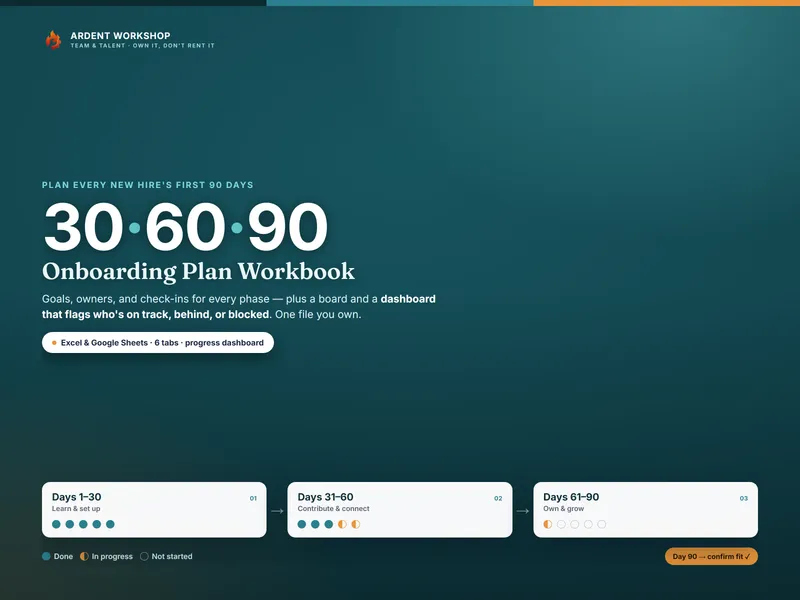
This isn't really template-versus-platform. A 30-60-90 plan is one feature that onboarding software happens to include. The mistake is buying the whole per-employee platform when the part you'll actually use — the plan and the progress view — is something you can own outright.
What each one is for
- A 30-60-90 template is a planning tool. Write a plan with each new hire, give every milestone an owner and a target day, track all your starters on one board, and see who needs a nudge. It answers “is this hire set up to succeed, and are they on track?”
- Onboarding software is a platform. Pre-boarding workflows, e-signature paperwork, IT and account provisioning, task automation, reminders, and an employee database — with the 30-60-90 usually one view inside it. It answers “automate our entire new-hire process,” at a price to match.
A full explanation of the 30-60-90 plan is in the glossary.
When a 30-60-90 template is exactly right
- You hire a few people at a time, not hundreds a quarter.
- You're a manager or a small team, not a large People function.
- You want a real plan for each hire, not just a paperwork checklist.
- You'd rather own the file than rent a platform per employee.
- You want your onboarding and people data in your own hands, offline.
At this stage a template beats a platform outright for the planning job. The free 30-60-90 starter plan is a no-signup taste of the method, and the templates for HR & team leads hub collects the rest.
The signals you may want a full platform
- You onboard at volume. Many hires a month, where manual setup and reminders don't scale.
- You need paperwork and provisioning automated. E-signature offer letters, tax and policy forms, and accounts created automatically on day one.
- You need it wired to payroll and an HRIS. New hires flowing into the systems of record without re-keying.
- You have a People team to run it. A platform needs an owner; a plan needs a manager and an hour.
Even then, the plan for each hire still lives on a 30-60-90 — the platform just hosts it. The template is the thinking; the platform is the plumbing.
Side by side
| What matters | 30-60-90 template (owned workbook) | Onboarding software |
|---|---|---|
| What it is | A focused onboarding plan & tracker | A broad new-hire automation platform |
| Cost | One-time, low — you own the file | Ongoing subscription, often per employee |
| The plan & progress view | The whole point — goals, owners, dashboard | One view among many |
| Paperwork & e-signature | Not its job — bring your own process | Full — forms, signatures, workflows |
| IT / account provisioning | You track it as a milestone | Automated account creation |
| Setup | Open it and plan — an hour | Implementation, config, rollout |
| Data ownership | The file is yours, offline | Hosted in the vendor's platform |
| Best for | A manager or small team onboarding a few hires | A People team onboarding at scale |
The honest middle ground
Plenty of organizations grow into an onboarding platform eventually, and that's the right move when automating paperwork and provisioning across a large, fast-hiring workforce becomes the job. The mistake is the reverse: buying a per-employee suite to onboard a handful of people, when an owned plan does the part that actually matters — giving each new hire a strong, tracked first quarter — better and costs once.
Onboard your new hires either way
Whichever stack you end up on, the plan itself lives on a 30-60-90. The 30-60-90 Onboarding Plan Workbook gives every hire a plan with owners and dates, tracks all your starters on one board, and flags who's on track, behind, or blocked — one owned file for Excel, Google Sheets, and LibreOffice. Own the plan; add a platform only when automating onboarding at scale becomes the job. If you are still hiring for the role, the Hire & Onboard Kit adds that workbook to an applicant tracker and an interview scorecard, so the goals you copy into the plan come from what the interview scored lowest rather than from the job description.
Frequently asked questions
- What's the difference between a 30-60-90 template and onboarding software?
- A 30-60-90 template is the artifact: a plan that maps a new hire's first three months into goals, owners, and check-ins, and a board that tracks how each hire is progressing. Onboarding software is a platform that may include a 30-60-90 view alongside pre-boarding workflows, e-signature paperwork, IT provisioning, task automation, and an employee database — usually sold as a per-employee subscription. One is a focused plan you own; the other is a broad system you rent. For most small and mid-size teams, the plan and the progress view are the parts they actually use, and a spreadsheet delivers them without the platform.
- Can a spreadsheet replace onboarding software?
- For the planning-and-tracking job most managers actually do — writing a 30-60-90 plan with the new hire, tracking every starter on one board, and knowing who's on track, behind, or blocked — an owned workbook does it completely. What a spreadsheet doesn't do is automate account provisioning, route new-hire paperwork for e-signature, sync to payroll and an HRIS, or trigger reminders across a large org. If you're onboarding at scale with compliance paperwork and IT automation, a platform earns its keep; if you're a manager or small team getting each hire off to a strong start, the template is the right size of tool.
- How much does a 30-60-90 template cost vs onboarding software?
- An owned 30-60-90 workbook is a single low one-time cost — you keep the file, edit it offline, reuse it for the next hire, and pay nothing monthly. Onboarding software is typically a recurring per-employee subscription, often with a minimum seat count and an annual contract. The subscription pays off when you need the automation and paperwork at scale; paying per employee just to give each new hire a good plan is renting far more system than the job needs.
- Is a 30-60-90 plan just for new managers or big companies?
- No — a 30-60-90 plan is most valuable for exactly the teams that don't have onboarding software: a manager or small company hiring one person at a time. It works for any role you hire for, from a first employee to a seasoned specialist, and the point is the same at any size — give the new starter a shared plan so their first quarter is set up to succeed. A plan is a planning aid, not a performance-management or probation instrument on its own.