
Why stitches, and not size
An embroidery machine does not care how wide your logo is. It cares how many times the needle goes down. Every stitch consumes a fraction of a second of machine time and a length of thread, and those two things are what the job actually costs.
That is why size is a bad proxy. Two designs of identical width can differ by a factor of three in stitch count:
- A light script five inches wide is mostly air — a single running outline, a few thousand stitches.
- A solid-fill crest two inches wide has to cover every square millimeter of its area with thread, and can run three or four times as many stitches as the script.
Quote either one from its dimensions and you will overcharge for the first and lose money on the second.
How is stitch count calculated?
Stitch count is a property of the digitized file, not of the artwork you were emailed. Digitizing is the process of converting a logo into machine instructions — stitch types, directions, densities and underlay — and two digitizers can produce very different counts from the same image.
Practically, that means you cannot know the exact price until the file exists. Shops handle this by quoting from a band, then correcting the spec once the count comes back:
- Three-letter monogram — roughly 1,200 to 2,500 stitches
- Left-chest logo, light fill — roughly 4,000 to 8,000 stitches
- Left-chest logo, dense fill — roughly 8,000 to 12,000 stitches
- Cap front — roughly 5,000 to 10,000 stitches
- Jacket back, filled design — roughly 20,000 to 45,000 stitches
These are common small-shop starting points for quoting before a design is digitized, not an industry standard. Ask your digitizer for the final count and price from that.
How much does 1,000 stitches cost?
A thousand stitches costs you three separate things, and the third is the one most often left out:
- Thread and backing. Cents to low tens of cents per thousand stitches depending on your thread cost and how densely the design is filled, plus a fixed per-piece cost for the stabilizer behind the fabric.
- Machine time. A commercial head is rated far higher than it runs on real garments; a common small-shop planning range is roughly 700 to 800 stitches a minute, and caps, dense fills and difficult fabrics run slower still. Time a real job on your own machine rather than trusting the rating — stitch count converts almost directly into minutes once you have.
- Your hands-on time, which is not the same thing. Hooping, trimming, changing colors and unhooping are your minutes. The sewing itself is unattended — you are hooping the next piece while it runs.
That last distinction is the one that decides whether your embroidery pricing is competitive or theoretical. The honest model charges operator minutes at your loaded shop rate and machine minutes at the machine's own hourly cost — worked through with real figures in the step-by-step pricing walkthrough.
Is digitizing a setup cost or a per-piece cost?
Digitizing happens once per design, however many garments you sew. Treat it as a job-level setup charge and divide it across the run — the same way a screen printer treats a burned screen — rather than burying it in the per-piece price.
Do that, and two things become obvious that are otherwise invisible: a single-piece order with a new design carries the entire digitizing cost on one garment (which is what minimum orders exist for), and the second order for that same design is a completely different, much cheaper job.
Where stitch-count pricing sits among the other methods
Embroidery is one of the four decoration methods a small shop most often runs — sublimation and pressed plastisol transfers add two more — and each bills in its own units, which is why a single flat "decoration fee" is always wrong for something:
- DTF transfer — square inches of printed film
- Heat-transfer vinyl — square inches of vinyl, and then again in minutes of weeding
- Screen print — ink per color per piece, with a screen to burn for each color
- Embroidery — thousands of stitches
The free Decoration Cost Calculator converts a design size into a real cost per piece in whichever of those units applies, with six worked examples pre-filled and no signup. The full Custom-Apparel Shop Order & Pricing Workbook carries that number into a quote, an order queue with deposits and proof approvals, and profit by order, by customer and by method. For the method end to end, see how to price a custom shirt step by step.
Illustrative figures throughout — thread prices, machine speeds and digitizing fees vary widely, and stitch bands are quoting starting points rather than a standard. A business reference, not tax, accounting, or legal advice.
Templates that implement this
Tools that price the decoration for you
3 templates
The apparel workbook costs embroidery by the thousand stitches, DTF by the square inch and screen print by the ink color, then turns it into a quote and an order queue — alongside the wider maker pricing tools that sit around it.
- $24.95 Spreadsheet

Custom-Apparel Shop Order & Pricing Workbook - DTF, Screen Print & Embroidery Costing (Excel + Google Sheets)
Price DTF, vinyl, screen print and embroidery in the units each one actually bills in - then quote, track the order, and see real profit.
Operator OSView details - $24.95 Spreadsheet
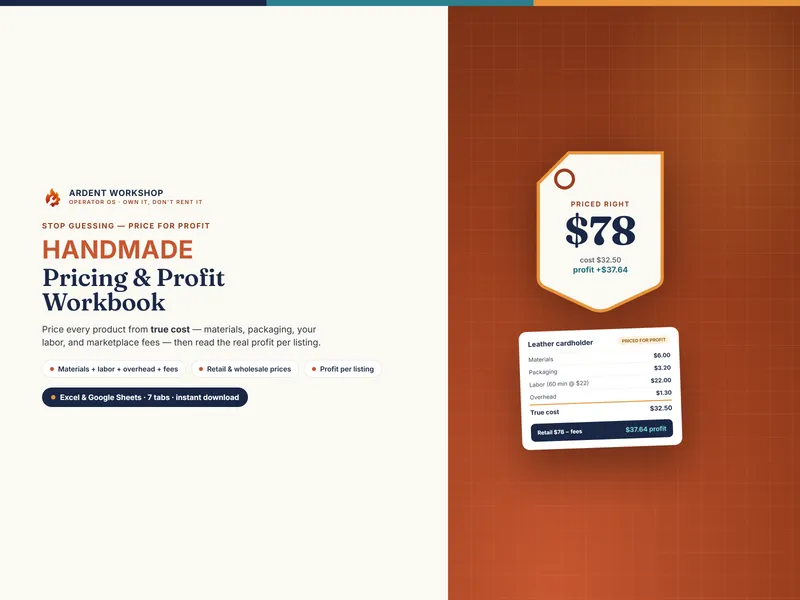
Handmade-Seller Pricing & Profit Workbook — Price Your Craft from True Cost, Markup vs Margin, Marketplace Fees & Wholesale (Excel + Google Sheets)
A handmade pricing workbook for Excel & Google Sheets — price every product from true cost (materials, labor, overhead, fees) and see the real profit on each.
Operator OSView details - $19.95 Spreadsheet
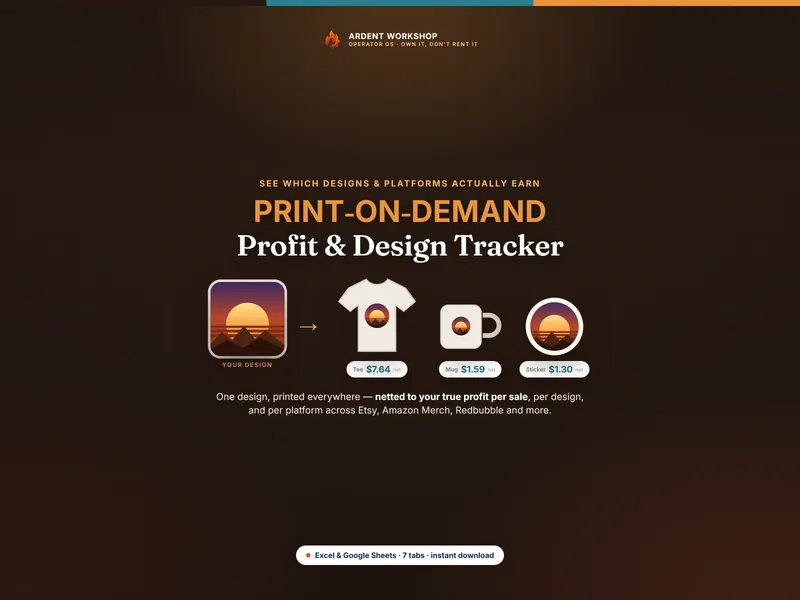
Print-on-Demand Profit & Design Tracker — POD Profit per Design, Platform Fees & Pricing for Etsy, Printful, Amazon Merch & Redbubble (Excel + Google Sheets)
A print-on-demand profit tracker for Excel & Google Sheets — net your profit per sale and per design across Etsy, Printful, Amazon Merch & Redbubble.
Operator OSView details