The four letters
Every cell of the matrix carries one of four roles. The letters are the whole vocabulary of the tool — keep them clean and the chart stays readable; overload them with combinations and it stops working.
- R — Responsible. The person who actually does the work. A task can have more than one R if multiple people share the doing, but that's usually a sign the task needs to be split.
- A — Accountable. The single person who answers for the outcome. There is exactly one A per task. If two people are accountable, neither one is.
- C — Consulted. Subject-matter experts who are asked for input before the work is done. Two-way communication.
- I — Informed. People who need to know the outcome but aren't part of the decision. One-way communication.
What a RACI is actually for
On paper, a RACI documents who does what. In practice, the chart is a diagnostic. The moment you fill one out honestly, you can see three failure modes at once: a senior person marked R on a dozen rows while juniors sit idle, three people marked A on the same task (which means nobody is), and entire workstreams where the team that owns the outcome isn't even in the matrix.
Most RACI problems aren't fixed by adding more meetings — they're fixed by reassigning a few cells until the workload looks balanced and every task has exactly one A. That's why the most useful RACI tools include a workload tally per person, not just the grid itself.
When to use one
- Kicking off a project with more than three contributors, especially when people are sharing or new to the team.
- Untangling a project that's stalled because nobody knows who decides.
- Restructuring after a reorg or onboarding a new lead.
- Documenting a recurring process (release, incident response, onboarding) so the next person doesn't have to ask who owns step four.
How to build a RACI in ten minutes
- List every meaningful task or deliverable down the left column.
- List every role or person across the top row.
- For each task, mark exactly one A — the person who owns the outcome.
- Mark one or more R — the people who do the work.
- Mark C for advisers and I for people who just need to know.
- Tally R + A counts per person. If one column is dramatically higher than the others, the project is one sick day away from slipping.
Common mistakes
- Two A's on a single task. The whole point of A is one throat to choke. Two means consensus, and consensus on accountability slows decisions to a crawl.
- R-everywhere superstars. If one person is R on most rows, the matrix has surfaced a key-person risk. Fix the matrix by delegating, not by celebrating.
- Treating it as paperwork. A RACI you fill out for the PMO and never reference again is a worse-than-useless artifact. Pull it up at every status meeting until the team can recite their column.
- Skipping the workload check. The grid alone doesn't tell you who's overloaded. Tally the letters per person before you sign off on the chart.
Related templates and concepts
A RACI pairs naturally with a stakeholder register (who outside the team needs to be C or I) and a risk register (where the missing A's tend to surface as risks). For project managers running multiple artifacts, see the templates for project managers hub.
Templates that implement this
Templates that build a RACI
2 templates
Drop in your tasks, list your team, type R / A / C / I — and watch the workload chart surface who's overloaded before the sprint starts.
- $4.95 Excel
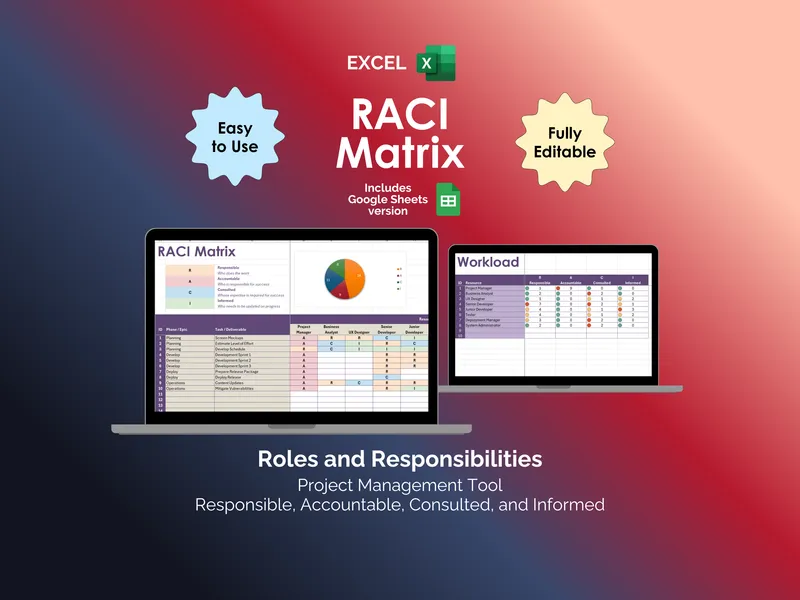
RACI Matrix - Excel
A RACI chart isn't paperwork. It's how you spot the person you're about to burn out. Excel RACI matrix template with a live workload view per resource.
Project ManagementView details - $4.95 Sheets
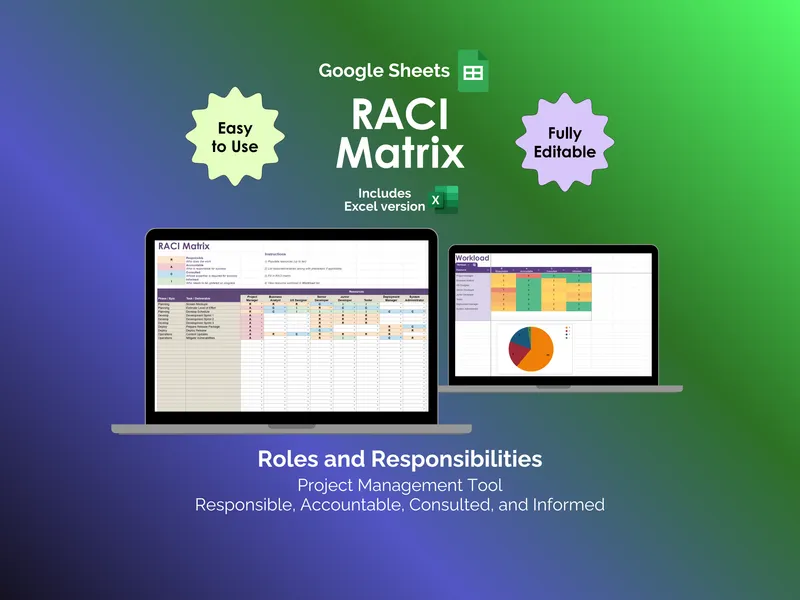
RACI Matrix - Google Sheets
Is anyone on your team quietly drowning under the work? This google sheets raci matrix template doubles as a raci chart template with a live workload view.
Project ManagementView details