What the term means
A marketplace facilitator is a platform that does two things at once for a third-party seller: it lists the product, and it processes the buyer's payment. That combination — listing plus payment — is the common shape of the definition, though each state writes its own wording and the edges differ. It's what separates a facilitator from a site that merely advertises a seller's goods and leaves the buyer to pay the seller directly.
What changed after Wayfair
Before 2018, a state generally couldn't require an out-of-state seller to collect its sales tax unless that seller had a physical presence there. The Supreme Court's 2018 decision in South Dakota v. Wayfair (PDF) changed that, opening the door to economic-nexus rules based on sales volume alone. States responded with two related sets of laws: economic-nexus thresholds for sellers, and — separately — marketplace-facilitator laws that shifted the actual collect-and-remit duty for marketplace sales onto the platform itself, on the reasoning that the platform is in the best position to calculate the correct tax on every sale it processes.
What it does for you
Practically, this is a real convenience. When you sell through Etsy, Amazon, eBay, Walmart, Faire or a similar marketplace, the platform calculates the buyer's sales tax at checkout, collects it, and remits it to the correct state on its own schedule — not yours. You never touch that money. It is not part of your payout, not your income, and not your deduction — it passes through the platform to the state without ever reaching your bank account. Booking it as revenue (or trying to claim it as an expense you paid) is an easy mistake to make, because the buyer's total on a sales report includes it and the whole line gets swept into "sales."
As of August 2026 this coverage was broad — the great majority of US states with a statewide sales tax, plus DC, have some form of marketplace-facilitator law on the books, and each state's own revenue agency is the place to confirm its position — but the details are set state by state and platform by platform, and they have changed repeatedly since 2018. Confirm current coverage with the marketplace's own tax help pages and, if it matters to your filing, with your state revenue agency.
What it does not cover
Facilitator status applies only to sales the platform itself processes. It does not extend to:
- Your own website — a Shopify store, a standalone checkout, or any direct sale you process yourself.
- In-person sales — a craft fair table, a farmers-market booth, or any cash-or-card sale made off the platform.
- Wholesale or invoiced sales — an order you bill a customer directly, outside the marketplace's checkout.
On every one of those channels, calculating, collecting and remitting sales tax is still your responsibility, under your own state registration and on your own filing schedule — the marketplace's coverage doesn't follow you off its platform.
Why marketplace sales can still create nexus
Here's the trap most sellers don't see coming: in many states, sales made through a marketplace facilitator still count toward your own economic-nexus threshold in that state, even though the platform is the one that collected and remitted the tax. Other states exclude facilitator-collected sales from that count — which way your state goes is a state-by-state question, not a general rule. A strong sales year on one marketplace can quietly push you past a state's threshold and create a registration obligation there — for taxes on your other channels, or for reporting requirements the state still expects of you — even though you never personally collected a dollar of sales tax in that state. Whether and how this applies to you depends on the state and on your total sales there across all channels; it genuinely varies, so check the specifics with that state's Department of Revenue rather than assuming a marketplace's remittance means you have nothing left to track.
Don't confuse this with the 1099-K
A marketplace facilitator's sales-tax duty and a marketplace's Form 1099-K are two different things governed by two different sets of rules. The 1099-K reports your gross payment volume to the IRS — it has nothing to do with sales tax, and it is not a measure of what you earned. Sales tax collected by a facilitator was never your money and is not your income. Whether it sits inside the gross figure printed on your form is a separate question about how that particular processor reports: Etsy generally excludes facilitator-collected tax from Box 1a, but processors differ, so check what your own form says it covers rather than assuming it has already been taken out. Keeping the two ideas apart in your own records is what makes both numbers make sense at tax time.
What to check with your state
- Whether each marketplace you sell on is currently registered as a facilitator in every state where you have customers — coverage has grown over time and can still have gaps for newer or smaller platforms.
- Whether your state still expects you to hold a seller's permit and report marketplace sales on your own return, even when the tax was already remitted for you — some states do.
- Whether marketplace sales count toward your economic-nexus total in states where you also sell directly, and whether that total has crossed a registration threshold.
Each of those is answered by one authority only: the state itself. Find yours through the USA.gov directory of state tax agencies, and check it against what the marketplace publishes on its own tax help pages, since the two have to agree for your filing to be right.
Related templates and concepts
The Sales-Tax & 1099-K Reconciliation Workbook separates the sales tax a marketplace already remitted for you from the sales tax you still owe on your own, across 52 pre-filled jurisdictions — each with its state source, and its threshold where one applies — and bridges your 1099-K's gross figure down to what actually reached your bank. If pricing your work to survive a marketplace's fees is the more immediate problem, the Handmade-Seller Pricing & Profit Workbook and the Etsy Seller Toolkit both work marketplace fees into the price you charge, not just the tax you owe after the fact. You own each workbook outright — no seats, no monthly fee. If the reconciliation itself is what you're facing, the eight-step Etsy 1099-K walkthrough is free, and an owned workbook against monthly bookkeeping software compares the two ways of doing it. Not sure a form is even coming? The free 1099-K threshold tracker checks your per-platform totals against the federal and state tests.
Templates that implement this
Templates for reconciling what a marketplace already handled
3 templates
A workbook that separates the sales tax a marketplace already remitted from what you still owe, plus the pricing and profit tools that turn your gross sales into what you actually keep.
- $24.95 Spreadsheet

Sales-Tax & 1099-K Reconciliation Workbook — Marketplace Seller Tax-Time Bookkeeping for Excel & Google Sheets
Reconcile your marketplace 1099-K to your real bank deposits and your Schedule C — every fee, refund and timing gap named. Excel & Google Sheets.
Operator OSView details - $24.95 Spreadsheet
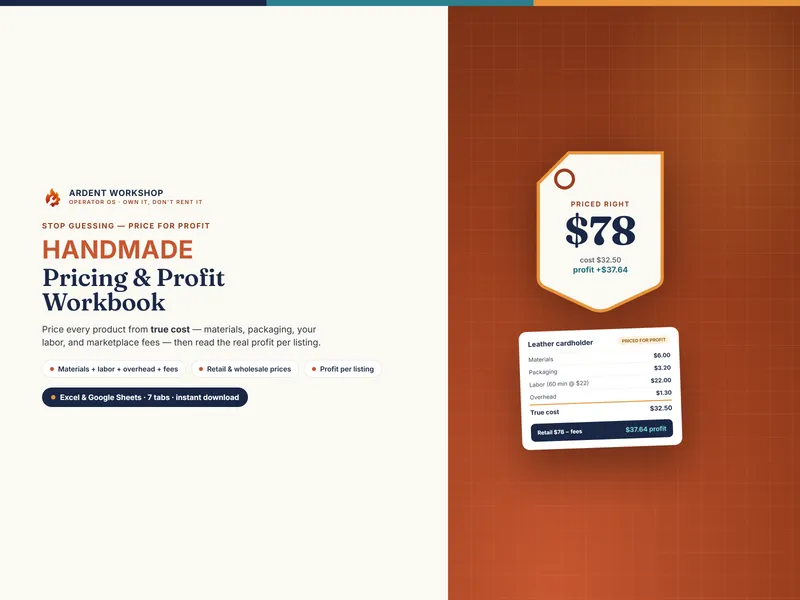
Handmade-Seller Pricing & Profit Workbook — Price Your Craft from True Cost, Markup vs Margin, Marketplace Fees & Wholesale (Excel + Google Sheets)
A handmade pricing workbook for Excel & Google Sheets — price every product from true cost (materials, labor, overhead, fees) and see the real profit on each.
Operator OSView details - $26.95 Spreadsheet

Etsy Seller Toolkit - Excel & Google Sheets
Six tools in one workbook: the price to charge worked back from your costs, profit after every Etsy fee, tag scoring, and pricing against your competition.
Operator OSView details