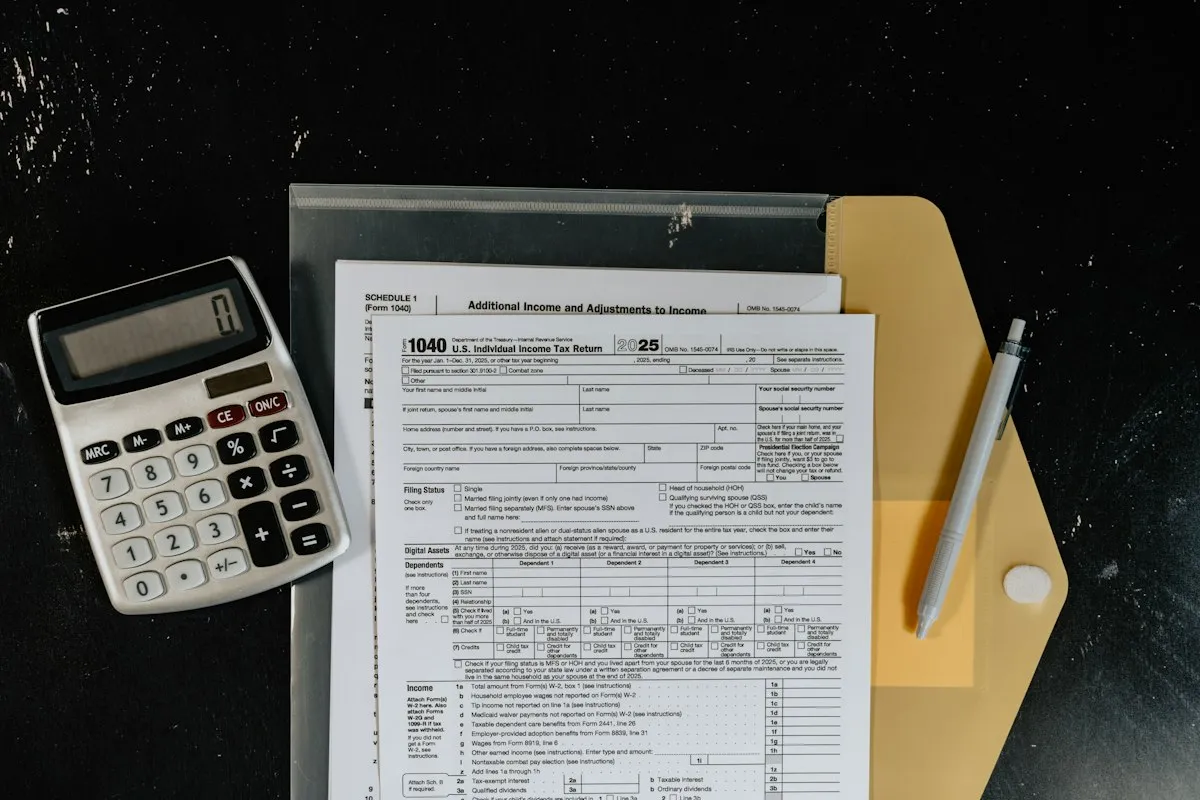
What the form actually reports
Box 1a is the form's gross figure — its printed label is "Gross amount of payment card/third party network transactions", which is a mouthful for gross payment volume — and that word "gross" is doing all the work. It's the total dollar amount the processor settled to you across the year — every sale, before a single fee, refund, discount, chargeback, or dollar of buyer-paid shipping comes back out. It is not your revenue net of returns, not your take-home pay, and not a measure of profit in any sense. A seller who did $40,000 in gross sales and refunded $6,000 of it still sees $40,000 in Box 1a — the refund shows up nowhere on the form itself.
The rest of the form is mostly bookkeeping: your name and taxpayer ID as the processor has them on file, the filer's information, and a month-by-month breakdown of that same gross total. There's no line for fees, no line for what actually landed in your bank, and no line that tells you what to report as income — the form hands you one number and leaves the reconciliation to you.
Who sends it, and when
The sender is always a payment settlement entity — the company that moved the money, not necessarily the marketplace you sell on. For an Etsy seller using Etsy Payments, that's Etsy. For a Shopify store, it's Shopify Payments or whichever processor is wired up. PayPal, Square, Venmo (for goods and services), and similar processors each issue their own. If you sell across three platforms and each crosses the threshold, you get three separate forms — no one entity sees your total picture.
When a threshold is crossed, the form is due to you by the end of January for the prior calendar year, the same window as a W-2 or a 1099-NEC. The processor files a matching copy with the IRS, which is why the number on it isn't really optional to reconcile — the IRS already has it too.
The thresholds: federal, and the states that go lower
The federal reporting threshold, reinstated by the One Big Beautiful Bill Act after several years of uncertainty around a much lower figure that kept being enacted and then delayed, requires a platform to issue a 1099-K once a seller receives more than $20,000 in gross payments and more than 200 transactions on that platform in a calendar year. Both conditions have to be cleared — a seller at $25,000 across 150 transactions isn't required to be reported under the federal rule, and neither is one at 250 transactions totaling $12,000. Note that this is a floor on when a platform must report, not a ceiling on when it may: some processors issue a form below any threshold as a matter of policy, so a form arriving doesn't prove you crossed anything. The IRS sets out the current rule on its Understanding your Form 1099-K page.
Crucially, the threshold applies per platform, not per seller. Three marketplaces each processing $15,000 for the same person trigger no federal filing requirement between them, because none of the three individually crossed $20,000 — though any one of them may still send a form voluntarily, and a lower state threshold can pull one in regardless. If you just want to know whether a form is coming this year, the free 1099-K threshold tracker runs your per-platform totals against both tests for you.
A number of states set their own, much lower trigger, and a platform doing business with a resident of one of those states generally has to follow it regardless of the federal figure. As of August 2026, nine states plus the District of Columbia had a lower threshold on the books. Each jurisdiction below links to its own revenue agency, which is the only authority on its figure:
- $100, with no transaction-count test. Rhode Island.
- Around $600. The District of Columbia, Massachusetts and Montana. Maryland and Virginia are commonly cited at the same figure, but each describes its trigger in its own terms, so confirm rather than assume.
- $1,000. Illinois, which also requires four or more transactions, and New Jersey, which does not.
- $2,000. Vermont, per the state's own 1099-K guidance. Third-party trackers commonly list $600 for Vermont instead, which is why the state's page is the one linked.
- $2,500. Arkansas.
Treat every number above as a starting point, not a figure to file from — these rules change often, and third-party trackers routinely disagree with each other and with the state itself. If your state isn't listed, find it through the USA.gov guide to state taxes.
Why the number is bigger than your bank
Expect your bank deposits to come in under the Box 1a figure. That isn't a sign anything is wrong — it follows directly from how Box 1a is measured, which is before everything below comes out. It's made of several real, explainable pieces sitting between the two numbers:
- Platform fees. Listing, transaction, payment processing, and advertising fees are taken out before the payout settles, but Box 1a is measured before they come out.
- Refunds. A refunded sale still counted toward gross payment volume when it was originally processed; the form doesn't net it back out.
- Buyer-paid shipping and label costs. Shipping the buyer paid you flows through as part of the gross figure, even though most of it turns around and goes out the door as a label cost.
- Marketplace-collected sales tax. Under marketplace facilitator laws, platforms like Etsy generally collect and remit sales tax without it ever reaching your account or belonging to you — Etsy's own Box 1a is generally understood to exclude that tax, but processors differ in how they handle it, so check what your own form actually includes rather than assuming.
- Timing. A sale made on December 29 that doesn't settle into your bank until January 3 sits on one year's 1099-K and shows up in the next year's bank statement — a mismatch that has nothing to do with an error and everything to do with when money actually moved.
Add those up and the difference between a reported gross and a banked total is usually explainable in full. The problem most sellers hit isn't that the gap exists — it's that nothing on the form itself walks them through it. This page is the what; if you want the how, in order, with the reports to pull at each stage, follow the step-by-step method for reconciling an Etsy 1099-K to your bank.
What to do when it arrives
A 1099-K by itself isn't something you file — it's a figure you reconcile and then report correctly. Box 1a doesn't go straight onto a tax return untouched. On a Schedule C the top of the form is still a gross figure: gross receipts on Line 1, returns and allowances backed out on Line 2, and the net of the two on Line 3. Your fees and other business costs come off further down the form as expenses, and profit only appears at the bottom — so "what you earned" is an output of the return, not something you write in place of Box 1a. Keep the form with your records, reconcile the gross figure against your own platform statements and bank deposits so you can show where every dollar of difference went, and file from that reconciled picture rather than from the single number the form gives you.
What it is not
A 1099-K is not a bill, not a tax calculation, and not a statement of profit. It is also not the only source of truth about what you owe: income you earned through a platform is taxable whether or not a form was ever issued, because the threshold governs when the platform has to report to the IRS — not when the underlying income becomes taxable to you. A seller who stays under every threshold and receives no form at all still owes tax on what they made.
Reconciling your own 1099-K
The Sales-Tax & 1099-K Reconciliation Workbook walks a reported Box 1a figure down to expected bank deposits line by line — fees, refunds, shipping, the timing cut, and marketplace-remitted sales tax each named and summed from your own ledger — and carries the result onto Schedule C. If your real question is what you're actually keeping from each sale rather than what a form reports, the Handmade-Seller Pricing & Profit Workbook and the Etsy Seller Toolkit both build fee-aware profit numbers from your own costs, which is the figure a gross 1099-K was never designed to give you. Prefer to do it by hand first? The eight-step Etsy 1099-K reconciliation walkthrough is free, and an owned workbook against monthly bookkeeping software weighs the two ways of doing this job every year.
Templates that implement this
Reconcile the form to your books
3 templates
The reconciliation workbook walks a 1099-K's gross figure down to your actual bank deposits and onto your Schedule C, line by line; the pricing and toolkit workbooks build the fee-aware profit numbers that a gross 1099-K figure can't tell you on its own.
- $24.95 Spreadsheet

Sales-Tax & 1099-K Reconciliation Workbook — Marketplace Seller Tax-Time Bookkeeping for Excel & Google Sheets
Reconcile your marketplace 1099-K to your real bank deposits and your Schedule C — every fee, refund and timing gap named. Excel & Google Sheets.
Operator OSView details - $24.95 Spreadsheet
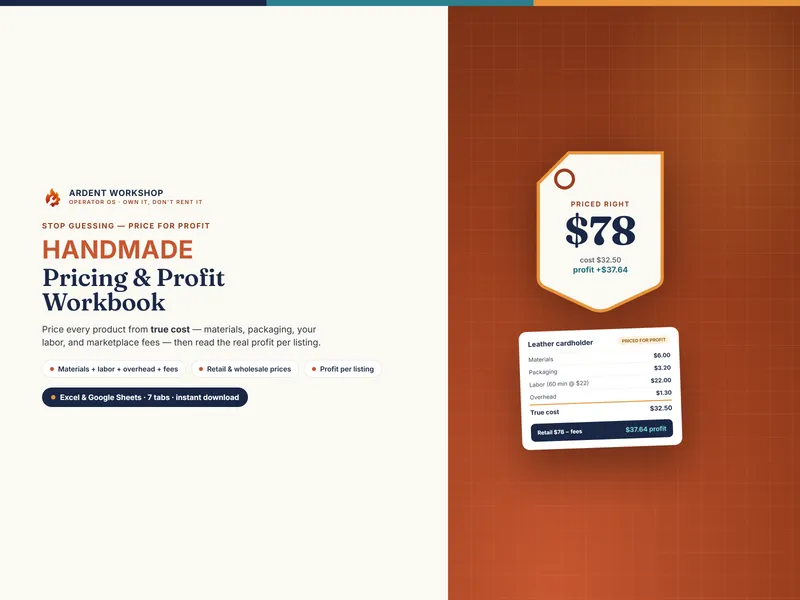
Handmade-Seller Pricing & Profit Workbook — Price Your Craft from True Cost, Markup vs Margin, Marketplace Fees & Wholesale (Excel + Google Sheets)
A handmade pricing workbook for Excel & Google Sheets — price every product from true cost (materials, labor, overhead, fees) and see the real profit on each.
Operator OSView details - $26.95 Spreadsheet

Etsy Seller Toolkit - Excel & Google Sheets
Six tools in one workbook: the price to charge worked back from your costs, profit after every Etsy fee, tag scoring, and pricing against your competition.
Operator OSView details