You had a good conversation. They seemed warm, competent, and easy to talk to, and by the end of the hour you had mostly decided. That feeling is real information — and it is also the least reliable part of the whole process, because it measures how someone performs in a job interview, not how they behave on an ordinary Tuesday three months from now when nobody is watching.
This is one of the highest-stakes hiring decisions a household ever makes — and the one with the least structure around it by default. Hiring at work comes with a job description, more than one interviewer, and a process somebody designed on purpose. Hiring the person who will be alone with your child or your parent for hours at a time comes with none of that unless you build it yourself.
The fix isn’t more suspicion. It’s a small amount of structure: the same questions asked of every family a candidate actually worked for, and a short list of documents checked at the source instead of taken on trust.
If you’re about to make the calls, here are the six, asked of every reference in exactly these words:
- Can you confirm the dates and responsibilities as they described them?
- Would you have them back, if you needed care again?
- Did they turn up when they said they would?
- Were there any surprises around money or hours?
- Tell me about the one time something went wrong — how did they handle it?
- Is there anything you’d want to know, in my position, that I haven’t asked?
There’s more on what each of the six questions confirms and on what to verify, and where below. Everything else here is why those two lists look the way they do.
Two different jobs, not one
References and verification answer different questions, and doing one well does not cover the other. A reference tells you what someone is like to actually have in your house — patient on a bad day, honest when something breaks, good with a frightened kid or a confused parent. Verification tells you whether the things the candidate told you about themselves — their identity, their record, their credentials — are true.
A glowing reference from a family who adored this person tells you nothing about whether their CPR certification lapsed last spring. A clean background check tells you nothing about whether they showed up when they said they would. Skip either half and you’re only half informed, no matter how thorough the half you did was.
Get references from people who actually employed them
Ask directly for the last two or three families, agencies, or facilities the candidate worked with in this kind of role — not a friend, not a former coworker from a different job, and not someone they’d describe as a character reference. A neighbor who likes them is not a family who trusted them with a child, or a parent, unsupervised for a year. The people who actually employed them are the only ones who watched the work closely enough, for long enough, to have something real to say about it.
If a candidate can produce plenty of people who like them but no one who actually employed them for care, treat that as information rather than a technicality — and ask directly where their care experience is documented. Someone early in their career may genuinely have only one or two employers to offer, which is a different situation from someone with years behind them and nobody to call; the question is worth asking plainly rather than inferring an answer.
Choose an accessible reference format
A call allows follow-up questions; written answers may be more accessible or easier to retain. Use an accessible format that works for the reference, and open with something that cannot be answered in one word: “walk me through what a normal Tuesday looked like” produces a story. “Were they reliable?” produces a single syllable and tells you almost nothing.
Give the reference time to answer and ask for concrete examples. Do not treat voice, fluency or hesitation as a reliability test. Written answers can also provide a useful record.
The same six questions, every time
These are the same six listed at the top of the page, with what each answer confirms. Once you’ve got someone on the phone, put them in this order — worded exactly the same way you’ll word them for every other reference, so their answers can actually be compared afterward. Three families each drifting through their own version of a conversation produces three things you can’t lay side by side. Six identical questions, asked the same way three times, produce something you actually can.
| Ask | What the answer confirms |
|---|---|
| Can you confirm the dates and responsibilities as they described them? | The résumé matches what actually happened |
| Would you have them back, if you needed care again? | Whether the reference would rehire; ask for examples rather than interpreting pauses |
| Did they turn up when they said they would? | Reliability, stated plainly rather than inferred |
| Were there any surprises around money or hours? | Whether the working relationship stayed straightforward under the parts that most often go wrong |
| Tell me about the one time something went wrong — how did they handle it? | Judgment under pressure, not just a good week |
| Is there anything you'd want to know, in my position, that I haven't asked? | Whatever the other five questions didn't reach |
What matters most, specifically, for care
Beyond the six, a handful of questions matter more here than they would for almost any other kind of hire:
- What actually happened the day someone got sick or hurt. Sooner or later a long arrangement has one. Ask the reference to walk you through that day specifically: what the caregiver noticed first, what they did before calling anyone, and how quickly they called. How they describe it tells you far more about judgment than any general question about reliability.
- Phone and screen habits during quiet stretches — nap time, television time, the drive. This is a fair, ordinary question, and one an honest reference can answer easily.
- How the caregiver handled disagreeing with how the family wanted something done. Did they raise it directly, quietly do it their own way, or never push back on anything at all? You want someone who says it out loud.
- Why the job ended — asked plainly, then left to sit. Many reasons are entirely ordinary, and a reference can usually say so plainly and unprompted. An unclear answer is a reason to ask a follow-up, not to assume wrongdoing.
What you never ask — and what to do if it comes up anyway
Keep every question, of the candidate and of any reference, off age, race, religion, national origin, disability, pregnancy, family or marital status, and medical history. None of it tells you anything about whether this person will do the job well, and asking about it is a genuinely different category of mistake than a clumsy question.
If a reference volunteers any of it unprompted — and occasionally one will, usually meaning no harm by it — don’t write it down, and don’t let it factor into your decision in any direction. Steer the call back to the six questions and move on.
When a reference goes quiet on one question
Record what was actually said and what remains unanswered. Silence can reflect an employer policy, privacy concerns, language differences or uncertainty; it is not proof of misconduct. Seek clarification and corroborating information without converting a pause into an adverse finding.
What to verify, and where
This section concerns U.S. hiring. First establish whether you, an agency or another organization will employ the person, and which rules cover the arrangement.
- Employment verification. Follow the USCIS Form I-9 instructions (opens in new tab) when I-9 is required. Certain casual domestic work is excepted. Employees choose acceptable documents; do not demand a particular passport or card. Use the prescribed timing and examination procedure, not a blanket identity-document demand for every applicant.
- Employment background reports. FTC and EEOC guidance (opens in new tab) explains disclosure and written permission before obtaining a consumer report. If it may lead to rejection, follow the required pre-adverse-action and adverse-action notices and dispute process. Consent alone is not the whole procedure. Check state and local restrictions, including timing and use of criminal records.
- Driving. If driving is part of the role, confirm a valid license, relevant insurance and any required consent for obtaining a driving record. Establish whose vehicle will be used.
- Credentials. Verify claimed professional licenses with the issuing board. For CPR or first aid, use the issuer’s verification process, match the holder and course, and check expiration. The American Red Cross provides digital certificates (opens in new tab); a physical card is not the only valid format or sufficient verification by itself.
A search-engine result or a clean report does not guarantee safety. Record the source, date and limits of each check. Store sensitive reports securely and restrict access.
The date test that’s easy to skip
A certification that reads current the day you check it can lapse three months into an arrangement nobody expected to run that long. Don’t ask whether it’s current today. Ask whether it will still be current on the date you expect the arrangement to end. If the certification expires before then, that’s a renewal to plan for now, not a surprise to discover later, at the exact moment it would matter most.
A short paid trial, with you there
Once references and verification both check out, pay for a short trial with you home and reachable — not hovering, but present enough to actually see the work. A genuinely ordinary afternoon, with a meal, a nap that doesn’t go to plan, or a small mess, tells you things no phone call ever will, and it costs far less than finding out afterward that you were wrong.
Not legal advice, and not a background-check service
This page is general guidance, not legal advice, and it does not run background checks on your behalf. Consent requirements, what you can act on, and screening rules generally all differ by country, state, and city — confirm what applies where you live before you rely on anything here.
The method, and the workbook that runs it
Doing this well doesn’t require suspicion of every candidate who walks through the door. The point of a structure is the opposite: to be fair to every candidate by asking all of them the same honest questions, in the same order, and checking the same handful of things at the source rather than on trust. You can run the whole method with a phone and a notebook.
The Reference & Vetting Tracker is the paid workbook built around exactly that: the same six probes logged for every reference so their answers can actually be compared, a count of the probes your references disagreed on, and a verification ledger that measures each certificate against the day your arrangement actually ends rather than the day you happened to look. It records what you find; it doesn’t search for anything, and it doesn’t screen anyone.
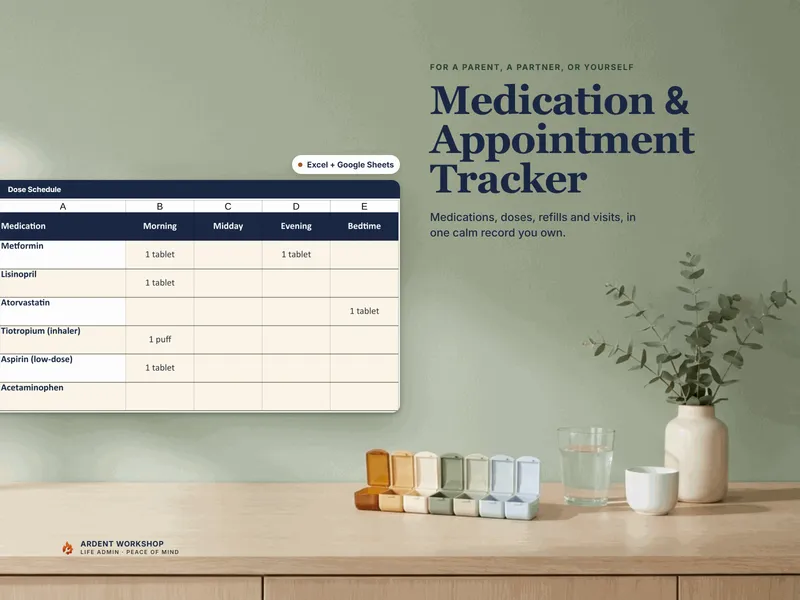
If the bigger question underneath the hire is which kind of care to arrange at all, the Elder-Care Decision Helper weighs in-home care against the alternatives, and the Medication & Appointment Tracker keeps the day-to-day record once someone is in place. All three sit with the rest of the templates for caregivers.
The hardest part of vetting a care provider
It isn’t the phone calls, and it isn’t the paperwork.
It’s asking the same six questions of the second and third reference after the first one already sounded great. That’s the easiest moment to stop checking — and it’s exactly the moment the comparison starts being worth anything.