Sound familiar? You make $80,000. A client, or a friend who freelances, mentions they bill $50 an hour. You do the arithmetic on the back of a receipt: $50 × 40 hours × 52 weeks is $104,000. That’s a raise. Why are you still here?
Because that arithmetic compares two numbers in different units. The salary-equivalent rate is the hourly rate you would have to bill as a self-employed person to end up exactly as well off as you are in your salaried job, with the payroll tax, the benefits and the unbilled hours all counted. For an $80,000 salary, worked through below with illustrative assumptions, it comes out at about $92 an hour. That’s 2.4 times the $38.46 you get by dividing the salary by 2,080, the paid hours in a full-time year (40 hours × 52 weeks).
Without converting your salary to this rate, you end up comparing a pre-tax freelance quote to a salary that has already had half its costs paid by someone else. The Career-Pivot Decision Helper does the conversion for you, path by path, but the method matters more than the tool, so here it is either way.
Why a salary and a freelance rate aren’t comparable
A salary and a freelance rate aren’t comparable because a salary is only part of what a job pays you, and a freelance rate has to pay for all of it.
Three things sit between them:
- Half your payroll tax is invisible. You see the 7.65% Social Security and Medicare taken from your paycheck. You don’t see that your employer pays a matching 7.65% (opens in new tab) on top. Self-employed, you pay both halves.
- A large share of your pay never reaches your bank account. Benefits accounted for 30.0% of private-industry employer compensation costs in June 2026 (opens in new tab), per the Bureau of Labor Statistics. That’s health premiums, retirement contributions, paid leave, insurance and legally required payments. None of it shows up in your salary figure, and all of it stops when you leave.
- Not every hour you work is an hour someone pays for. Your employer pays you for meetings, for email, for the slow Friday afternoon. A client pays for delivered work. Selling, quoting, invoicing, chasing late payments and doing your own books are all yours, unpaid.
The salary-equivalent rate puts all three back in, so the two paths are measured in the same unit. If you’ve already met the total compensation of a job offer, this is the same idea pointed the other way.
How much you need to make self-employed: the salary-equivalent rate formula
The salary-equivalent rate is required revenue divided by billable hours, where required revenue is the profit that leaves you your job’s after-payroll-tax pay and benefits, plus your business costs.
In four lines:
- Job value after payroll tax = salary × 0.9235 + employer health contribution + retirement match + other employer-paid benefits
- Required net profit = job value ÷ 0.8587
- Required revenue = required net profit + yearly business expenses
- Salary-equivalent rate = required revenue ÷ billable hours
The two constants come straight from the tax code:
- 0.9235 is 1 − 0.0765, the employee’s share of FICA, the Social Security and Medicare payroll tax (6.2% Social Security plus 1.45% Medicare).
- 0.8587 is 1 − (0.9235 × 0.153). Self-employment tax is 15.3% (12.4% Social Security and 2.9% Medicare) (opens in new tab), and the IRS says that generally, the amount subject to it is 92.35% of your net earnings (opens in new tab). So it costs about 14.13% of profit, and dividing by 0.8587 grosses your target up to cover it.
Both constants hold below the Social Security wage base, which is $184,500 of combined wages and net earnings for 2026 (opens in new tab). Above it, only the Medicare part keeps applying, and the multipliers shrink.
A worked example: converting an $80,000 salary
Here’s how the math plays out with illustrative numbers. The salary, the match, the expenses and the billable share below are assumptions for the example, not averages; the health figure is a real national average. Swap in your own numbers. Your benefits statement or HR portal, if you have one, may list your employer’s health contribution and match, and last year’s receipts are a good start on expenses.
Step 1: what the job is worth after payroll tax.
- Salary after the employee’s 7.65%: $80,000 × 0.9235 = $73,880
- Employer share of health insurance: the 2025 KFF Employer Health Benefits Survey (opens in new tab) puts the average single-coverage premium at $9,325, of which workers pay $1,440. The employer’s share is $7,885, and that’s what you’d now cover yourself.
- Retirement match, illustrative 4%: $3,200
- Job value: $84,965
Step 2: the profit that leaves you that much after self-employment tax.
$84,965 ÷ 0.8587 = $98,946 of net profit. Self-employment tax on it is about $13,981, which takes you back to $84,965.
Step 3: add what the business costs to run. Software, a laptop every few years, business insurance, a bookkeeper, professional dues: illustratively $6,000 a year. Required revenue: $104,946.
Step 4: divide by the hours a client will actually pay for. Paid time off in a job is already inside the salary. Self-employed, a day off is a day unpaid.
- Days off: illustratively 23 (15 vacation days plus 8 holidays).
- Working hours: 2,080 − (23 days × 8 hours) = 1,896.
- Billable share: illustratively 60%, with the rest going to selling, admin and finding the next client. That’s 1,896 × 60% = 1,137.6, rounded to 1,138 billable hours.
$104,946 ÷ 1,138 = $92.22 an hour.
That’s the salary-equivalent rate. Bill less than about $92 an hour and the self-employed path pays you less than the job you already have, before you’ve weighed anything else about it.
How the billable share changes your salary-equivalent rate
The billable share moves the salary-equivalent rate more than any other input, and it’s the one people guess most optimistically.
| Billable share | Billable hours a year | Salary-equivalent rate | Multiple of salary ÷ 2,080 ($38.46) |
|---|---|---|---|
| 50% | 948 | $110.70 | 2.9× |
| 60% | 1,138 | $92.22 | 2.4× |
| 70% | 1,327 | $79.09 | 2.1× |
| 80% | 1,517 | $69.18 | 1.8× |
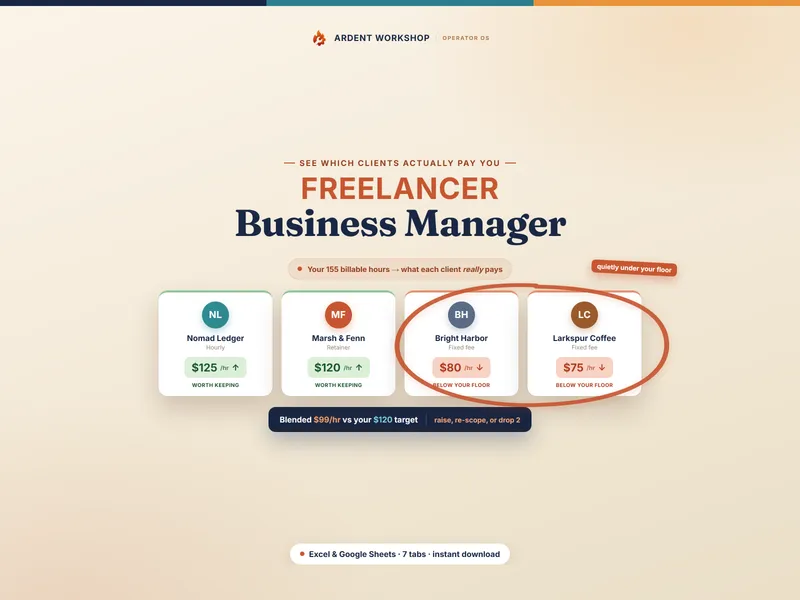
Going from 80% billable to 50% raises the rate you need by about $42 an hour. The fair question to ask yourself isn’t “what can I charge?” but “how much of my week will someone actually buy?” If you’re tracking that once you’ve made the leap, the Freelancer Business Manager logs billed against worked hours, which is the effective hourly rate this table is predicting.
The salary-equivalent rate at three salary levels
Holding the worked example’s other assumptions fixed at 60% billable, a $60,000 salary needs about $72.50 an hour, $80,000 needs $92.22 and $100,000 needs $111.94.
| Salary | Salary ÷ 2,080 | Required revenue | Salary-equivalent rate | Multiple of salary ÷ 2,080 |
|---|---|---|---|---|
| $60,000 | $28.85 | $82,505 | $72.50 | 2.5× |
| $80,000 | $38.46 | $104,946 | $92.22 | 2.4× |
| $100,000 | $48.08 | $127,386 | $111.94 | 2.3× |
The multiple falls slightly as the salary rises because the health premium is a fixed dollar amount, so it’s a bigger share of a smaller paycheck.
What the salary-equivalent rate leaves out
The salary-equivalent rate is a floor for matching your current life, not a full verdict on whether to leave. It deliberately leaves out several things:
- Income tax. It lands on both paths, so the model leaves it off both sides. Two rules tilt it toward self-employment: you can deduct one-half of your self-employment tax (opens in new tab) when figuring adjusted gross income, and you may be able to deduct up to 20 percent of qualified business income (opens in new tab). Leaving both out keeps the rate slightly conservative. Once profit is high enough, an S corp election changes the math again; when an S corp makes sense has that break-even.
- The first year. The rate assumes a full year of steady work. For a new business, that shouldn’t be assumed. Runway, meaning how many months of savings cover the gap while you ramp up, is a separate question.
- Risk you can’t price as a premium. Disability cover, the stability of one employer versus many clients, and how payment delays hit your cash flow all matter, and none of them fit in an hourly rate.
- Everything that isn’t money. Autonomy, commute, the work itself. These are real reasons to leave at a lower rate. They should be a choice you make knowingly, not a gap the arithmetic hid from you.
That last point is why the rate works best as one input to the decision, not the whole decision. The Career-Pivot Decision Helper computes the money criteria (total compensation, effective hourly rate, and a first year that goes 40% worse than planned) and then has you weigh the ten criteria that aren’t money against them. If your side business is already earning and you’re deciding when to make it full-time, the benchmarks in going from side hustle to full-time pick up where this rate leaves off.
Common questions about the salary-equivalent rate
Is the salary-equivalent rate the same as dividing my salary by 2,080?
No. Salary divided by 2,080 is what your employer pays you per paid hour. The salary-equivalent rate is what a client has to pay you per billed hour, after you have covered both halves of payroll tax, bought your own benefits, paid your business costs and absorbed the hours nobody pays for.
Why does self-employment tax cost so much more than the FICA on my paycheck?
Because you pay both halves. An employee pays 7.65% and the employer quietly pays another 7.65%. A self-employed person pays the full 15.3%, on 92.35% of net earnings, so the effective rate on profit is about 14.13%.
Does this include income tax?
No, and on purpose. Income tax lands on both paths, so the model leaves it off both sides. Two rules do tilt it toward self-employment: you can deduct half of your self-employment tax, and you may qualify for the deduction of up to 20% of qualified business income. Leaving both out makes the rate slightly conservative.
What billable share should I assume?
Use your own evidence if you have any: a side business, a past contract, a friend’s books. If you have none, model 50% and 70% and treat the gap between them as the honest uncertainty. Planning on 80% or more in your first year leaves little time for finding clients and running the business. For an $80,000 salary with illustrative assumptions, an 80% billable share lowers the rate you would calculate from about $92 at 60% to about $69 an hour, which can leave you underpriced if your real share turns out lower.
Do the conversion before you do the daydreaming
The leap might still be right. Some people take a lower effective rate for work they’d rather do, and that’s a legitimate trade. What isn’t legitimate is making it by accident, because $50 an hour sounded like more than $80,000 a year.
Work out your salary-equivalent rate first. Then score everything else. The Career-Pivot Decision Helper was built for exactly that order: convert first, then weigh up to six paths side by side, in one file you own instead of another subscription.