
The four quadrants
SWOT splits the world along two axes: internal vs. external, and helpful vs. harmful. That gives four cells, and every observation you make about your situation belongs in exactly one of them.
- Strengths — internal, helpful. Capabilities, assets, relationships, and reputation you can lean on.
- Weaknesses — internal, harmful. Gaps in skills, tooling, capacity, or process that hold you back.
- Opportunities — external, helpful. Market shifts, partnerships, customer needs, or trends you could ride.
- Threats — external, harmful. Competitors, regulation, economic conditions, or technology shifts that could hurt you.
The internal/external split is the part most beginners get wrong. A competitor launching a product is a threat (external). A skills gap that prevents you from responding is a weakness (internal). Same event, two different cells.
What SWOT is actually for
SWOT is often dismissed as a brainstorming exercise, but its real job is to force pairing. The interesting strategy isn't in the quadrants — it's in the crossings:
- Strength × Opportunity (S-O). Where do our strengths let us capture an opportunity? These are the moves to make now.
- Strength × Threat (S-T). Where can our strengths defend against a threat? These are the moats to harden.
- Weakness × Opportunity (W-O). Where does a weakness stop us from grabbing something good? These are the gaps to close first.
- Weakness × Threat (W-T). Where does a weakness leave us exposed to a threat? These are the survival items.
When to run one
- Annual planning or quarterly strategy review.
- Before pitching a new initiative, business plan, or grant application.
- When a competitor enters the market and the team needs a shared read.
- After a major customer loss or organizational change.
- As part of a project kickoff — most projects have their own SWOT.
How to run a SWOT in thirty minutes
- Pick a clear subject. "Our company" is too broad — "Q3 launch of Product X" or "our position vs. Competitor Y" gives a sharper analysis.
- Brainstorm individually first (five silent minutes per quadrant). Group brainstorming front-loads loud voices.
- Combine and de-duplicate. Aim for 3–7 items per quadrant.
- Sort each quadrant by impact. The chart only stays readable if every cell has the top items.
- Run the four pairings — S-O, S-T, W-O, W-T — and pull out one action for each. That's your strategy output.
Common mistakes
- Confusing internal with external. "Customers don't know about us" is a weakness (we haven't marketed), not a threat.
- Listing without prioritizing. A quadrant with 20 items is unreadable. Trim to the top half-dozen.
- Stopping at the quadrants. The diagram is the input, not the output. The output is the pairings.
- One-time use. Markets shift. A SWOT from a year ago describes a company that no longer exists.
- Vagueness. "Strong team" is a placeholder, not an insight. "Two senior PMs with payments-domain experience" is.
Related templates and concepts
SWOT pairs naturally with a gap analysis (turning the weakness column into closable gaps) and a risk register (turning the threat column into trackable risks). For more strategy tools, see the templates for project managers hub.
Templates that implement this
Templates that build a SWOT
2 templates
A four-quadrant grid, color-coded fields, and a built-in chart that visualizes the balance — so the SWOT becomes a working document, not a one-off slide.
- $3.95 Excel
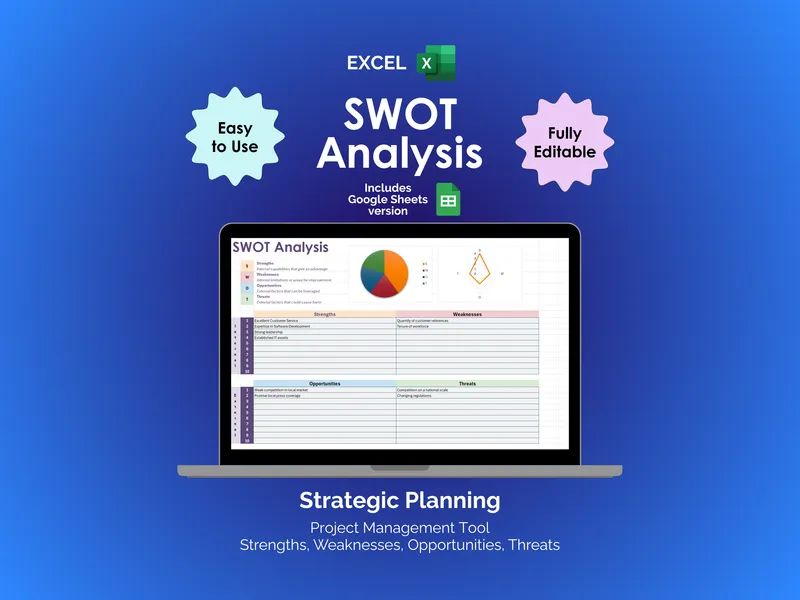
SWOT Analysis - Excel
Staring at a blank page trying to map your strategy? This excel swot analysis template gives you a four-quadrant layout, color-coded fields, and built-in charts.
Project ManagementView details - $3.95 Sheets
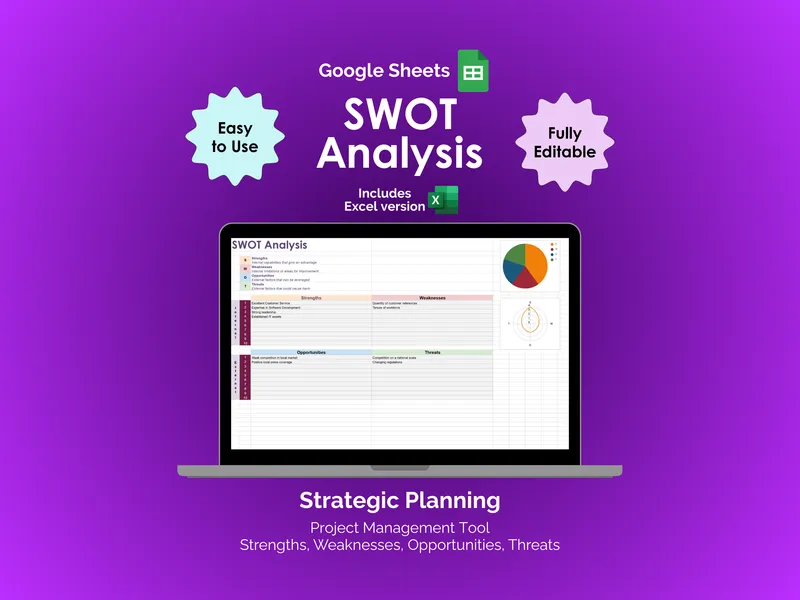
SWOT Analysis - Google Sheets
Every SWOT eventually dies in a sticky-note pile. This google sheets swot analysis template turns four quadrants into a live chart you can defend in a meeting.
Project ManagementView details