Inventory cost and a profit estimate answer different questions
For U.S. business tax reporting, IRS Publication 334 explains inventory, cost of goods sold and business expenses. Acquisition costs and freight-in can belong in inventory cost; packaging is not automatically cost of goods sold merely because it was used for a sale. The accounting method and nature of the cost matter.
For your own pricing decisions, a broader estimate can allocate a share of selling and travel costs to each item. Label that figure as an estimated total cost, and preserve its components so it is not mistaken for a tax classification.
Keep supplies and travel identifiable
- Record the item's purchase price and any separately identifiable acquisition costs.
- Record preparation materials, packaging, platform fees and shipping separately.
- Keep the date, distance and business purpose of sourcing trips. An allocation to an item does not itself substantiate a deduction.
IRS business-car guidance sets out mileage-method eligibility and recordkeeping. A planning allocation must not lead to deducting the same travel cost both through inventory and again as a vehicle expense.
An illustrative per-item calculation
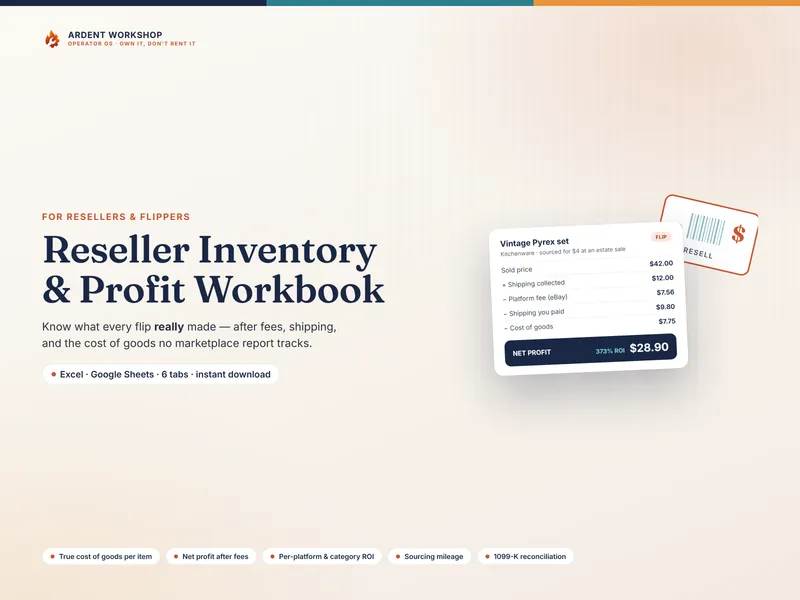
Suppose an item sells for $40, with a $10 purchase price, $6 in selling fees, $5 in net shipping, $2 in packaging and $3 in allocated sourcing costs. That leaves an estimated $14 before other overhead and taxes. This is a management calculation, not a tax-return line or a determination of deductible costs.
State which costs you include when comparing profit or ROI across items. Keep actual receipts and trip records behind estimates. The Flip-Profit Calculator can help explore the arithmetic; it does not decide tax treatment.
Reconcile sales and records separately
IRS Form 1099-K guidance explains that gross payment reporting does not account for every adjustment or expense. Reconcile the form to transaction records, refunds and fees, then determine income and eligible costs using the applicable rules. Do not subtract one all-inclusive workbook total without checking how its components are reported.
Common recordkeeping mistakes
- Calling a profit-planning estimate tax basis without checking the accounting treatment.
- Counting the same packaging, shipping or travel cost in two categories.
- Keeping only totals rather than receipts and transaction details.
- Assuming personal-item sales and business inventory follow identical rules.
This page concerns general U.S. recordkeeping. Use guidance for your tax year and have your preparer confirm classifications and the accounting method.
Related templates and concepts
Inventory costs connect to cost of goods sold — and, together with selling and other costs, help explain the profit margin that decides whether a flip paid. To see when a workbook is enough and when monthly reseller software earns its keep, read spreadsheet vs reseller inventory software, follow the how to track reselling profit tutorial, or browse every tool on the templates for resellers and flippers hub. You own the workbook outright — you don't rent it by the month.
Templates that implement this
Track the costs behind each flip
1 template
A workbook for recording purchase costs, supplies, sourcing trips, fees and sale proceeds. Its per-item calculations support profit planning; confirm tax classifications separately.