Sources checked September 28, 2026. This is a source check, not professional review.
This isn't really spreadsheet-versus-software. It's "the right tool for where your reselling is today." Most flippers should start on an owned workbook and stay there longer than the app companies would like — knowing the true profit on every flip is a solved problem in a spreadsheet. The skill is recognizing the day the file flips from saving you time to quietly costing you time — and not subscribing a moment before.
When an owned workbook is exactly right
- You want the true cost of every flip — purchase price, supplies and a share of sourcing mileage — in one place.
- You want fee inputs you can compare with actual marketplace statements and update when needed.
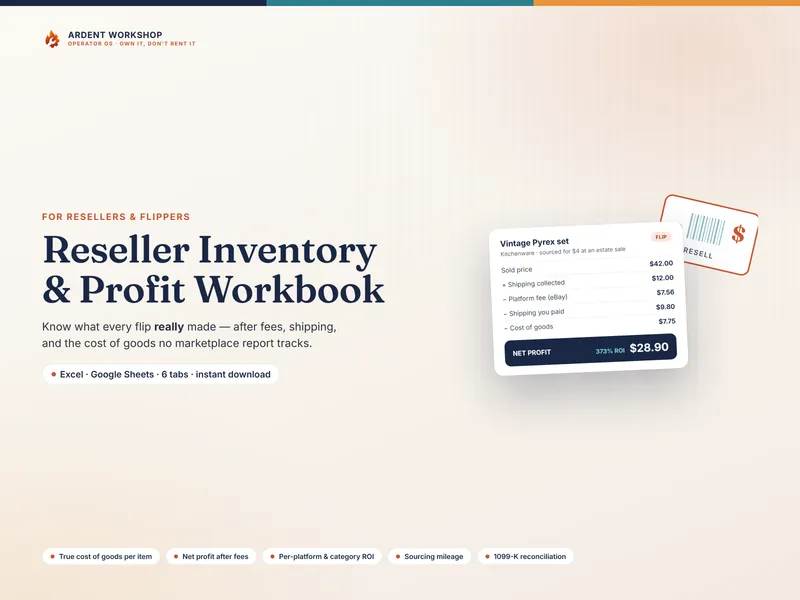
- You want net profit and ROI per item, rolled up by platform and category.
- You want separate transaction and expense records for reconciliation and tax preparation.
- You list mostly one-of-a-kind items, so the same SKU rarely needs to live on five marketplaces at once.
- You want something private, cheap, and bent exactly to how you flip.
At this stage an owned workbook beats software outright. It costs once, it's yours, and there's no subscription or onboarding. The resellers and flippers hub collects the tools built for exactly this phase, and the free Flip-Profit Calculator is a no-signup taste of the math.
The signals you've outgrown it
You don't decide to switch — the volume tells you. The tells:
- You re-type the same listing five times. The same item goes onto eBay, Poshmark, Mercari and more, by hand, every time.
- You've oversold. Something sold on one platform and you forgot to pull it from the others, and a buyer paid for stock you no longer have.
- Stock counts drift across channels. What's listed where is something you reconstruct, not something you can see at a glance.
- Relisting and sharing eat your evenings. Bumping, sharing and re-sharing listings across apps is a manual chore that scales with the catalog.
- "What's in stock and where?" takes an afternoon. Across hundreds of live listings, the cross-referencing eats the time the file was meant to save.
One or two of these is normal. All of them, every week, is the volume telling you it's time to add a cross-listing tool.
Side by side
| What matters | Owned profit-and-inventory workbook | Reseller inventory software |
|---|---|---|
| Cost | One-time, low — you own it | Ongoing subscription, often tiered by listing count |
| Allocated item costs | Full — purchase price, supplies & a share of sourcing mileage | Varies — some include profit/COGS; others keep it lighter or as an add-on |
| Per-platform fees | Per-platform inputs; verify current charges and fee bases | Pulled from connected accounts where supported |
| Profit & ROI per item | Netted per flip, rolled up by platform & category | Varies — some net per-item profit; many focus on listing and sync |
| Cross-listing to marketplaces | You list on each platform by hand | Cross-listing where supported; check each integration |
| Sell-through sync | You de-list manually when an item sells | May de-list on supported channels; check timing and failures |
| 1099-K reconciliation | Dashboard supports reconciliation; verify adjustments and categories | Usually export your data and reconcile elsewhere |
| Best for | Knowing real profit; mostly one-of-a-kind listings | High-volume cross-listing where live sync is the bottleneck |
The honest middle ground
Plenty of resellers run on an owned workbook far longer than they "should" — and that's fine, because the workbook is free of subscriptions and bent exactly to how they flip. The hidden cost only becomes real when the hours you spend re-listing and re-syncing across channels exceed what software would cost. Track that honestly and the decision makes itself.
Know your real profit either way
A purchase-and-supplies subtotal can help estimate a flip's contribution, but it is not a universal tax category. Keep pricing inputs and expense records separate. IRS Publication 334 explains inventory accounting; IRS Form 1099-K guidance explains gross reporting and reconciliation. Do not treat one dashboard total as a completed tax calculation.
See the workbook's method end to end in the how to track reselling profit tutorial, run a single flip through the free Flip-Profit Calculator, or browse every tool on the resellers & flippers hub.
Frequently asked questions
- When should a reseller move from a spreadsheet to inventory software?
- When the catalog is large and turns over fast enough that keeping the same item listed and in sync across several marketplaces by hand becomes the bottleneck. The tells: you're re-typing the same listing into eBay, Poshmark and Mercari; an item sells on one platform and you forget to pull it from the others, risking an oversell; and a 'what's actually in stock and where is it listed?' question takes an afternoon. Until then, an owned profit-and-inventory workbook usually does the job for a one-time cost.
- What can reseller inventory software do that a spreadsheet can't?
- Some reseller services offer cross-listing, sales imports and automatic delisting for supported marketplaces. Check integrations, sync delays and failure handling before relying on them. A basic workbook needs manual updates unless you add a separate integration. Neither approach guarantees that an item cannot oversell.
- Is a spreadsheet good enough for tracking reselling profit?
- A workbook can estimate contribution and ROI from separately entered purchase costs, supplies, sourcing allocations, fees and sales. Keep those components separate for tax preparation: a planning total is not automatically deductible COGS. Verify actual marketplace charges and reconcile transactions to payment reports. Add software when its supported integrations save enough manual work to justify the cost.
- How much does reseller inventory software cost vs a workbook?
- An owned profit-and-inventory workbook is a single low cost you keep forever; cross-listing and reseller inventory SaaS is typically a recurring monthly subscription, sometimes tiered by how many listings you carry. The subscription earns its keep once the hours it saves on cross-listing and sync exceed what it costs — but paying monthly before you're cross-listing at volume usually buys capability you're not using yet.