Skip Navigation

How to Track Your Reselling Profit on a Flip

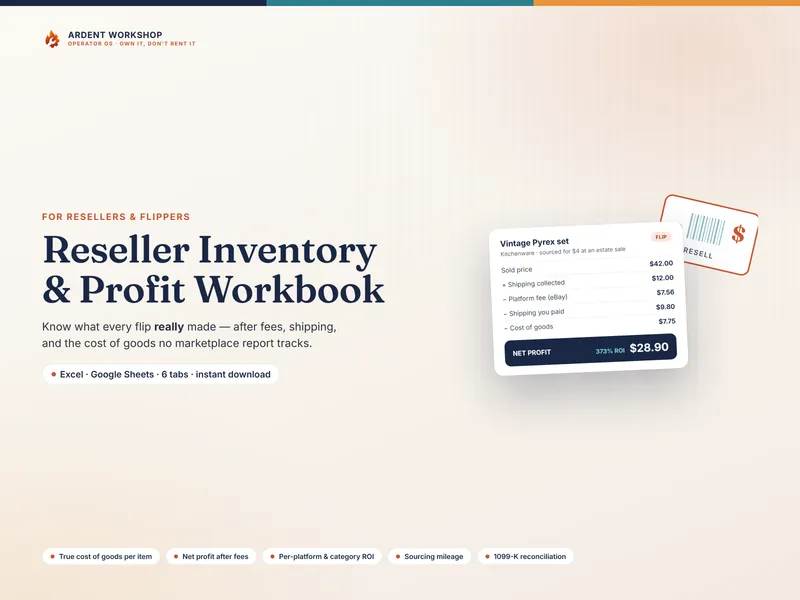
A sale isn't profit. The price a buyer pays runs a gauntlet — the platform fee, the shipping you paid, and the true cost of the item — before any of it is yours. Here's a full flip costed the same way the Reseller Flipping Inventory & Profit Workbook costs it, so you can see exactly where your real profit and ROI come from.

The figures below are an illustrative example to show the method — not a guarantee of what any item makes. Your purchase prices, supply costs, sourcing miles and platform fees will differ, which is exactly why a workbook you can change beats a number someone else picked.

Step 1 — Build the true cost of goods

Before any sale math, you find what the item truly cost you to have ready to ship. That’s never just the tag price. Take a $4 Pyrex set found at a thrift store. To get it sold you also spent on packaging, and you burned gas finding it. The true cost of goods is all three:

Cost of goodsAmount
Purchase price (thrift)$4.00
Supplies (box, bubble wrap, tape, label)$2.50
Share of sourcing mileage$1.25
True cost of goods$7.75

The mileage line is the one resellers skip. A sourcing trip rarely yields one item, so the drive’s cost gets spread across everything you found — value it at a per-mile rate and give each keeper a fair slice. We’ll build each number by hand below so the method is clear; the Reseller Flipping Inventory & Profit Workbook does the same in one linked file if you’d rather not start from a blank sheet.

Step 2 — The sale and the shipping the buyer paid

The item sells for $42, and the buyer pays $12 for shipping. That’s $54 of money arriving in your account — but almost none of it is profit yet. Two things still come out before the cost of goods: the platform’s fee and the label you buy.

Step 3 — The platform fee

Every marketplace takes a cut, and most charge it on the full amount the buyer paid — the item and the shipping. Sell on eBay at a 13.25% final-value fee plus a $0.40 per-order fee, and the fee is calculated on the whole $54:

  • 13.25% of $54 = $7.155
  • plus the $0.40 fixed fee
  • = a platform fee of $7.555, which shows as $7.56 rounded

Different platforms charge differently — Poshmark, Mercari, Whatnot, Depop, Facebook and Etsy each have their own rate — which is why the workbook keeps a fee for each one and applies the right one per flip instead of you guessing.

Step 4 — The shipping you actually paid

You charged the buyer $12, but the label from the carrier cost you $9.80. So shipping didn’t cost you anything on this flip — you came out $2.20 ahead on shipping. On many flips it goes the other way: free shipping you offered, or a heavy item that cost more to send than you collected. The point is to track the label you paid, separately from the shipping you charged.

Step 5 — Net the profit and the ROI

Now stack it all up. Start from the money that came in, then subtract the fee, the shipping you paid, and the cost of goods:

Net profitAmount
Sale price$42.00
Shipping charged to buyer+$12.00
Money received$54.00
eBay fee (13.25% + $0.40)−$7.56
Shipping you paid−$9.80
True cost of goods−$7.75
Net profit$28.90

Each line is rounded to the cent for display; the fee is exactly $7.555, so the net works out to $28.895 and rounds to $28.90 — adding the rounded rows by hand lands a penny off.

That $28.90 is the real number — not the $42 sale price, and not the $54 that hit your account. And the figure that tells you whether the flip was worth it is ROI: net profit divided by cost of goods.

  • ROI = net profit ÷ cost of goods = $28.90 ÷ $7.75 = 373%

A 373% ROI on a $7.75 cost of goods is an excellent flip. Notice it’s the small cost basis that makes the ROI shine — a $42 sale on an item that cost you $35 to acquire and ship would net far less and return a fraction of the ROI. You can run any single flip through the free Flip-Profit Calculator to see the fee, the net shipping and the profit without doing the arithmetic by hand.

Why this also matters at tax time

The marketplaces report your gross sales to the IRS on a Form 1099-K — that $54, not your $28.90. Without a record of what you spent, the gross figure is all you can show. The cost of goods, the fees and the shipping you logged on every flip are the costs that bring that gross number down toward what you actually made. Track them through the year and reconciling the 1099-K is a dashboard view; skip them and it’s a spring spent reconstructing thrift receipts from memory.

This explains how the records work, not how to file — it isn’t tax advice. Reporting thresholds, business-versus-hobby rules, and how mileage and other costs are deducted differ by country, state and year; confirm how they apply to you with a tax professional or your tax authority.

Track every flip in one connected file

Every number above lives on a scrap of paper or in your head for most resellers — which is how a forgotten mailer or an un-counted sourcing mile turns a 373% flip into a number you only think is good. The Reseller Flipping Inventory & Profit Workbook runs this exact flow — true cost of goods, the right per-platform fee, net shipping, net profit and ROI — for every item, then rolls it up by platform and category and reconciles the whole year to your 1099-K. It ships with this Pyrex flip already built as an example. You own the workbook outright in Excel and Google Sheets — you don’t rent it by the month. When the catalog outgrows a spreadsheet and live cross-listing across marketplaces becomes the bottleneck, it graduates to Ardent Seller, the maker-first inventory and sales app — see spreadsheet vs reseller inventory software for where that line is, or browse the resellers & flippers hub.

Where we fit

Most tools force a choice between a blank spreadsheet you build from scratch and a monthly app that's overkill. Ardent Workshop is the rung in between — structure you own.

  1. Blank spreadsheet

    Free, but you build and maintain every formula, tab and layout yourself.

    • Free
    • Infinite setup
    • No structure
  2. You are here

    Ardent Workshop

    Owned, structured, connected workbooks — a one-time price, yours to keep.

    • One-time price
    • Structured & connected
    • Yours to own
  3. Generic SaaS app

    Powerful, but overkill, rented and locked-in — built for someone bigger than you.

    • Monthly rent
    • Overkill
    • Lock-in

Running an operation that's genuinely outgrown the file? Ardent Seller isn't the generic SaaS app this ladder warns about — it's maker-first software built by the same workshop: your data stays yours, you can start free or pay as you go with no subscription required, and it's sized for your operation, not someone bigger. The platform to graduate to when a spreadsheet honestly can't keep up.