This page describes U.S. public-school rules. 34 CFR 300.320 specifies IEP content, including present levels, measurable goals, services and progress reporting.
What's in an IEP
An IEP is a specific, structured document. Under the federal Individuals with Disabilities Education Act (IDEA), a public-school IEP generally includes:
- Present levels of performance — where the student is now, academically and functionally.
- Annual goals — measurable goals for the year, and how progress toward each is measured and reported.
- Special-education and related services — the specialized instruction and services such as speech, occupational, or physical therapy, with the frequency and minutes for each.
- Accommodations and modifications — the supports in class and on tests, from extended time to a separate testing setting to assistive technology.
- Placement — the setting where services are delivered, and time in the general-education classroom.
- Dates and review — when services start, an annual review at least once a year, and a reevaluation at least every three years unless the parent and public agency agree it is unnecessary.
IEP vs 504 plan
An IEP is developed under IDEA for an eligible student. Section 504 is a different civil-rights framework with different eligibility and procedures. It is not limited to classroom accommodations: the Department of Education's Section 504 guidance describes regular or special education and related aids and services. Keep the plan and safeguards for the framework that applies to your child.
How a student gets an IEP
Following evaluation and eligibility determination, the IEP team includes parents in developing the plan. Under 34 CFR 300.324, review occurs at least annually; parents and the agency can also agree to amend it without another team meeting. 34 CFR 300.303 sets reevaluation requirements, including the exception when both agree that a three-year reevaluation is unnecessary.
Prior written notice covers proposed or refused changes to identification, evaluation, placement or the provision of a free appropriate public education; it is not simply a transcript of every meeting.
An IEP binder is not the IEP — or legal advice
This is the important distinction. The current IEP is the legally governed plan. Changes must follow the IDEA process, including permitted amendments agreed by the parent and agency. A family's IEP binder is an organized copy of the records a family is entitled to keep — it makes the plan easy to carry, honor, and remember, but it doesn't replace the current plan or the school's file, and it isn't legal or educational advice. For a dispute, families often consult a special-education advocate or attorney; the binder's job is to keep the record clear so those conversations start from facts.
Keep your own copy of the records
Because an IEP generates years of paper — evaluations, prior plans, progress reports, and meeting notes — the families who feel in control are the ones who keep their own organized copy. The rule that keeps it safe to share is to record what the child needs and where documents live — never a school- or parent-portal login or a full student ID number. That's the same owned-record logic behind a caregiver binder.
Where to start
Begin with the free IEP Meeting Prep Sheet — the one page to fill in before your next meeting — then organize the rest in a binder you own. See how a binder compares to a subscription tool in IEP binder vs a special-education app, or the step-by-step in how to organize your records for an IEP meeting. This is a record-organizing approach — not legal, medical, or educational advice.
Templates that implement this
Organize your child's IEP records
3 templates
A workbook that organizes the accommodations, evaluations, therapy schedule, providers, and meeting notes for a child's IEP or 504 plan — the records your family keeps, in a file you own.
- $24.95 Spreadsheet
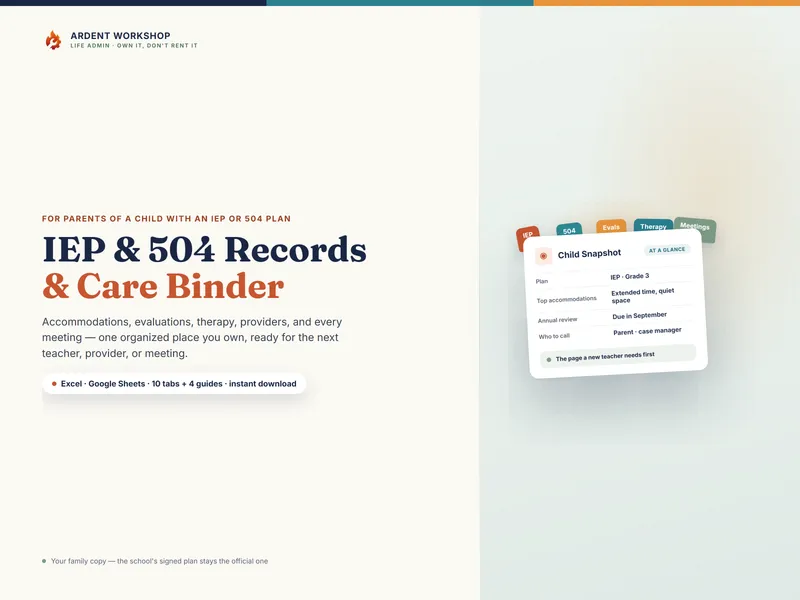
Special-Needs / IEP Records & Care Binder — Accommodations, Evaluations, Therapy & Meeting Notes Organizer (Excel + Google Sheets)
An IEP records binder — organize accommodations, evaluations, therapy, providers, and meeting notes for your child's IEP or 504 plan in one file you own.
Life AdminView details - $24.95 Spreadsheet

Caregiver / Aging-Parent Care Binder — Medications, Refill Status, Appointments & an Emergency Handoff Sheet That Writes Itself (Excel + Google Sheets)
Caregiver binder for an aging parent: medications flagged Order now or Due soon by refill date, appointments, care team and documents — plus a self-writing emergency handoff sheet.
Life AdminView details - $29.95 Spreadsheet
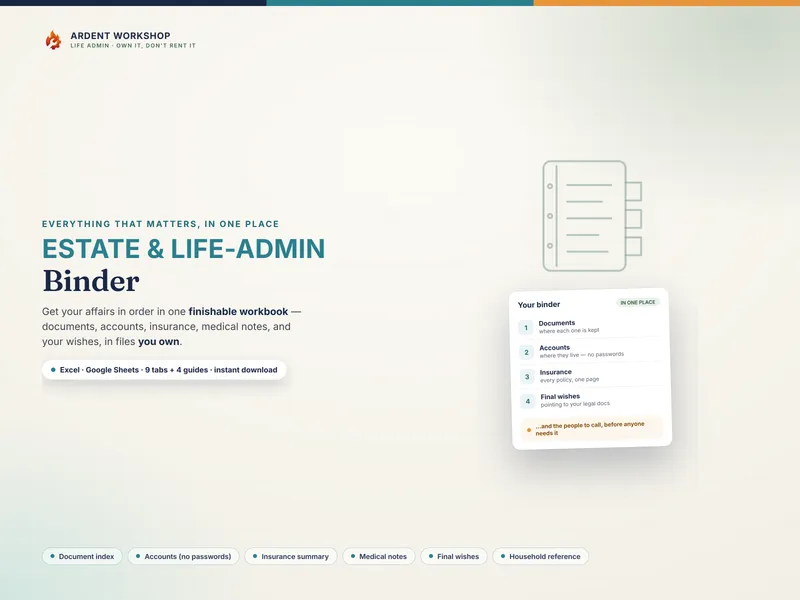
Estate & Life-Admin Binder — Important Documents, Accounts, Insurance & Final Wishes Organizer (Excel + Google Sheets)
An estate & life-admin binder for Excel & Google Sheets — organize important documents, accounts, insurance, and final wishes in one file you own.
Life AdminView details