
What you need
- A group of friends. We suggest four or more friends, and five or more makes the votes more fun.
- A list of categories. Ten to twelve is plenty for one sitting. Each one starts with "Most likely to...".
- A way to vote. Paper ballots and pens, or nothing at all if you point on three.
- A way to count. A tally sheet, a whiteboard, or a spreadsheet that does it for you, like the free Most Likely To ballots and winner tally.
- A numbered slip for each guest. You will only need these for the tie-break, but hand them out before voting starts.
Before the first category, tell everyone the tie-break rules below and whether votes for yourself are allowed, so the rules are the same for everyone.
How a round works
- Read a category. For example, "Most likely to talk their way out of a parking ticket."
- Everyone votes for one friend. Use a secret ballot, where each guest writes or ticks one name, or have everyone point at their choice on the count of three. Both work. Secret ballots keep the answers a surprise until the reveal, and pointing is faster and louder. Guests can vote for anyone, including themselves. A self-vote counts like any other.
- Count the votes. The friend with the most votes wins the crown for that category.
- Announce the winner, let them take a bow, and read the next category.
A friend can win any number of crowns over a night, so keep a running tally of who has won what. You will need it if two friends ever tie.
Counting votes and crowning a winner
Count the votes for each name, with a tick mark per vote on your tally sheet. The highest count wins. If a friend gets five votes and nobody else gets more than two, she takes the crown. That is the whole job. Ties are where a party game can stall, so the next section covers them.
The tie-break, in order
When two friends tie on votes, settle it with a rule everyone heard before the game began, so nobody has to referee:
- Rule 1: fewest crowns already won. The tied friend with the fewest crowns from the earlier categories takes it. This spreads the crowns around the table.
- Rule 2: lowest draw number. If they are still tied, the tied friend with the lowest draw number wins. Draw numbers are assigned before any voting: pass a hat of numbered slips, from 1 up to however many of you there are, as guests arrive.
We suggest a stated rule over a re-vote. A re-vote can invite campaigning, and the second round can tie again, while a rule fixed before anyone knew who would tie leaves little to argue about.
Worked example one
Suppose that on "Most likely to cry at a commercial," Rosie and Elena get three votes each. Neither has a crown yet, so Rule 1 cannot separate them. Under Rule 2, Elena drew number 1 and Rosie drew 3, so Elena takes the crown.
Worked example two
In the same example party, on "Most likely to talk their way out of a parking ticket," Tasha and Dani get three votes each. Tasha already holds a crown from an earlier category, and Dani does not. Rule 1 applies: Dani has fewer crowns, so Dani takes it.
Scoring across a night
Most Likely To works on its own, but it also fits a bigger game night. Give each crown a point value, add it to the points from the other games, and give a prize to whoever finishes on top. One option is 3 points per crown and 1 point per correct answer in a quiz or trivia round, so no single game decides the night.
If two guests finish on the same overall total, use this overall tie-break, in order:
- More crowns. The guest with more Most Likely To crowns ranks higher. Unlike the round tie-break, here more crowns means a stronger night, so it counts in her favor.
- Lowest draw number. If that is level too, the lowest draw number wins.
Using the same draw number throughout keeps every tie fair and fast.
Keeping categories PG and kind
The best Most Likely To categories celebrate something about a friend that she would laugh at herself. A few guidelines:
- Pick habits, not bodies. "Most likely to be late to her own party" is fine. Anything that singles out someone's looks is not.
- Leave money and sensitive topics out. Skip categories about income, spending, relationships, health or anything that could land on a sore spot.
- Let people pass. Anyone can skip a category without explaining why.
- Keep one wildcard. Leave a blank ballot row, or let anyone call out one extra category, so guests can invent one on the spot. It follows the same guidelines, and anyone can still pass.
Variations
- Galentine's. Use categories that cheer each friend on, then hand out crowns, small prizes or a toast to the winners.
- Girls' night. Mix silly categories with a few sweet ones, and play between courses or during a movie break.
- Office-friendly. Keep every category about work habits and harmless quirks, like "Most likely to answer an email at midnight," and let anyone sit a category out.
- Pointing version. No ballots and no pens. The host reads a category, counts to three, and everyone points. Count the fingers and keep a tally.
Paper ballots, a workbook, or a party app
Paper ballots cost almost nothing and work well for a small group, but you count them by hand and track the crowns and ties yourself. A workbook can do the counting for you. A party app takes the counting away too, though some party apps are subscriptions, some need a phone for every player, and some only know the categories they ship with.
The Galentine's & Girls' Night Game Pack is the workbook route, and you own it. It is an Excel and Google Sheets workbook with printable game books, in Letter and A4. You type each friend's answers once, and the workbook builds a shuffled "Whose Answer Is It?" quiz about your own group, with its answer key. It prints Most Likely To ballots with your friends' names already on them, counts the votes with the stated tie-break above, and totals every guest's score across the games for prize time. It is a file you keep, not an app you rent.
To try the voting part first, the free Most Likely To ballots and winner tally has the ballots and an automatic tally, pre-filled with an example group of eight invented friends.
Related: for keeping score at a card game night, see how Hand and Foot is scored.
Templates that implement this
Ballots, counting and tie-breaks you keep
3 templates
A Galentine's and girls' night game workbook that prints your ballots and counts the votes, plus score pads and a trivia pack for the rest of the night.
- $3.95 Spreadsheet
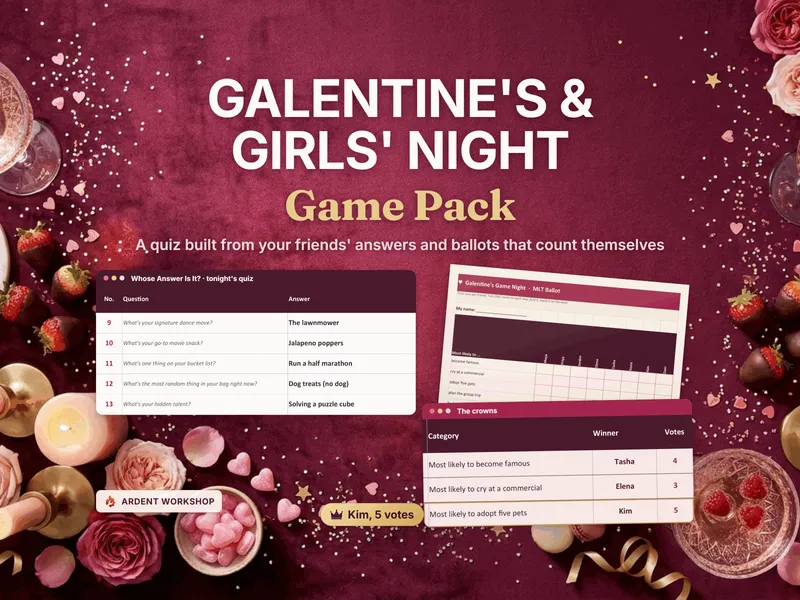
Galentine's & Girls' Night Game Pack — Friends Quiz & Most Likely To Ballots, Excel & Google Sheets
Girls' night and Galentine's games: a quiz built from your friends' own answers, Most Likely To ballots that count themselves, and printable game books.
TrackersView details - $3.95 Spreadsheet
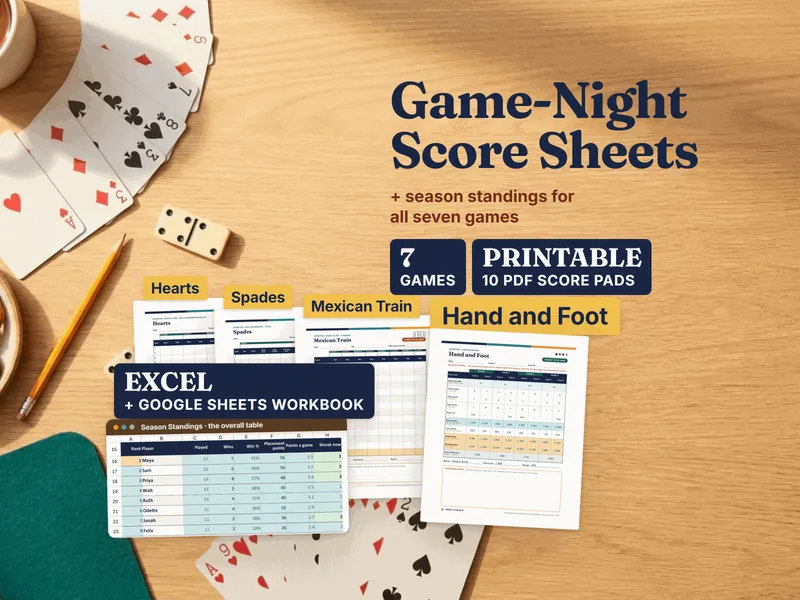
Game-Night Score Sheets & Season Standings — Hand and Foot, Mexican Train & More
Printable Hand and Foot, Mexican Train, Spades and Hearts score sheets, plus an Excel & Google Sheets workbook that keeps season standings for every game.
TrackersView details - $3.95 Spreadsheet
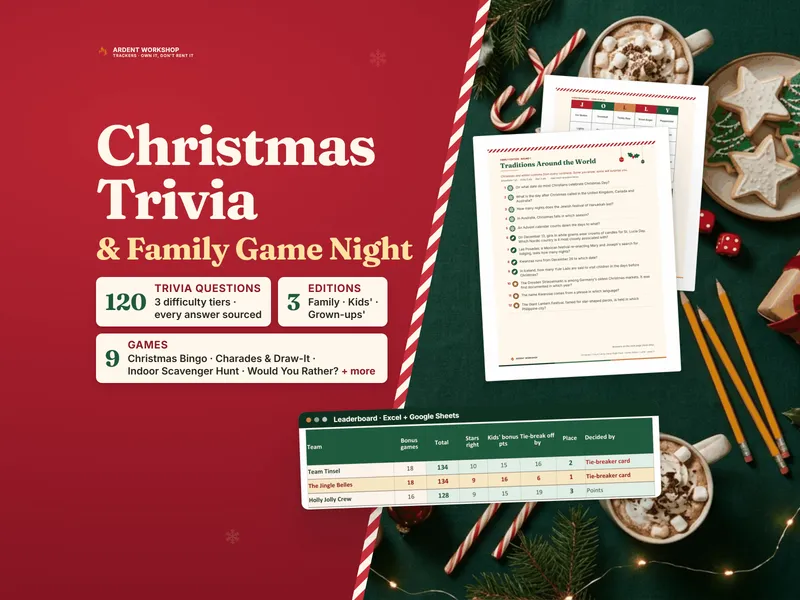
Christmas Trivia & Family Game-Night Pack — Printable Games, Team Scoring Workbook
Christmas trivia (120 tiered questions), bingo, charades and more: 9 games for kids and adults, with a scoring workbook for Excel and Google Sheets.
TrackersView details
Frequently asked questions
- How do you play Most Likely To?
- Someone reads a category, such as "Most likely to cry at a commercial." Everyone votes for the one friend the category fits best, either on a secret ballot or by pointing on the count of three. The friend with the most votes wins the crown for that category, and you move on to the next one.
- Can you vote for yourself in Most Likely To?
- Yes. A vote for yourself counts like any other vote. If you would rather not allow it at your party, say so before the first category so the rule is the same for everyone.
- What happens when two friends tie on votes?
- Use a rule you stated before the game. Rule 1: the friend with the fewest crowns already won takes it, which spreads the crowns around the table. Rule 2: if they are still tied, the friend with the lowest draw number, assigned before any voting, takes it. A re-vote can tie again, so a rule stated before the game leaves less room to argue.
- How many people do you need to play Most Likely To?
- We suggest four or more friends, so a vote means something, and five or more makes the votes more fun. There is no upper limit, though with a big group ballots are easier to count than a show of hands.
- How do you keep Most Likely To kind?
- Choose categories that celebrate a habit or a personality, such as always late, first to cry at a movie, or most likely to adopt another cat. Leave out anything that singles out looks, money, relationships or other sensitive topics, and let any guest skip a category.
- Can you keep score across a whole game night?
- Yes. Give each crown a point value, add it to the points from your other games, and the highest total at the end wins the prize. The Galentine's & Girls' Night Game Pack defaults to 3 points per crown and 1 point per correct quiz or trivia answer, and you can change any of those.