The eight stages
There's no single federally mandated checklist for the interactive process. The eight stages below are the sections of the Accommodation Process Documentation Log published by the Job Accommodation Network — a service funded by the U.S. Department of Labor's Office of Disability Employment Policy — which is the closest thing this area has to a common vocabulary. Its eighth section is marked optional. JAN's shorter process summary describes six steps rather than eight; the documentation log is the more detailed of the two, and it's the one used below:
- Recognition. Someone — the employee, or a supervisor who notices a struggle — has to actually recognize that a request or a need for accommodation exists. Nothing else starts until this happens.
- Begin the process. The employer opens a documented, two-way conversation rather than deciding on its own what the employee needs.
- Request information. If the need for accommodation, or the disability itself, isn't obvious, the employer may ask for reasonable documentation connecting a limitation to the accommodation requested, limited to what is needed to establish disability and need.
- Explore and choose. Employer and employee discuss options together. The employer gets to choose among effective accommodations; it does not have to be the specific one the employee first asked for.
- Implementation. The chosen accommodation is actually put in place, with an owner and a target date.
- Monitor. Check back — is the accommodation actually working, for this job, as the job or the limitation changes.
- Confidentiality. Medical information gathered along the way is kept separate from the personnel file, not folded into it.
- Audit and review. The accommodation, and the record of it, gets revisited on a set rhythm rather than being set once and forgotten.
A single open request can be run on paper, or on JAN's own free Accommodation Process Documentation Log, and that's a genuinely good tool for one case — a narrative form you fill in. Our own free Single Accommodation Request Log covers the same one case as a spreadsheet instead, with no signup, so the dates you type are dates something can later subtract.
Where either runs out is the fifth request, or the fiftieth: neither rolls up across requests, ages a silent one, or notices that two similar requests got opposite answers. That's the gap the Workplace Accommodations Request & Records Workbook is built to close — it keeps these same eight stages, plus a dated contact log, for every open request in one file, and flags the ones that have gone quiet.
What the interactive process is not
- Not a form to file. A request form can kick it off, but the process itself is the conversation and the record of it — filing the form and moving on is not the process.
- Not a decision. "We looked into it and said no" is an outcome. The process is everything that happened, or should have happened, before that outcome was reached.
- Not a medical review. The employer isn't diagnosing anything. It's gathering enough information — from the employee, and where appropriate from a treating provider — to understand functional limitations and match them to a workable accommodation.
Is failing to engage in the interactive process its own violation?
Under the federal ADA, generally no — and this is the point most often stated backwards. The regulations themselves describe an informal, interactive process at 29 C.F.R. § 1630.2(o)(3). What that regulation does not do is make skipping it a claim by itself: a refusal to engage goes to the employer's good faith. An employee ordinarily still has to show that some reasonable accommodation was actually available; do not infer that a missing conversation guarantees either side will win. The outcome depends on the facts and applicable law.
That is a federal answer, and it is exactly where the state-law section below diverges from it. The EEOC's enforcement guidance on reasonable accommodation and undue hardship is the primary source for how the process is expected to run.
Who starts it
Either side can start it. Most often it's the employee or a family member or representative speaking for them, but a supervisor who notices an obvious, job-affecting struggle can have a duty to raise it too — the trigger is the employer knowing, or having reason to know, that an accommodation might be needed, not waiting for a specific form to land on a desk.
Does the request have to be in writing, or use the words "reasonable accommodation"?
No. The employee doesn't have to put anything in writing, and doesn't have to say "I am requesting a reasonable accommodation under the ADA." Plain language describing a problem connected to a medical condition is enough — "I'm having trouble getting to work on time because of my treatment schedule" is a request. What matters is that the employer reasonably understood a request was being made, not the form of words used to make it. Employers are still free to ask for the request in writing going forward, for their own record — that's a reasonable administrative step, not a legal requirement for the employee to have made one in the first place.
How long should it take?
This is the question that gets an answer wrong more often than any other part of this topic. There is no fixed clock in the ADA for how long a private employer has to complete the interactive process. The standard set out in the EEOC's enforcement guidance on reasonable accommodation and undue hardship is that an employer should proceed expeditiously, and that unnecessary delays can themselves violate the ADA — but "expeditiously" is a facts-and-circumstances standard, not a number of days.
That is why the response targets in any tracker worth using are yours to set, and should be labeled as your own policy target rather than a legal one.
What an employer may — and may not — ask for
When a disability or the need for accommodation isn't obvious, an employer may ask for reasonable documentation showing that the employee has a covered disability and that it creates the need for the accommodation requested. What it may not do is demand a full medical file or unrelated information. A specific diagnosis may not be necessary, but the rule is not an absolute ban on diagnosis information. The EEOC’s mental-health-provider guidance explains that a general description of the condition may suffice when a client does not want a specific diagnosis disclosed.
Medical information collected this way has to be kept confidential, on separate forms, in a separate file from the regular personnel file. The ADA sets that rule out for post-offer entrance examinations at 42 U.S.C. § 12112(d)(3)(B), and applies the same treatment to information gathered from a current employee at § 12112(d)(4)(C) — implemented at 29 C.F.R. § 1630.14(b)(1) and (c)(1). An accommodation request from someone already on the payroll runs under the employee provision, which is the one most of this page is about. A request letter to a treating provider should identify the limited information needed to establish disability and the accommodation need. Keep detailed medical material in the restricted file rather than reproducing it in a broadly shared tracking log.
What to document at each stage
A record that can actually be relied on later has something dated at each stage, not just a final outcome:
- When the request was recognized, and by whom.
- Each substantive conversation, with a date and who was in it.
- What information was requested from the employee or a provider, and whether sufficient information was received. Keep the underlying medical documentation separate and restrict access; the tracking log need not repeat it.
- The options discussed, and why the one chosen was selected.
- The implementation date, and who was responsible for it.
- Any follow-up or effectiveness check, and its outcome.
- The decision itself — approved or denied, and on what basis.
- The date set for the next review.
A file with an approval or denial date but nothing in between is a decision with no documented process behind it — exactly the gap the interactive-process requirement exists to close.
Where the record has to live, and for how long
Two separate rules govern this, and they're often confused with each other. First, confidentiality: medical information has to sit in a separate confidential file, not the general personnel file — see the ADA and 29 C.F.R. § 1630.14 citations above.
Second, retention: personnel records — which explicitly include requests for reasonable accommodation — generally have to be preserved for one year from the record or the personnel action, whichever is later, under 29 C.F.R. § 1602.14. Once a charge of discrimination is filed, or the EEOC or the Attorney General brings an action, all relevant records have to be kept until it is finally resolved. That is a federal floor: state law or a company's own contracts can require longer.
Federal law only — state law can add to this
Everything above describes the federal process under the ADA. State law can layer on additional requirements, and this is the clearest example of it: California's Fair Employment and Housing Act makes it unlawful, at Cal. Gov. Code § 12940(n), "to fail to engage in a timely, good faith, interactive process" in response to an accommodation request — its own separate cause of action, which the federal ADA does not generally provide, even though a California plaintiff bringing it still has to identify an accommodation that was available.
An employer reading only the federal rule can therefore be reading the wrong one. Nothing here should be read as a statement of what any particular state requires — that's a question for counsel familiar with the state in question.
Keep the record, whichever way you keep it
However this gets tracked — a single JAN-style log for one open request, a shared drive folder of dated emails, or a file built to roll all of it up — the point of the interactive process is the same: a dated, documented record that a real back-and-forth happened, for every open request, not just the ones that ended in approval.
Start with the free single accommodation request log — the eight stages, a short contact list and the decision fields for one case, at no cost and with no signup. When one case becomes several, the Workplace Accommodations Request & Records Workbook does the same across every request at once and adds the aging, parity and retention checks a single-request log has no way to compute.
If the question you're actually weighing is whether to buy a case-management platform instead, that trade-off is worked through in spreadsheet vs HR case-management software.
Templates that implement this
Templates that run this process
2 templates
The full workbook runs these same eight stages for every request at once, and computes on top of them: days since the last documented contact against your own policy target, and where the same kind of request got different answers from different decision-makers. It is also where the approval and denial letters for a request live. Beside it, the HR letters and document pack is the general employment-document set, and it stamps every document with which of the two employee files it belongs in — the same personnel-file-versus-confidential-file split this page describes. Not ready to buy either? The free Single Accommodation Request Log carries the eight stages for one case, at no cost.
- $24.95 Spreadsheet

Workplace Accommodations Request & Records Workbook — Interactive Process Tracker, Silence Alerts & Parity Check (Excel & Sheets)
An ADA reasonable-accommodation tracker for Excel & Google Sheets that flags requests which have gone quiet, and where the same ask got opposite answers.
Team & TalentView details - $29.95 Mix
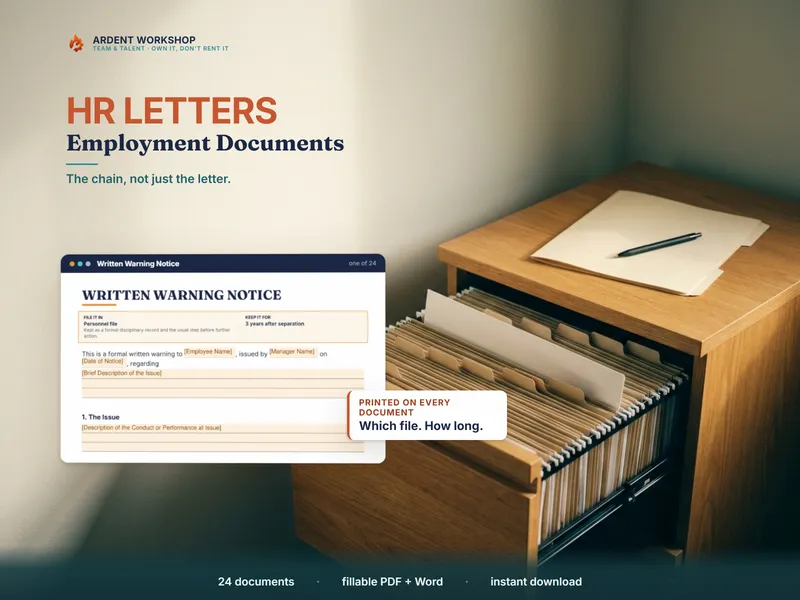
HR Letters & Employment-Document Template Pack — 24 Fillable Employment Documents, Each Stamped With Which Employee File It Goes In and How Long to Keep It
The letter is the easy part. This is the chain — which document a situation needs, what must already be on file, and where it gets filed. PDF + Word.
Team & TalentView details
Frequently asked questions
- How long does an employer have to respond to an accommodation request?
- Under the ADA there is no fixed deadline for a private employer. The EEOC's standard is that an employer should proceed expeditiously and that unnecessary delays can themselves violate the ADA, but that is a facts-and-circumstances standard, not a number of days. The "~30 business days" figures that circulate come from federal-agency internal procedures written under Executive Order 13164 and the Rehabilitation Act — the day counts are what individual agencies set for themselves, and none of it governs a private employer. Set a response target as your own policy, and label it that way.
- Can an employer be sued just for ignoring an accommodation request?
- Under the federal ADA, generally not on its own. Federal courts have generally treated a refusal to engage as evidence going to the employer's good faith, but an employee ordinarily still has to show that some reasonable accommodation was actually available. State law can differ — California's Fair Employment and Housing Act makes a failure to engage in a timely, good faith interactive process its own separate cause of action, which the ADA does not.
- Does an employee have to request an accommodation in writing?
- Under the federal ADA, no. The employee does not have to put anything in writing and does not have to say the words "reasonable accommodation" or mention the ADA. Plain language describing a problem connected to a medical condition is enough — "I'm having trouble getting to work on time because of my treatment schedule" is a request. What matters is that the employer reasonably understood a request was being made. An employer can still ask for the request in writing going forward for its own record; that is an administrative step, not a condition of the request having been made.
- Can an employer ask for a diagnosis?
- Not as a blanket rule either way. When the disability or accommodation need is not obvious, an employer may seek reasonable documentation limited to establishing disability and the need for accommodation. A specific diagnosis may not be necessary; a general description may suffice. This does not authorize demanding a complete medical file. Keep necessary medical documentation confidential and separate from ordinary personnel records.
- What are the eight stages of the interactive process?
- Recognition, Begin the process, Request information, Explore and choose, Implementation, Monitor, Confidentiality, and Audit and review. There is no federally mandated checklist for the interactive process; these eight are the sections of the Accommodation Process Documentation Log published by the Job Accommodation Network, a service funded by the U.S. Department of Labor's Office of Disability Employment Policy, and its eighth section is marked optional. JAN's shorter process summary describes six steps rather than eight.