Ask five anime fans whether you should watch subbed or dubbed, and you’ll get five answers — at least three of them delivered with the intensity of a courtroom closing argument. It’s the oldest flame war in the fandom, older than the “is it a sport anime or a drama” discourse and roughly as resolvable as pineapple on pizza.
Here’s the good news: it’s not actually unresolvable. The honest answer isn’t “subs are objectively superior” or “dubs have come so far.” The honest answer is that the right choice depends on what you’re watching, what you’re doing while you watch, and what you actually want out of the next 24 minutes. Let’s settle it — fairly, with both sides getting their strongest case, and a real verdict at the end.
First, the twist: dubs are quietly winning
Before we hand each side a microphone, one fact reframes the whole debate. The loudest voices online are sub-purists — but on the actual platforms, dubs win, and it’s not close.
Crunchyroll’s president, Rahul Purini, revealed that 48% of UK fans watch anime with subtitles (opens in new tab) — and that the UK is the most sub-heavy region in the world. Everywhere else, the majority of viewers are watching dubbed. Netflix’s numbers are even more lopsided: at Anime Expo 2025, the company said 80 to 90 percent of its users watch anime dubbed (opens in new tab).
So if you’ve ever felt like the “real fans watch subbed” crowd was speaking for everyone, they weren’t. They were speaking for a vocal minority. This matters because anime is no longer niche — the global market hit a record 3.84 trillion yen (about $25.1 billion) in 2024, with the overseas portion jumping 26% in a single year, according to the Association of Japanese Animations (opens in new tab). A huge share of that new, global, mainstream audience is watching dubbed — and they’re enjoying it just fine.
That doesn’t make subs wrong. It just means the debate isn’t a referendum on who’s a “real” fan. It’s a question of fit. So let’s give both sides their day in court.
The case for subbed anime
Subtitles preserve the performance the creators actually approved. When you watch subbed, you’re hearing the original Japanese voice cast — the seiyuu — performing the roles as the director cast and coached them. In Japan, voice acting is a genuine celebrity profession with its own stars, and studios often build a character’s energy around a specific actor’s delivery. Watch subbed and you get that performance unfiltered.
The strongest arguments for team sub:
- Nuance and intent. Tone, emotional cadence, and the exact rhythm of a line are part of the original direction. A great sub lets you feel a character’s hesitation or menace exactly as it was performed.
- Untranslatable wordplay survives. Puns, honorifics, regional dialects, and culturally specific jokes frequently can’t be localized cleanly. A subtitle can footnote or preserve them in a way a dub script has to flatten or rewrite.
- It’s available first. Simulcasts drop subtitled episodes within hours of the Japanese broadcast. A polished dub — a “simuldub” — usually trails by days or weeks. If you want to be in the conversation the night a hyped seasonal premiere airs, subs get you there first.
- Consistency across a long franchise. Original casts tend to stay locked in for years. Dub casts can change between seasons, studios, or licensors.
The team-sub thesis, boiled down: anime is a Japanese art form, and the closest seat to the original is the subtitled one.
The case for dubbed anime
Dubs let you actually watch the animation — which is the entire point of animation. This is the argument sub-purists most often wave away, and it’s the strongest one on the board. Anime is a visual medium. Sakuga-heavy fight scenes, subtle facial acting, background detail, comedic timing built into the framing — all of it competes for your eyes with a line of text at the bottom of the screen. With a dub, your attention stays where the artists put the work.
The strongest arguments for team dub:
- Eyes on the art. Reading and watching are both active tasks. For fast, dense, or visually spectacular shows, a dub frees you to absorb the craft instead of speed-reading.
- Accessibility, not laziness. Dubs open anime to viewers who are visually impaired, dyslexic, dealing with fatigue, or simply can’t read fast enough to keep up. “Just read faster” is not an accessibility plan.
- You can multitask. Folding laundry, cooking, drawing, gaming on mute — a dub plays like a radio drama with picture. A sub demands a screen lock.
- Modern dubs are genuinely good. The bargain-bin, heavily-censored localizations that scarred a generation are mostly a relic. Today’s dub studios cast strong actors, keep scripts faithful, and often work with the licensor early. The quality gap that justified the old snobbery has narrowed dramatically.
- Family and group watching. Trying to share a show with a parent, a partner, or a kid who won’t read? Dubs turn “I’ll pass” into “okay, one episode.”
The team-dub thesis, boiled down: you came to watch a cartoon, so watch the cartoon.
Where the real dividing line is
Here’s where it gets interesting: the smartest viewers don’t actually pick a side. They pick per show — and sometimes per viewing session. The real dividing line isn’t loyalty. It’s a handful of practical questions.
- What are you doing while you watch? Giving it your full attention on the couch? Subs are great. Watching while you cook, commute, or sketch? A dub keeps the story going while your eyes are busy.
- What kind of show is it? Dialogue-dense, pun-heavy, courtroom-and-politics anime rewards the precision of subtitles. Action spectacle, slapstick comedy, and visually dazzling fantasy reward keeping your eyes on the screen with a dub.
- How good is this specific dub? “Dubs are good now” is a generalization. Some are superb; some are flat. It’s worth sampling an episode before committing a 50-episode run.
- How fast do you need it? Chasing the weekly hype cycle? Subs simulcast first. Bingeing a finished series a year later? The dub’s almost certainly ready, so it’s a free choice.
- Who’s in the room? Solo, anything goes. Watching with someone who won’t read subtitles, and your only real options are “dub” or “watch alone.”
Notice what’s not on that list: which option makes you a more legitimate fan. That question has no answer, because it was never a real question.
Subbed vs. dubbed: a side-by-side comparison
When you strip out the tribalism, the trade-offs line up cleanly. Use this to decide on any given show:
| Factor | Lean subbed when… | Lean dubbed when… |
|---|---|---|
| Your attention | You can give the screen your full focus | You’re multitasking or your eyes are busy |
| Show type | Dialogue-heavy, wordplay-rich, talky drama | Action, comedy, or visually spectacular |
| Timing | You want the newest episode the day it airs | You’re bingeing a finished, fully-dubbed series |
| Performance | You want the original cast and direction | A strong English cast nails the tone |
| Accessibility | Reading speed and vision aren’t a barrier | Reading is tiring, hard, or impossible for you |
| Who’s watching | Solo or with fellow readers | Sharing with kids, family, or sub-averse friends |
If a row tips you one way, follow it. If the whole table is a toss-up, flip a coin — genuinely, it won’t matter, and that’s allowed.
The verdict: how to actually decide
After all of that, here’s the stand: there is no wrong way to watch anime — and the only real mistake is letting someone else’s snobbery decide for you. Subs and dubs are both legitimate, both excellent in 2026, and both exist precisely so more people can fall in love with the medium.
If you want a simple rule to live by:
- Default to whichever gets you to actually finish the show. A “purist” sub run you abandon at episode three beats nothing, but it also loses to a dub you binge in a weekend.
- Match the format to the moment. Full attention and a talky plot → subs. Busy hands and a flashy show → dubs.
- Re-watch in the other format. Loved a series subbed? A dub re-watch is a genuinely different, often delightful experience — and vice versa.
- Sample before you commit. Watch one episode each way and let your own ears, not a forum, cast the deciding vote.
The fans who get the most out of anime aren’t the ones who picked the “correct” side. They’re the ones who stopped treating it as a side to pick.
Whatever you choose, keep track of how you watch
Once you stop fighting about the format, a more useful problem appears: keeping straight what you’ve watched, which season you’re on, whether you saw it subbed or dubbed, and what’s worth a re-watch in the other format. That’s a tracking problem, not a debate — and it’s exactly the kind of thing your memory quietly loses, especially once your backlog grows past what your brain can hold.
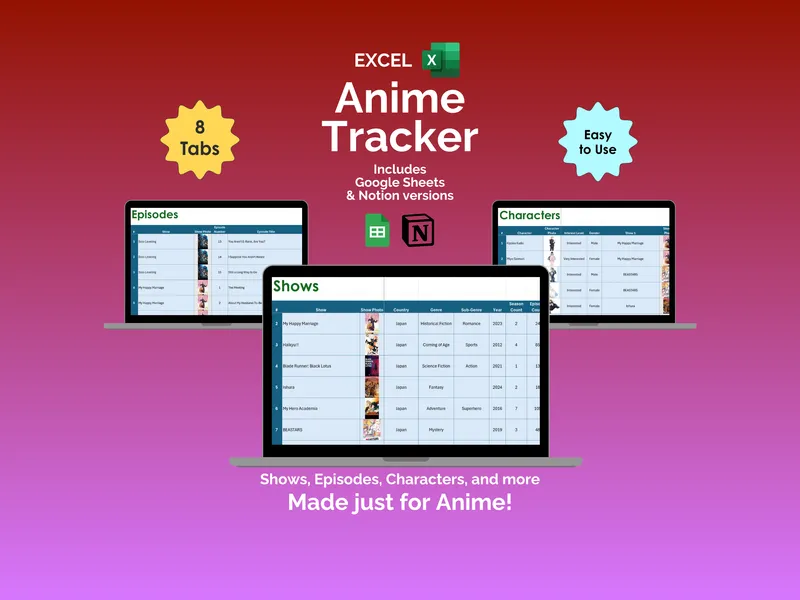
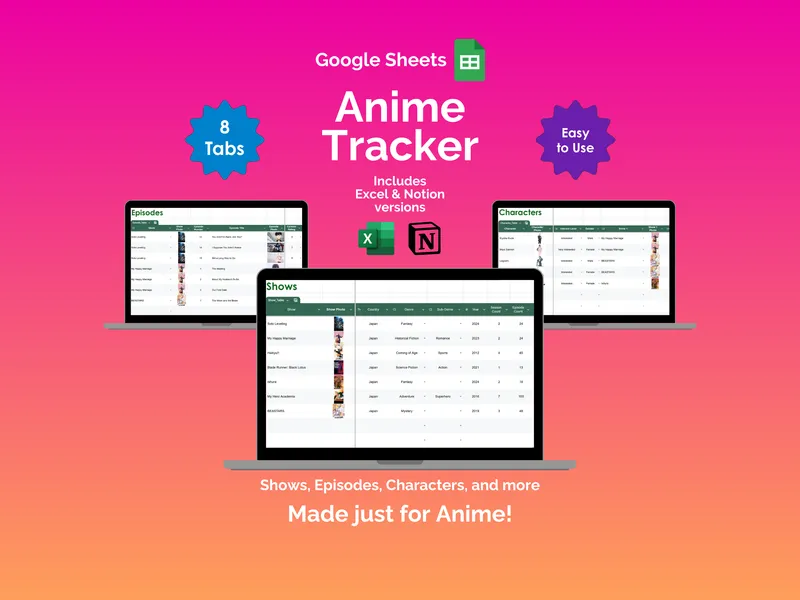
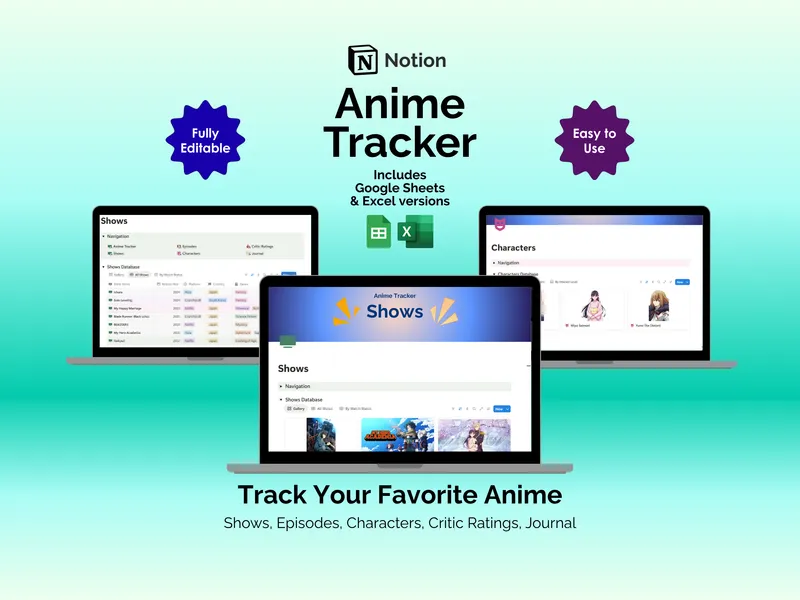
A simple log fixes it. The Anime Tracker (Excel) gives you a clean spreadsheet to record titles, ratings, status, and a format column so you can flag your sub-vs-dub picks and re-watch ideas. Prefer the cloud or a connected workspace? The same tool comes in Google Sheets and Notion versions. And if anime is only one slice of your viewing, the Asian Media Bundle pulls anime, manga, K-dramas, and more into one place.
Pick your format. Pick your show. Track what you love. The debate was never the point — the watching is.