This isn't really spreadsheet-versus-software. It's "the right tool for where your operation is today." Most owner-operators should start on a workbook and stay there longer than the software companies would like — knowing your cost-per-mile and filing IFTA is a solved problem in a spreadsheet. The skill is recognizing the day the file flips from saving you time to quietly costing you time — and not subscribing a moment before.
When a workbook is exactly right
- You run one truck — your own — and need your true cost-per-mile.
- You want IFTA kept straight all quarter, not reconstructed from a shoebox.
- You want to know the profit on each load, deadhead included.
- You — and maybe a bookkeeper — touch the numbers.
- You want something private, cheap, and bent exactly to how you run.
At this stage a good workbook beats software outright. It costs once, it's yours, and there's no subscription or onboarding. The owner-operator hub collects the tools built for exactly this phase, and the free cost-per-mile calculator is a no-signup taste of the math.
The signals you've outgrown it
You don't decide to switch — the operation tells you. The tells:
- You're running more than one truck. Settlements, maintenance, and IFTA across several trucks no longer fit one file.
- You're dispatching for other drivers. Loads, pay, and availability need to be coordinated, not just logged.
- Miles and fuel should arrive automatically. Re-keying ELD and fuel-card data by hand eats the time the file was meant to save.
- Invoicing and factoring need to connect. Billing brokers and tracking what's been paid isn't something a workbook does well.
- "How did the fleet do?" takes a day. Across trucks, the cross-referencing is the bottleneck.
One of these is normal. All of them, every week, is the work telling you the file is done.
Spreadsheet vs trucking-management software, side by side
| What matters | Trucking workbook | Trucking-management software |
|---|---|---|
| Cost | One-time, low | Ongoing subscription, often per truck or driver |
| Cost-per-mile | Full — fixed, variable, and your pay | Full, often pulled from live cost data |
| IFTA | Miles & gallons by state, the filing math done for you | Often auto-calculated from ELD and fuel-card feeds |
| Per-load profit | Every load against your cost-per-mile, by hand | Tracked automatically as loads and costs post |
| Multiple trucks | One file per truck, reconciled by hand | One dashboard across the whole fleet |
| Dispatch & invoicing | Not built for it | Core feature — loads, drivers, billing |
| Flexibility | Total — change anything | Structured around how the system models a truck |
| Best for | One owner-operator who wants their numbers | A growing fleet where coordination is the bottleneck |
The honest middle ground
Plenty of owner-operators run on a workbook far longer than they "should" — and that's fine, because it's free of subscriptions and bent exactly to how they run. The hidden cost only becomes real when the hours you spend keeping numbers true across trucks exceed what software would cost. Track that honestly and the decision makes itself.
Know your numbers either way
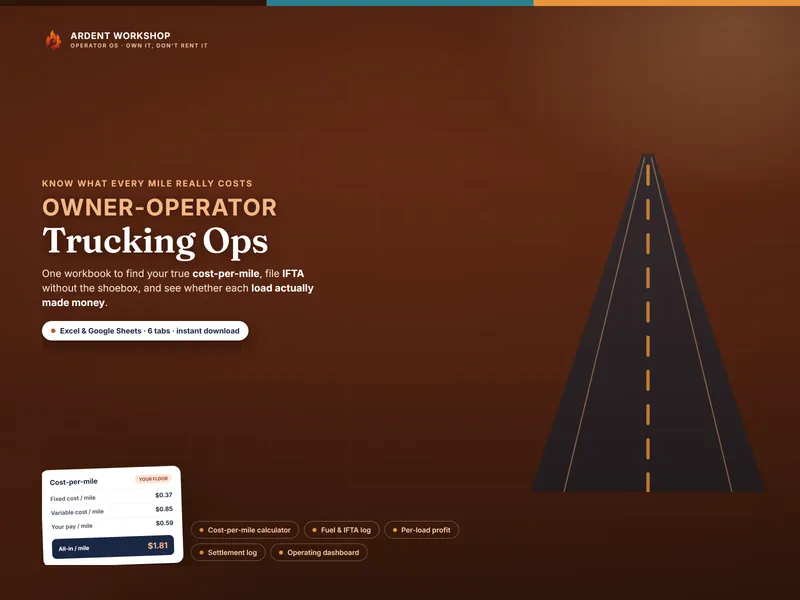
Here's the part the software pitch skips: even an operator who runs a full TMS still needs to know their cost-per-mile to judge a rate. The Owner-Operator Trucking Ops Workbook builds it from your real fixed and variable costs, keeps IFTA straight, and shows the profit on every load — in one connected file you own, in Excel, Google Sheets, or LibreOffice. Own the number; rent the fleet tooling only when the trucks demand it.
New to it? Start with what cost-per-mile is, or browse every tool on the owner-operator hub.
Frequently asked questions
- When should an owner-operator move from a spreadsheet to trucking-management software?
- When you're running more than one truck, or dispatching loads for other drivers, and you can no longer see your whole operation in one file. The tells: settlements to reconcile for several drivers, loads and rate confirmations you track by hand, and a fleet-wide 'how did we do this month?' that takes a day to answer. A single owner-operator running their own truck usually gets everything they need from a structured workbook for a fraction of the cost.
- What can trucking-management software do that a spreadsheet can't?
- Dedicated TMS software connects dispatch, load boards, driver settlements, IFTA, and invoicing in real time, often pulling miles and fuel automatically from an ELD or fuel card. A spreadsheet can model any one of those — your cost-per-mile, your IFTA quarter, your per-load profit — but it can't sync them across multiple trucks or capture data from the road on its own.
- Is a spreadsheet good enough for an owner-operator?
- For a single owner-operator, almost always — often for years. A well-built workbook handles your true cost-per-mile, fuel and IFTA tracking, per-load profitability, and settlements, and it costs once. Where a spreadsheet struggles is running a multi-truck fleet and pulling miles and fuel automatically. Know your numbers in the workbook; graduate to software when dispatching and reconciling across trucks becomes the bottleneck.
- How much does trucking software cost vs a workbook?
- A one-time workbook is a single low cost you own forever; trucking-management software is typically a recurring monthly subscription, often per truck or per driver. The subscription is worth it once the time it saves across a fleet exceeds what it costs — but paying monthly while you run one truck usually buys capability you're not using yet.