
What a giving statement usually contains
A year-end giving statement is short, but the details matter — a household relies on it, and in many places so does the tax authority. Most statements list:
- The congregation's name and details. Who the recipient gave to, so the statement stands on its own as a record.
- The household or donor. Named as they'd want it to read on their own records.
- The period. Usually a single calendar or giving year.
- The total contributed — and often the split by fund (general or operating, building, missions, youth, benevolence) and the number of gifts.
- Any required wording. Depending on the tax rules where you are, a valid statement may need specific language — for example, about whether the giver received any goods or services in return.
Why the honest limit matters
A giving statement is a record-keeping document, and it is easy to overstate what it does. The exact wording that makes a statement valid for a tax deduction — and how gifts of goods, services, or anything received in return are treated — depends on the tax rules where you are, and those rules change. A workbook can make the numbers correct and effortless; it cannot decide what the statement must legally contain. Confirm the required wording with your accountant or the tax authority, and reconcile the totals against your bank and books before issuing statements.
The hard part is the totals, not the letter
Writing the letter is quick. The work is arriving at an accurate total for every household — across cash in the plate, checks, online recurring gifts, and the occasional stock or in-kind gift, spread over twelve months and several funds. Done by reconstructing it in January, it is hours of sorting and a real chance of error. Done from a donations log kept all year, where each gift was recorded once and tagged to its fund, the totals already exist — the statement is just a view of them.
How a workbook produces them
The method is simple: log every gift on one sheet, with the household, the fund, the amount, and the date. Then, for a chosen giving year, total each household's gifts — overall and by fund. In the Place-of-Worship Operations Workbook, that is a single cell: set the giving year, and every household's total, gift count, and split by fund computes itself from the log, ready to copy into a printed or emailed statement. Change the year and every statement recomputes.
Do it once a year — or watch it all year
The statement is an annual document, but the habit that makes it painless is weekly: log gifts as they come in, tagged to the right fund. A congregation that keeps its donations log current is a congregation that can produce a giving statement the day it is asked for — and answer a giver honestly about how their gift was used, at any point in the year.
Related tools and concepts
To keep giving straight for free, the free congregation donations log is an ungated single-tab log that totals gifts by fund; the full Place-of-Worship Operations Workbook adds the one-cell year-end statement engine, pledge tracking, a member directory, a facility calendar, and a live dashboard. See the tools for congregations hub for the rest, and spreadsheet vs. church-management software for how an owned workbook compares to a monthly subscription.
Templates that implement this
Tools that produce year-end giving statements
2 templates
Log each gift once and the year-end totals — overall and by fund, per household — compute themselves, ready to drop into a contribution statement.
- $29.95 Spreadsheet

Place-of-Worship Operations Workbook — Church Donation Tracker, Giving Statements & Pledges for Excel & Google Sheets
A church and congregation operations workbook for Excel & Sheets — donations, pledges, year-end giving statements, members, and volunteers in one file.
Operator OSView details - $38.95 Spreadsheet
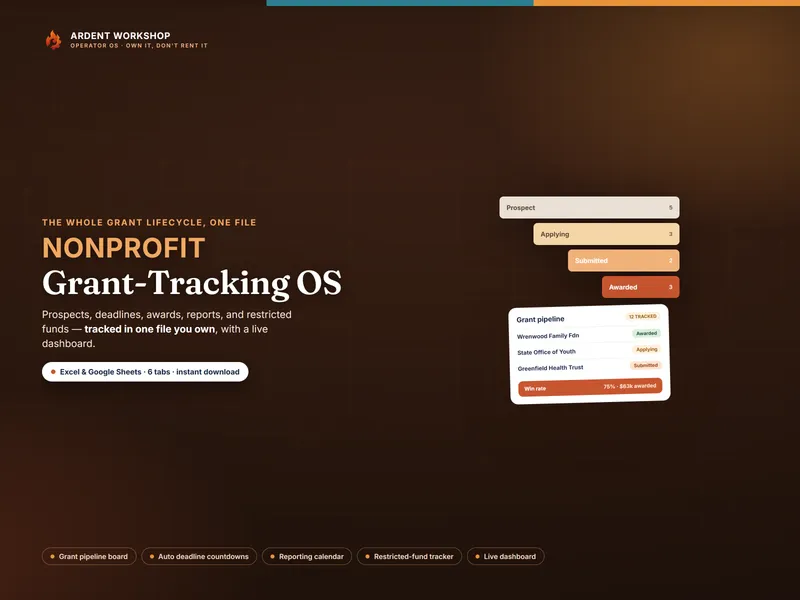
Nonprofit Grant-Tracking OS — Grant Pipeline, Deadline & Reporting Tracker for Excel & Google Sheets
A nonprofit grant tracker for Excel & Google Sheets — manage your grant pipeline, deadlines, reports, and restricted funds in one owned file.
Operator OSView details