SSDI vs. SSI — they are not the same thing
For adults, SSDI and disability-based SSI generally use the same medical definition of disability, but the nonmedical requirements differ. SSI also has categories for older adults and children. The difference is what qualifies you:
- SSDI (Title II) is based on your work record. You qualify by having paid in — by being "insured" through work credits.
- SSI (Title XVI) is based on financial need, not work history.
Some people file for both. Which one applies changes the money and the rules around it, and the adult disability evaluation is separate from those nonmedical requirements.
The work test: "insured status"
Eligibility on your own work record depends on how long and how recently you worked in covered employment. The rules vary with age and include exceptions, such as for statutory blindness. SSA's insured-status requirements explain these tests. Use SSA's work-credit guidance for current credit amounts rather than relying on a fixed figure in a worksheet.
The adult sequence below is described in 20 CFR 404.1520, also cited in the related five-step evaluation article. It concerns disability findings, not a guarantee that all benefit requirements are met.
How SSA decides you are disabled — the five steps
SSA applies a five-step sequential evaluation, in order, stopping as soon as it can decide:
- Are you working? If you are doing substantial gainful activity (SGA), you are found not disabled. Check the applicable SGA rules and amount for the relevant year.
- Is your impairment severe? And does it meet the duration requirement?
- Does it meet a listing? If it meets or equals one of SSA's listings, you are found disabled and it stops here.
- Can you do your past work? SSA compares your residual functional capacity — what you can still do — against what your past jobs actually required.
- Can you adjust to other work? Considering your capacity, age, education, and work experience.
Steps 4 and 5 are why your work history matters so much. The physical and mental demands of a job you no longer do can decide the claim as much as the diagnosis does — which is why "supervisor" is a useless answer, and "on my feet seven hours a shift, lifting 40-pound cartons" is a useful one.
Appeals: confirm the deadline for the decision
A denial notice should explain the decision and how to challenge it. SSA's appeal overview describes reconsideration, an administrative law judge hearing, Appeals Council review and federal court review.
A request for reconsideration is generally due within 60 days after receipt under 20 CFR 404.909. SSA's receipt rule generally presumes receipt five days after the notice date unless a reasonable showing establishes otherwise. That presumption is not a universal deadline calculator. Confirm the decision type, receipt date, notice instructions and applicable filing rules.
Some related choices have shorter deadlines. For example, continued benefits during certain medical-cessation appeals generally require a request within 10 days after receipt. Do not wait for an ordinary appeal deadline to ask about benefit continuation.
If a deadline has passed, contact SSA or your representative promptly. SSA's good-cause rule describes circumstances considered for an extension; acceptance is not automatic. Federal court filing requirements must be checked separately.
The evidence is the claim
SSA considers medical and functional evidence, including symptoms. Useful records can include: objective medical evidence (signs and laboratory findings), medical opinions about your specific limitations, other medical evidence (history, treatment tried, how you responded), and statements from nonmedical sources — including you.
One caution worth carrying: a great deal of advice online still says a treating doctor's opinion gets "controlling weight." For claims filed on or after March 27, 2017, that rule no longer applies. Under 20 CFR 404.1520c, supportability and consistency are the most important factors in evaluating medical opinions. Document specific limitations and their supporting evidence rather than assuming a conclusion alone decides the claim.
An honest word
This page is general explanation — not legal, medical, or benefits advice, and no guarantee of any result. Ardent Workshop is not affiliated with, endorsed by, or connected to the Social Security Administration or any government agency. Whether you qualify, which evidence matters, and the date your deadline actually falls are set by SSA, by the notices SSA sends you, and by the rules that apply to your case. Check ssa.gov, and consider a qualified representative. Confirm the applicable fee-authorization rules before agreeing to representation.
Related tools and concepts
Read about the ALJ hearing if your claim has reached that level, and start with the free Disability Claim Document Checklist — the one-page list of what to gather. The full Disability / SSDI Claim & Records Organizer tracks the appeal clock, indexes your evidence, and keeps the correspondence trail. If you are weighing that against a subscription service, see records organizer vs. a disability-claim app. The step-by-step tutorial walks a claim from the first notice to a hearing, and the tools for disability claimants hub has more.
Templates that implement this
Tools that keep a claim on track
2 templates
Record the deadline you confirm from your notice, index medical evidence and keep the correspondence together. A worksheet countdown is not a determination of your legal deadline.
- $23.95 Spreadsheet

Disability & SSDI Claim & Records Organizer — Appeal Deadline Tracker, Medical Evidence Index & Work History (Excel + Google Sheets)
A disability & SSDI claim organizer for Excel & Sheets — track every appeal deadline, index your medical evidence, and keep the claim in one file you own.
Life AdminView details - $21.95 Spreadsheet
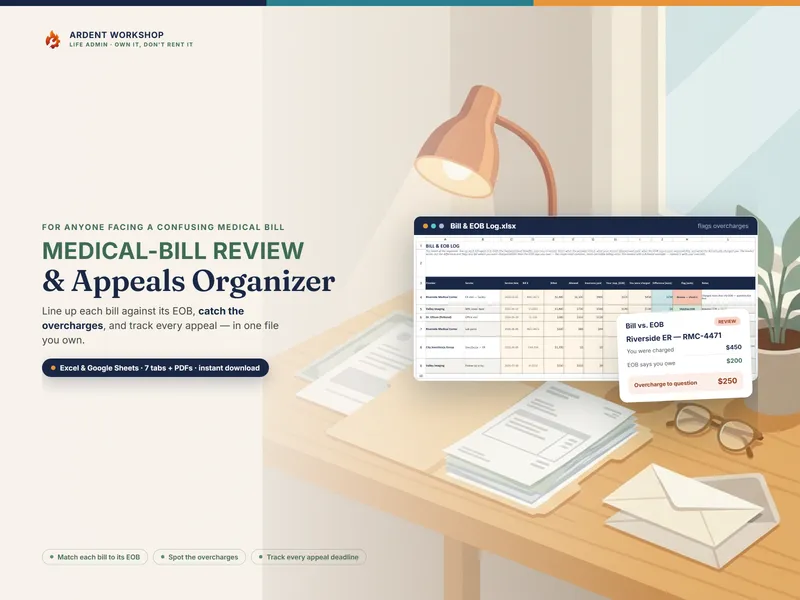
Medical-Bill Review & Appeals Organizer — EOB Matching, Denial & Appeal Tracker for Excel & Google Sheets
A medical-bill review & appeals organizer for Excel & Sheets — match bills to EOBs, catch overcharges, and track every denial and appeal you own.
Life AdminView details