Where the hearing sits
SSA lists four appeal levels: reconsideration, an ALJ hearing, Appeals Council review and federal district court. The initial determination is not itself an appeal level.
Section 404.933 generally gives 60 days after receipt to request a hearing. The five-day receipt presumption is rebuttable. Confirm the applicable notice and action rather than using a universal notice-date countdown.
Certain medical-cessation appeals require a separate request for continued benefits within 10 days after receipt. If late, ask promptly about an extension under the applicable rules; good cause is not automatic. Check federal-court procedures separately.
How the judge reviews the case
Under SSA's hearing procedure, the ALJ examines the issues, questions witnesses and receives evidence. A non-adversarial process does not mean the evidence cannot be questioned or that approval is assured. Ask about representation and any accommodation you need.
What you can actually do at the hearing
You can explain your position, examine the record and question witnesses under the hearing procedure. Follow the notice for arrangements and submissions.
Section 404.935 generally requires you to inform SSA about or submit written evidence at least five business days before the scheduled hearing. Late evidence is subject to specified exceptions; it is not automatically accepted because it arrived late. Keep records of your efforts to obtain it and tell SSA about outstanding evidence promptly.
Who is in the room
- The ALJ — the impartial decisionmaker.
- You, and any witnesses you bring.
- Your representative, if you have appointed one. You are not required to have one.
- A vocational expert (VE), if the judge calls one — they speak to what work exists and what it requires. This is where your work history comes back: the VE is asked about jobs with the demands you described.
- A medical expert (ME), if the judge calls one.
Follow the hearing notice for participation arrangements and ask SSA how any witnesses will take part.
About representatives and their fees
You may appoint a representative. SSA describes separate fee-agreement and fee-petition procedures. Confirm the applicable authorization rules, current limits and separate expenses before signing. An organized file does not guarantee a lower fee.
How to arrive ready
The hearing is a records conversation. What helps is being able to answer "where are you up to?" and "what stops you working?" without reconstructing it from memory on a bad day:
- A one-page claim summary you can print and bring — claim type, onset date, what you are claiming, where the claim is.
- An evidence index that says which record supports which impairment, and which are still outstanding.
- A work history written as you actually did the job, because the VE will be asked about its demands.
- A dated symptom log kept as things happened — which reads very differently from one written the week of the hearing.
The Disability / SSDI Claim & Records Organizer keeps all four in one owned file.
An honest word
This page is general explanation — not legal, medical, or benefits advice, and no guarantee of any result. Ardent Workshop is not affiliated with, endorsed by, or connected to the Social Security Administration or any government agency. What happens at your hearing is set by SSA's rules and the notices SSA sends you. Read them, check ssa.gov, and ask SSA or a representative when you are unsure.
Related tools and concepts
Start with what SSDI is and how the five-step evaluation works. Gather with the free Disability Claim Document Checklist, and track the clock with the full Disability / SSDI Claim & Records Organizer — or weigh it against a subscription service in records organizer vs. a disability-claim app. The step-by-step tutorial walks the whole claim, and the tools for disability claimants hub has more.
Templates that implement this
Tools that get you to the hearing organized
2 templates
Track the deadline that gets you here, index the evidence the judge will read, and arrive with the whole claim on one page.
- $23.95 Spreadsheet

Disability & SSDI Claim & Records Organizer — Appeal Deadline Tracker, Medical Evidence Index & Work History (Excel + Google Sheets)
A disability & SSDI claim organizer for Excel & Sheets — track every appeal deadline, index your medical evidence, and keep the claim in one file you own.
Life AdminView details - $21.95 Spreadsheet
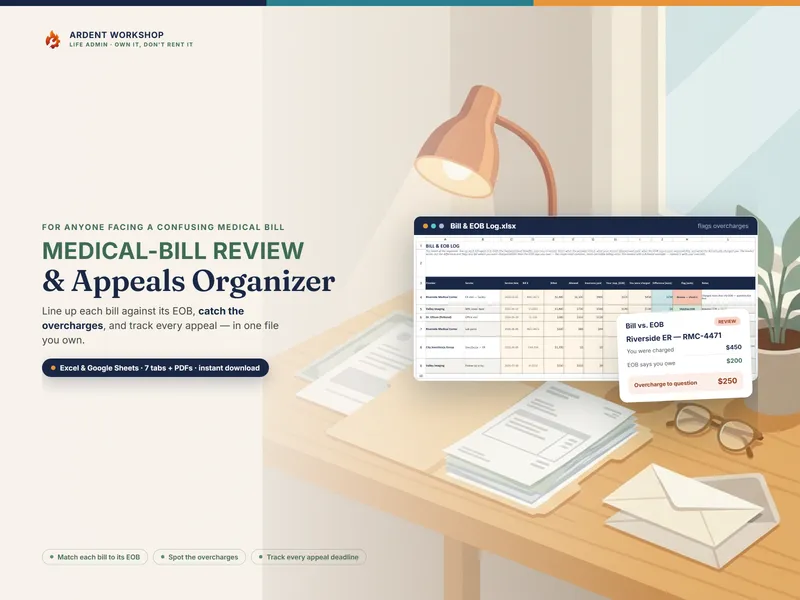
Medical-Bill Review & Appeals Organizer — EOB Matching, Denial & Appeal Tracker for Excel & Google Sheets
A medical-bill review & appeals organizer for Excel & Sheets — match bills to EOBs, catch overcharges, and track every denial and appeal you own.
Life AdminView details