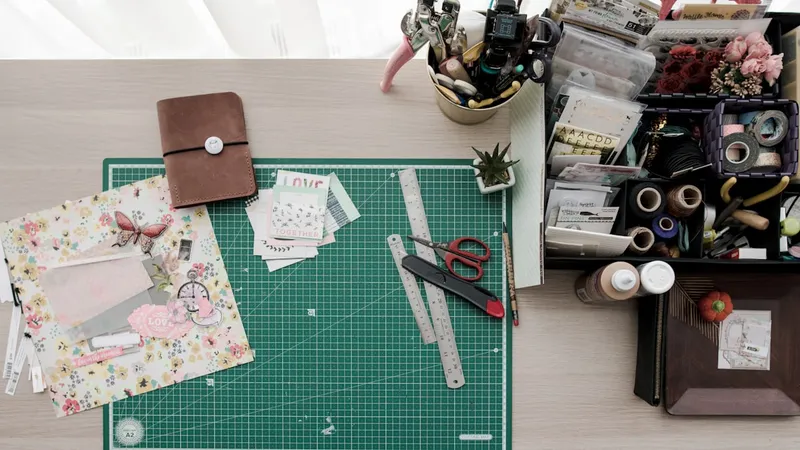
There’s a Bag of Beads in a Drawer Somewhere
You bought them three months ago. Or was it six? You needed them for a custom order — no, wait, it was for that new earring design you were testing. Either way, you’re almost positive you still have them. Somewhere.
So you tear through your craft room. You check the bins, the drawers, the shelf behind the sewing machine, the tote bag you haven’t opened since the last craft fair. Twenty minutes later you find beads — but not the right ones. You find the right ones eventually, buried under a pile of ribbon you forgot you ordered.
Sound familiar? If you’re a handmade seller, it probably does. And that little scene — repeated a few times a week, across dozens of supplies — is costing you far more than you realize.
Welcome to the inventory trap.
What the Inventory Trap Actually Is
The inventory trap isn’t about being messy or disorganized (though it can look that way). It’s a business problem disguised as a storage problem. Here’s what it really means:
You have supplies and finished products sitting in your workspace, but you don’t have a reliable count of what’s there, what it cost, or how long it’s been there.
That’s it. No running total. No cost tracking. No system that tells you when you’re running low on something or when you’ve got way too much of it. Just vibes, memory, and the occasional panicked reorder.
Most craft sellers don’t realize they’re in the inventory trap because they feel in control. You can look around your workspace and see the supplies. You know roughly what you have. But “roughly” is doing a lot of heavy lifting in that sentence — and the gap between “roughly” and “accurately” is where money disappears.
The Five Ways the Inventory Trap Eats Your Profits
1. Buying What You Already Have
This is the most obvious one, and it happens constantly. You’re prepping for a market and you think you’re running low on cotton wicks. So you order another 200-pack. When they arrive, you find the 150 wicks you forgot about in a box under the table.
Now you’ve got 350 wicks and $18 tied up in supplies you didn’t need yet. Multiply that by every material you use — wax, jars, labels, clasps, thread, fabric, packaging — and the phantom spending adds up fast. Many sellers are sitting on hundreds of dollars in duplicate purchases they don’t even know about.
2. Dead Stock Collecting Dust
That batch of holiday-themed candle jars you ordered in October? It’s February. Those seasonal labels for your “Pumpkin Spice” line? Still in the shipping envelope. The specialty resin you bought for a product you decided not to launch? Unopened.
Dead stock is inventory that isn’t moving — and in the craft world, it’s everywhere. Every dollar sitting in a supply you’re not using is a dollar you can’t spend on materials you actually need, marketing that could bring in sales, or tools that would make you faster.
The worst part is that dead stock is invisible when you don’t track inventory. You don’t see it as a $200 loss. You see it as “stuff I’ll use eventually.” But eventually has a cost, and that cost is your cash flow.
3. Spoiled, Expired, and Degraded Materials
If you work with perishables — fragrance oils, food ingredients, natural dyes, certain adhesives — unused inventory doesn’t just sit there. It goes bad. Bakers know this pain intimately: the fondant that dried out, the flavor extracts past their prime, the decorating supplies that hardened in the container.
But even non-perishable materials degrade. Elastic loses its stretch. Glue dries out. Paint separates. Fabric fades in sunlight. If you’re not tracking how long supplies have been on the shelf, you’re throwing away materials without realizing it — and rebuying them at full price.
4. Pricing Without Knowing Your True Costs
You can’t price accurately if you don’t know what your materials actually cost. And I don’t mean “I paid about $12 for this spool of wire” — I mean knowing that you paid $11.47 for that spool on January 3rd, and that the same spool now costs $13.89 because your supplier raised prices.
When you don’t track purchase costs alongside inventory counts, you end up pricing based on old numbers, estimates, or guesses. Over time, as supply costs creep up (and they always do), your margins quietly shrink — and you don’t notice until the bank account tells you something’s wrong.
5. Emergency Reorders and Rushed Shipping
When you don’t know your stock levels, you don’t get early warnings. You discover you’re out of something when you need it — usually right before a deadline, a market, or a rush of orders. So you pay for expedited shipping. You buy from a more expensive local source instead of your usual wholesale supplier. You make do with a substitute material that isn’t quite right.
These emergency purchases are always more expensive, and they happen far more often than sellers admit. A reliable inventory system turns these emergencies into routine restocks ordered at the best price, on your schedule.
Signs You’re in the Inventory Trap
Not sure if this applies to you? Here’s a quick gut check:
- You’ve bought the same supply twice in the last three months because you couldn’t find it or forgot you had it
- You can’t say within 10% how much you’ve spent on materials this year
- You have supplies you bought more than six months ago that you haven’t used
- You’ve had to throw away materials because they expired, dried out, or degraded
- You’ve paid for rush shipping on a restock that could have been a planned order
- When someone asks what your best-selling product costs to make, you have to guess
- Your workspace has bins, drawers, or bags of supplies that you haven’t inventoried
- You’ve lowered a price because it “felt too high” without calculating the actual material cost
If you checked three or more of those, you’re in the trap. But here’s the good news: getting out is simpler than you think.
Escaping the Inventory Trap
You don’t need expensive software or a warehouse management system. You need three things: a count, a cost, and a habit.
Step 1: Do a Full Count (Just Once)
Set aside a few hours on a slow day. Go through every supply in your workspace and write down what you have. Not a rough estimate — an actual count. Spools of thread, yards of fabric, number of jars, weight of wax, quantity of labels.
Yes, this is tedious. Yes, it’s worth it. Think of it as a reset button. You only have to do this thorough count once — after that, you’ll maintain it incrementally as you buy and use materials.
Group your supplies into categories that match how you actually work:
- Raw materials (the stuff that goes into your products)
- Packaging (boxes, tissue, labels, inserts, mailers)
- Tools and consumables (things you use up over time, like sandpaper or glue)
- Finished products (ready-to-sell inventory)
Step 2: Record What Everything Cost
As you count, note the purchase price for each item. If you can’t remember the exact price, check your email receipts, order history from your suppliers, or bank statements. For bulk purchases, calculate the per-unit cost — if you bought 500 labels for $40, each label costs $0.08.
This is the step that changes everything. Once you know the quantity and the cost, you can calculate the total value of your inventory. Most sellers are shocked by this number. You might have $300 in supplies. You might have $3,000. Knowing that number is the difference between running a business and running a hobby.
A tool like the Craft Business Manager makes this process significantly easier — you enter purchases as you make them, and it automatically tracks costs, quantities, and per-unit pricing across all your supplies. No formulas to build, no spreadsheet to design from scratch. If baking is your craft, the Bakery Business Manager does the same thing with built-in support for recipe costing and perishable ingredient tracking.
Step 3: Build the Habit
The initial count gets you out of the trap. The habit keeps you out. Here’s what that looks like in practice:
- When you buy supplies: Record the item, quantity, and cost immediately. Don’t tell yourself you’ll do it later. Later never comes.
- When you make products: Deduct the materials used. If a candle takes 8 oz of wax and a wick, subtract those from your counts.
- Once a month: Do a quick review. Check for low-stock items and place restocks before they become emergencies. Check for items that haven’t moved — that’s your dead stock forming.
- Once a quarter: Do a spot check. Pick 10 supplies at random and verify the count matches your records. If it doesn’t, adjust and figure out where the gap is.
The whole system takes about 10 minutes per day once it’s set up. That’s less time than a single “where did I put those beads” hunt.
The SKU System That Saves Your Sanity
Once you’re tracking inventory, you’ll quickly realize that “the blue ribbon” and “the other blue ribbon” isn’t a useful naming system. This is where SKUs come in.
A SKU (Stock Keeping Unit) is just a short code that uniquely identifies each product or material. You decide the format — it could be as simple as CAN-SOY-LRG-LAV for a large lavender soy candle, or MAT-WAX-SOY-10LB for a 10-pound bag of soy wax.
Good SKUs let you:
- Find any item instantly in your records
- Track variants (same product, different size/color/scent) without confusion
- Communicate clearly with anyone who helps with your business
- Spot patterns in your inventory data (which material categories are eating your budget?)
The SKU Generator can help you set up a consistent naming system across your entire product line and material list — so you’re not inventing codes on the fly and ending up with duplicates.
What Good Inventory Tracking Actually Gives You
This isn’t just about avoiding waste (though that alone is worth it). When you know your inventory, you unlock a set of capabilities that change how you run your business:
Accurate pricing
When you know exactly what each product costs to make — down to the last bead, the last ounce of wax, the last square inch of fabric — you can price with confidence instead of guessing. No more “I think I’m making money on this.” You know.
Smarter purchasing
Instead of panic-buying when you run out or stockpiling “just in case,” you order what you need, when you need it, at the best price. Your cash stays liquid instead of sitting in a closet as unused supplies.
Clear profit visibility
Revenue means nothing without knowing your costs. Inventory tracking closes the loop between what you sell and what you spend, giving you an actual profit number instead of a feeling.
Faster production
When every material has a place and a count, you stop wasting time searching for supplies. Your workspace becomes a production line instead of a scavenger hunt.
Tax-time sanity
If you’re deducting business expenses on your taxes (and you should be), a clean inventory record is exactly what you need. No more digging through shoeboxes of receipts in April.
Start Small. Start Now.
You don’t need to inventory your entire craft room this weekend. Start with your top five products. List every material that goes into each one. Count what you have. Record what it cost. That’s it.
Once those five products are tracked, you’ll immediately start seeing things you missed — a material that costs more than you assumed, a supply you have way too much of, a product that’s barely profitable once you account for everything.
Then expand from there. Add more products, more supplies, more categories. Within a few weeks, you’ll have a complete picture of your business that most handmade sellers never achieve.
The Craft Business Manager was built for exactly this process. It handles inventory counts, purchase tracking, bill of materials, cost calculations, and profit reports in one place — so you can go from “I think I have some of those” to “I have 47 units at $0.83 each” in seconds. Available for both Excel and Google Sheets.
And when your business reaches the point where a spreadsheet can’t keep up — multiple sales channels, production batches, and inventory that needs real-time tracking across your whole operation — Ardent Seller is the next step. It’s a full business management platform built for makers, with inventory tracking, manufacturing workflows, and sales analytics all in one place. Start with the spreadsheet to get your inventory under control, and graduate to Ardent Seller when you’re ready to scale.
The Bottom Line
The inventory trap is silent, slow, and incredibly common. It doesn’t announce itself with a crisis — it just quietly drains your money through duplicate purchases, dead stock, expired materials, inaccurate pricing, and emergency reorders. Most craft sellers don’t even realize it’s happening because they’ve never had a system that shows them the full picture.
You don’t need to be perfect. You need to be informed. A rough count is better than no count. An estimated cost is better than no cost. And a simple system you actually use beats a complex system you abandon after a week.
Your supplies aren’t just stuff on a shelf. They’re money you’ve already spent. Track them like it matters — because it does.