It’s 9pm on a Tuesday and you’ve just photographed twelve new pieces for your shop. Now comes the part nobody enjoys: inventing a code for every variant so your spreadsheet, your Etsy listings, and your packing slips all agree. This google sheets sku generator does that work for you with pattern-based SKU generation: you set up the categories once, pick from the dropdowns, and a clean, consistent code appears in the next column.
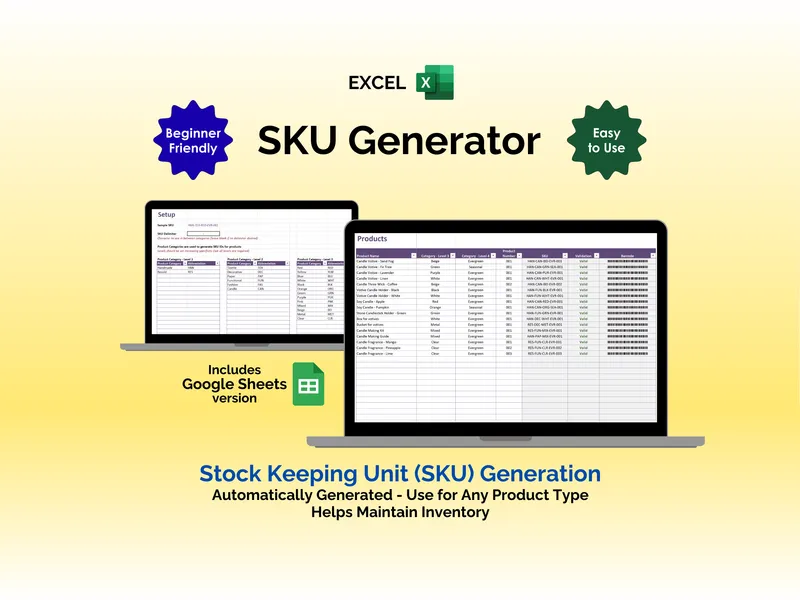
Here is how the pattern-based SKU generation actually works. On the Setup tab you define up to four product categories (think Material, Color, Size, Collection), and for each one you list the values and the short abbreviation you want — Handmade becomes HND, Yellow becomes YLW, and so on. On the Products tab you describe a new item, choose the matching category values from the dropdowns, and the formula stitches the abbreviations together with your chosen delimiter (a dash, a slash, whatever reads cleanest to you).
That single rule does a lot of quiet work. Because every code is built from the same blueprint, two people entering products on different days still produce codes that look like siblings, which is exactly what you want when you eventually export to Shopify, Square, or a wholesale buyer’s spreadsheet. The google sheets sku generator also runs automatic duplicate validation, so if a code already exists in your catalog the cell flags it before you commit the mistake to a barcode label.
Speaking of labels — the workbook also handles automatic barcode generation for each SKU in the row, which means you can print straight from the sheet without bouncing through a separate barcode tool. The category lists are fully configurable: use one level if your catalog is simple, use all four if you sell across multiple lines, and rename the headers to whatever vocabulary your business actually uses.
A quick note on format. This is the google sheets sku generator listing, but the download bundles both the Google Sheets and the Excel versions, so you can switch between them or hand the Excel file to a bookkeeper who prefers desktop. There are no macros, no add-ons to install, and no monthly fee — it is a plain spreadsheet you own outright.
What makes this tool worth the download is the consistency the pattern-based SKU generation enforces over time. A year from now, when your catalog has grown from twelve items to two hundred, you will still be able to read a SKU at a glance and know exactly what it is — which is the whole point of having SKUs in the first place.